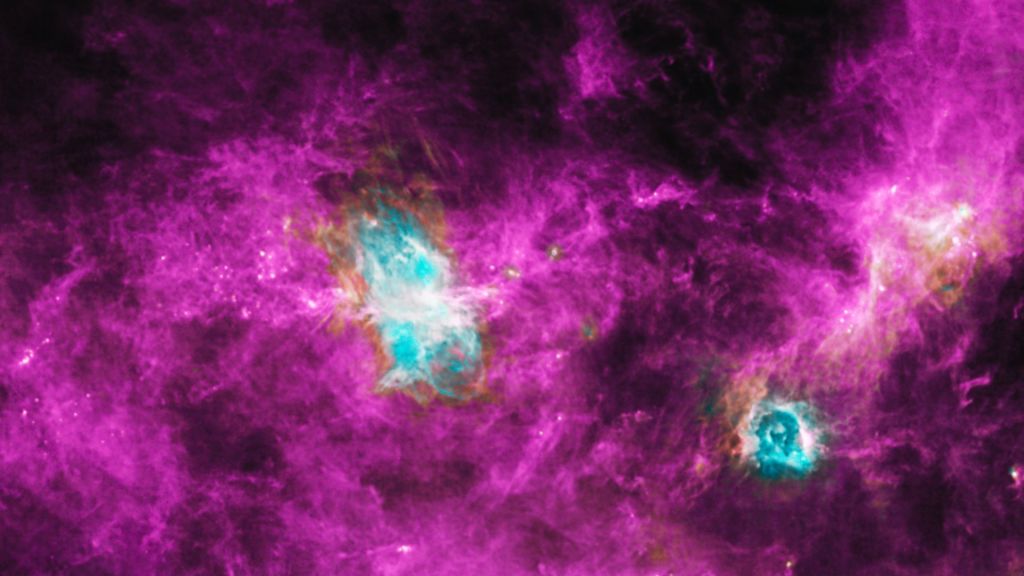
Giant molecular clouds look, at first glance, like clouds in space. They are cold accumulations of gas and dust. They are ten to twenty kelvin. Their densities are so low that two molecules may wander for years before they meet. Yet these are the stellar nurseries where stars are born, where ices grow molecule by molecule on dust, and where the chemistry that later arrives on planets first becomes complicated.
The conventional picture treats these molecular clouds as reservoirs. Gas and dust collapse. A star ignites. Planets assemble from leftovers. Organics hitch a ride on comets and meteorites. That sequence is well-understood, but the picture of the processes involved is still getting resolved. What is becoming increasingly harder to ignore is how much of the interesting chemistry is already finished before a planet exists at all.
Cold Factories
In the interiors of dense clouds, micron-sized grains of silicate and carbon act as workbenches. Water, carbon monoxide, ammonia and methanol freeze onto their surfaces and form layered ice mantles. Collision rates in the gas are too slow, and temperatures too low, for many reactions to proceed in free flight. On the grains of ice and dust though, the molecules cling on linger. Cosmic rays and faint ultraviolet photons supply the energy for some incredibly interesting chemistry.
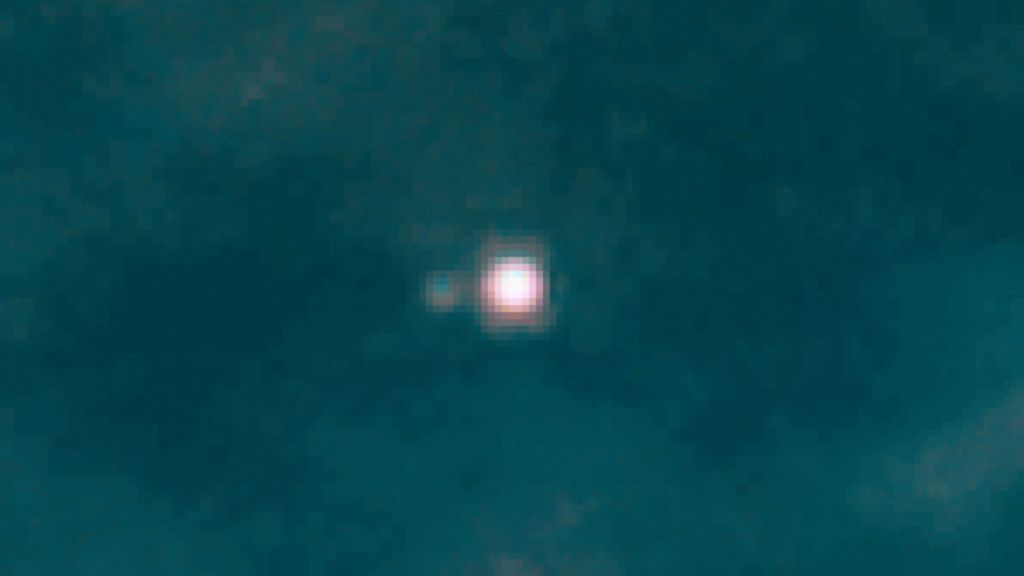
Laboratory ice analogues and, now, mid-infrared spectra from the James Webb Space Telescope show the same inventory again and again: water ice, carbon dioxide, methanol, formaldehyde, ammonia, formic acid, and a growing list of complex organics. Ethanol, methyl formate, acetaldehyde and acetic acid have been identified in ices, including, recently, around a protostar in the Large Magellanic Cloud. This last detection matters. It suggests the factory of prebiotic chemistry, or the ‘building blocks of life’ in stellar nurseries is not a local quirk of the Milky Way.
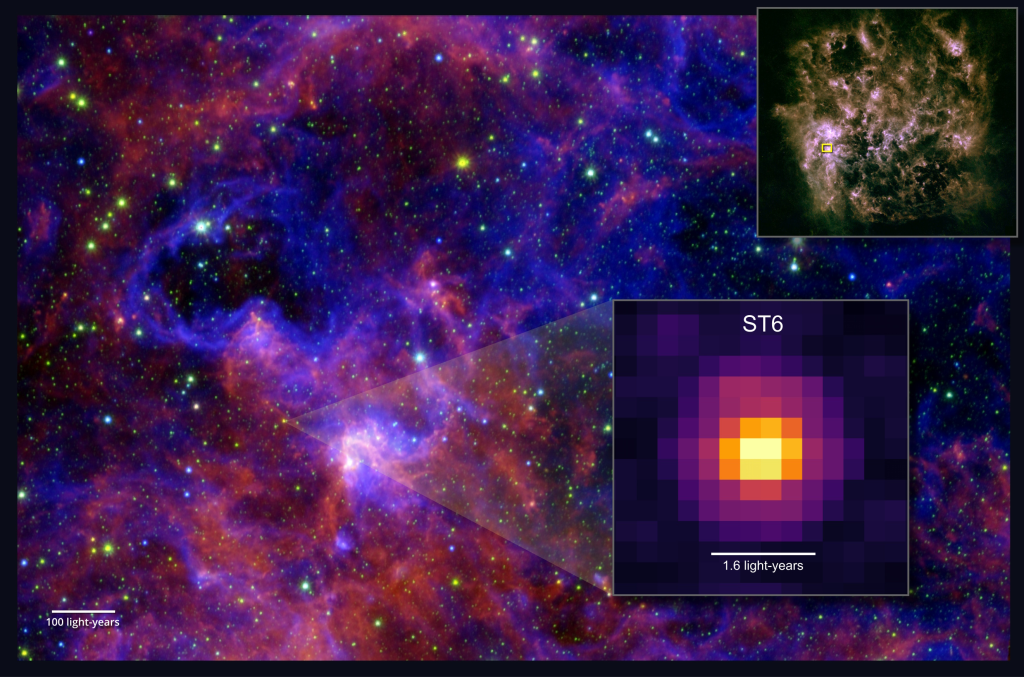
Complex organic molecules have been discovered around a young star called ST6 in the LMC. Image Credit: NASA/ESA/CSA/JPL-Caltech/M. Sewiło et al. (2025).
Meteorites close the loop. Carbonaceous chondrites such as Murchison, and samples returned from Ryugu and Bennu, contain amino acids, nucleobases and isotopic fingerprints that point back to cold molecular-cloud chemistry rather than to later hydrothermal alteration alone. The cloud stores, and organises carbon.
Origins of Chirality
Chirality is the ‘handedness’ of molecules. Life on Earth is ‘homochiral’, meaning its biological molecules exclusively use a single ‘hand’ of mirror-image pairs, or both possible ‘handednesses’ (enantiomers). On Earth, life uses L-amino acids and D-sugars. Racemic mixtures (containing equal amounts of enantiomers) form easily. Homochirality does not. The question is whether the origins of this bias was terrestrial or already written into the ices.
Two interstellar mechanisms are in play here. Aligned dust in magnetised clouds can scatter ultraviolet light into circular polarisation. Laboratory irradiation of ice analogues with circularly polarised ultraviolet light produces small enantiomeric excesses in amino acids, of the same order as those measured in some meteorites. A second proposal invokes spin-polarised cosmic rays and low-energy electrons striking chiral centres on grain surfaces. Neither mechanism has been shown to finish the job. Both can, in principle, plant a tiny imbalance. Amplification into long homochiral polymers is then a separate physical problem, and one that becomes more efficient at cryogenic temperatures according to some statistical models. That last step is still theory.
The observational fact is simpler. Primitive meteorites arrive already slightly chiral. The bias looks older than Earth.
Energy Before Sunlight
Molecules are the traffic. Metabolism is the one-way street created by energy flowing from a donor to an acceptor. Without that directed flow there is no living chemistry, only equilibrium. Metabolism is a way of keeping energy flowing in one direction. Phylogenetic reconstructions of the last universal common ancestor (LUCA) increasingly describe an anaerobic, hydrogen-using, carbon-dioxide-fixing cell, closer to an acetogen than to a photosynthetic organism. Hydrogen as electron donor and carbon dioxide as acceptor sit at the root of that picture. Alkaline hydrothermal vents on a young planet supply a natural setting for those reactions. That is the mainstream geochemical story.
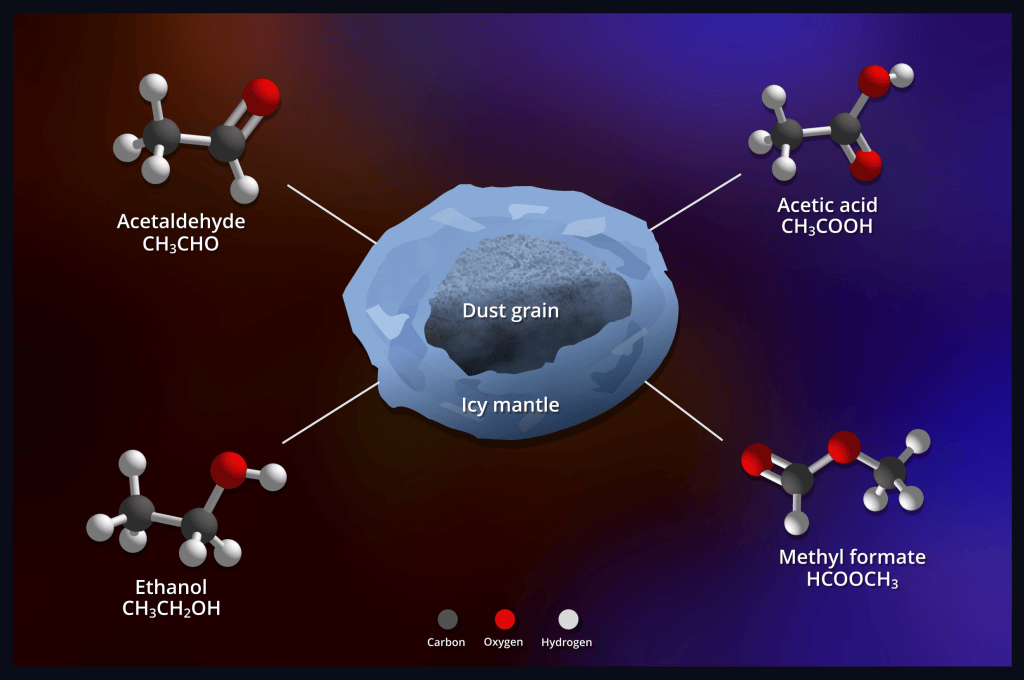
The Complex Organic Molecules detected around ST6. acetaldehyde, acetic acid, ethanol and methyl formate. Credit: NASA’s Goddard Space Flight Center.
A more speculative line of argument asks whether a related redox logic could operate even earlier. Cosmic rays ionise molecular hydrogen throughout a dense cloud, producing ions, secondary electrons and protons. In principle, a flow of those charges across a membrane-like barrier could establish an electrochemical gradient. The same papers that develop this idea also treat methanogenesis and acetogenesis as plausible cryogenic redox pathways, using the hydrogen and carbon oxides already abundant in the cloud. The free-energy numbers look generous on paper. What they do not yet have is an organism, a membrane, or an observation that distinguishes biology from ordinary ion chemistry. The proposal should be read as a hypothesis about the ancestry of chemiosmosis, not as a detection of metabolism in space.
Pre-Solar Biosphere
The Nebula-Relay hypothesis goes further still. It imagines primitive life arising around a progenitor star, surviving the star’s death inside the resulting molecular cloud, and later seeding the planets of the next generation, including Earth. The attraction of the idea is chronological: if life on Earth appears early, some of the hard work might have been done elsewhere and earlier. The cost is empirical. No confirmed microfossil in a carbonaceous chondrite has survived scrutiny as a living descendant of a pre-solar biosphere. Spatial alignments of carbon dioxide ice and methane around protostars, including systems observed by Webb, are interesting carbon chemistry. They are not, by themselves, a biosignature.
Galactic chemical evolution adds a quieter constraint. Life as we know it depends on a specific mix of bulk and trace elements. Those elements accumulate only after generations of stellar nucleosynthesis. There is a cosmic epoch before which the raw table of the periodic table is incomplete. To be perfectly clear: That is a statement about the available inventory for biochemistry to emerge, not about life in interstellar clouds.
What Can Be Tested
The useful predictions are modest. If interstellar ices routinely manufacture amino acids, sugars and nucleobases, those molecules should keep appearing in comets, asteroids and protoplanetary disks, with isotopic ratios that remember the cold. If circularly polarised light or cosmic-ray spin bias matters, the same enantiomeric sign should recur across unconnected meteorite groups. If homologous metabolisms were ever distributed through the pre-solar nebula, icy moons and carbonaceous bodies across the Solar System should preserve related organic patterns, not necessarily living cells.
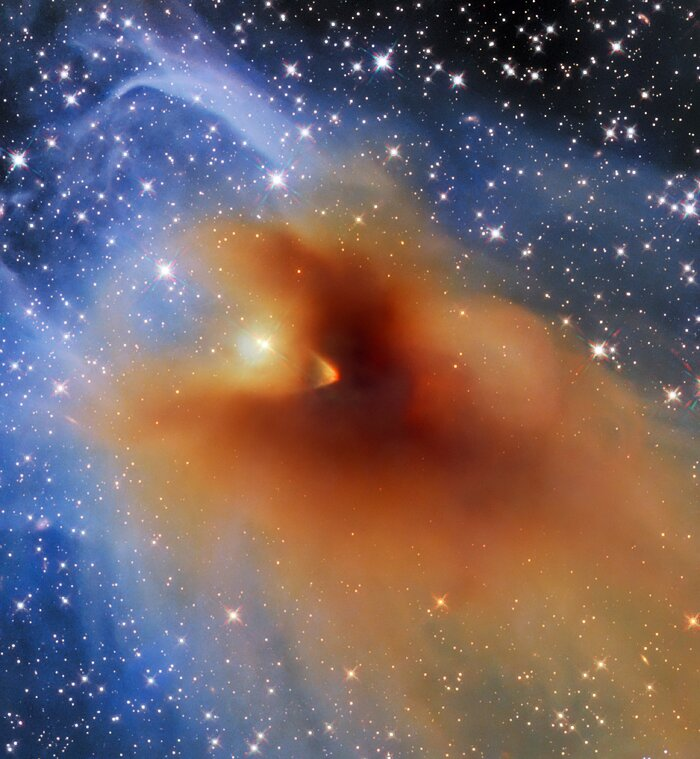
The CB130-3 Star-Forming Nebula. Image Credit: ESA/Hubble, NASA & STScI, C Britt, T Huard, A Pagan.
Laboratory work can tighten the rest. Ice irradiation, chiral photochemistry, and microbial survival under hydrogen-rich, cryogenic, irradiated conditions are all experiments that do not require a leap from chemistry to inhabited nebulae.
Molecular clouds remain what observations show them to be: the cold places where dust learns to hold water, carbon and nitrogen in increasingly intricate forms, and where those forms are handed, almost intact, to the next generation of worlds. Whether they are also incubators of living systems is still an open question. The chemistry is already strange enough. The deeper puzzle is how far that chemistry has to go before a planet is even necessary.
Cover Image:
ESA/PACS/SPIRE/Tracey Hill & Frédérique Motte, Laboratoire AIM Paris-Saclay, CEA/Irfu – CNRS/INSU – Univ. Paris Diderot, France
Sources:
Nebula-Relay Hypothesis: The Chirality of Biological Molecules in Molecular Clouds
Cosmic ray-driven bioenergetics for Life in Molecular Clouds
Possibilities for methanogenic and acetogenic life in molecular cloud

Leave a comment