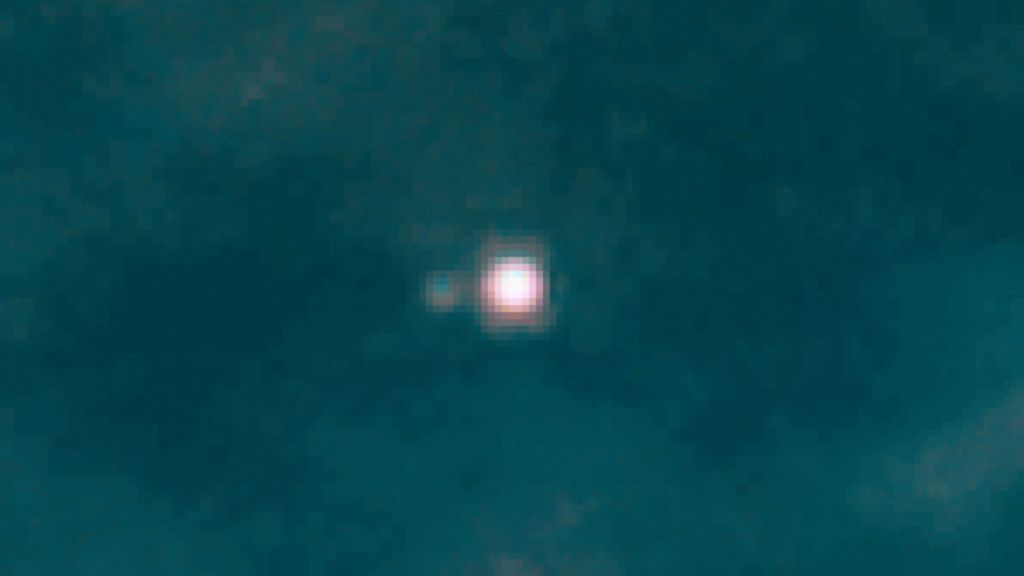
The James Webb Space Telescope was built to find faint things in dusty environments. In the Orion Nebula, it found something unexpected and troublesome: pairs of objects that occupy the gap between planets and stars. They were called Jupiter-Mass Binary Objects, or JuMBOs. The name is descriptive rather than an established astronomical class. The original JWST survey identified 540 planetary-mass candidates in the inner Orion Nebula and Trapezium Cluster, with estimated masses extending down to about 0.6 Jupiter masses. Forty-two of those candidates appeared to belong to 40 binary systems, with two additional systems appearing to contain three components. The pairs were remarkably wide, with projected separations of roughly 28 to 384 astronomical units.
That was the extraordinary part.
A free-floating object with a few Jupiter masses is already difficult to explain. Two such objects remaining gravitationally bound while wandering through a dense stellar nursery just do not fit into the conventional models of planet or star formation.
The planetary nature of the JuMBO candidates is still disputed. A 2024 analysis by astronomer KL Luhman found that most of the proposed JuMBOs had colours more consistent with reddened background stars, or lacked enough reliable photometry to establish their nature. Later spectroscopy has also shown that some objects selected as substellar candidates are actually background sources, while others are genuine young members.
So the JuMBO story is no longer simply, How did nature make these impossible planetary binaries?
The more scientifically useful question is:
How many of these objects are actually what JWST first suggested, and if the binaries are real, what physical process made them?
That distinction turns an apparently solved discovery into a live astrophysical problem.
Orion Lab
The scene is the Trapezium Cluster, at the centre of the Orion Nebula roughly 1,300 light-years from Earth.
This is not a quiet stellar neighbourhood. Orion is a laboratory for star formation, containing large numbers of young stars packed into a relatively small volume. Massive stars flood the surrounding gas with ultraviolet radiation while stellar encounters continually perturb young planetary systems.
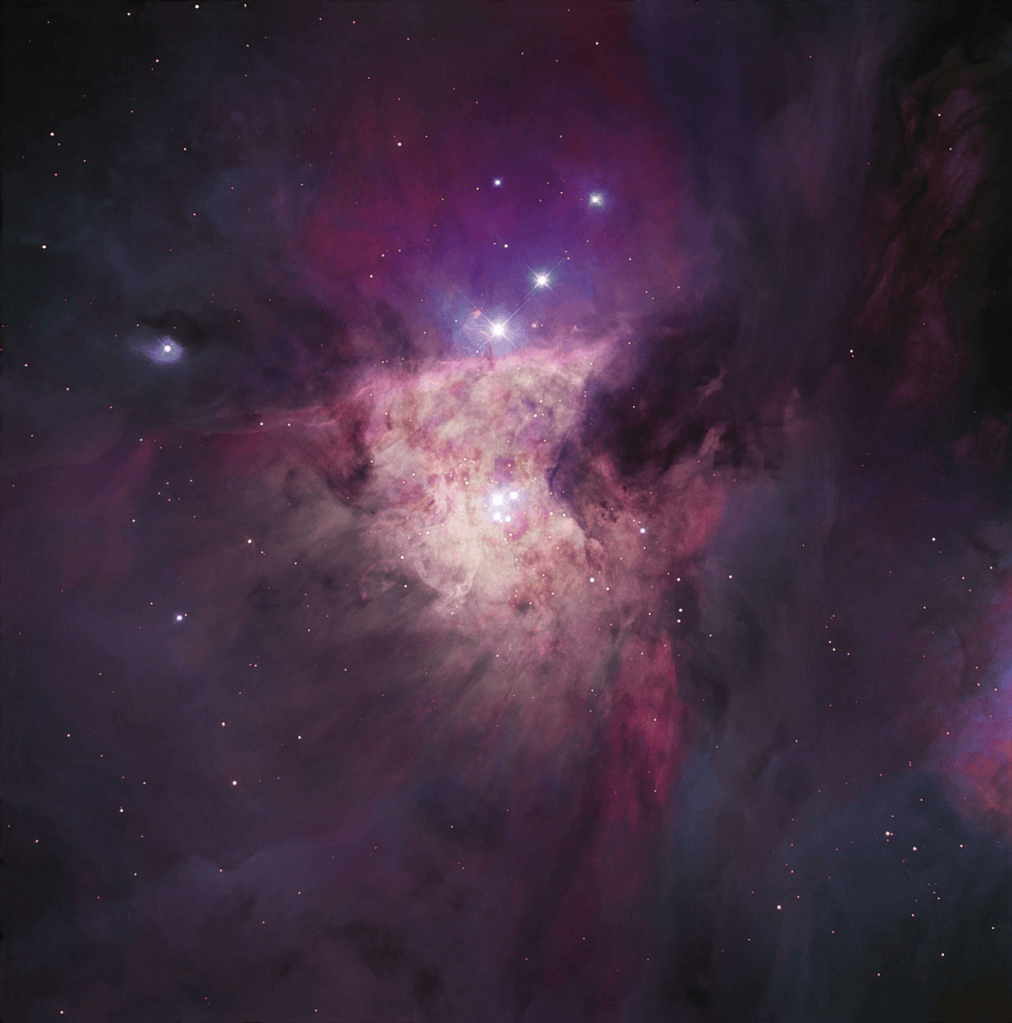
The Trapezium Cluster in the heart of the Orion Nebula .
The Webb survey used its NIRCam instrument to observe a region about 10.9 by 7.5 arcminutes across, corresponding to roughly 1.25 by 0.85 parsecs at Orion’s distance. Its filters covered wavelengths from about 1 to 5 microns, allowing astronomers to distinguish cool planetary-mass candidates from ordinary background sources and to search for the spectral signatures of young objects.
The survey revealed something that conventional expectations of astronomers could not comfortably accommodate. There were hundreds of extremely faint objects whose estimated masses fell into the planetary regime.
The lower end was particularly interesting. The candidates extended to about 0.6 Jupiter masses. Their masses are inferred from their luminosities, colours, ages and evolutionary models. At the age of the Orion Nebula Cluster, a young planetary-mass object is still relatively hot and bright compared with an old planet. That makes it detectable in the infrared wavelengths, that Webb is sensitive to.
Mass estimates for such faint objects are model-dependent. A young object with a given infrared brightness can correspond to very different masses depending on assumptions about its age, atmospheric properties and evolutionary history. The survey nevertheless found a striking population. And then came the pairs.
The Binary Problem
Binary systems are not unusual in astronomy. Stars commonly form in pairs, and massive stars have particularly high multiplicity rates. Multiplicity, however, does not remain constant as mass decreases. Brown dwarfs are less frequently found in wide binaries than ordinary stars. Planetary systems are generally considered an even more difficult environment for producing free-floating, widely separated pairs.
The JuMBO candidates seemed to reverse that trend. Roughly 9 per cent of the planetary-mass candidates appeared to be in wide binary systems. Their components had estimated masses between about 0.7 and 13 Jupiter masses, while their projected separations ranged from about 28 to 384 astronomical units.
For scale, 28 astronomical units is comparable to the orbital distance of Neptune from the Sun. A separation of several hundred astronomical units is vastly larger. The two objects are therefore not orbiting one another like a close stellar binary. They are extremely loose gravitational systems, and that creates the real problem.
Soft Binaries
A binary survives because the gravitational binding between its components exceeds the energy that external encounters can inject into the system. JuMBOs, if they are real, sit at the extreme end of soft binaries.
Take two objects with roughly Jupiter-like masses separated by hundreds of astronomical units. Their mutual gravitational binding energy is tiny compared with that of a normal stellar binary. A passing star does not need to hit either object. It merely needs to pass close enough to perturb their relative orbit.
The result can be ionisation: the binary becomes unbound. In stellar dynamics, ionisation is the destruction of the binary’s gravitational association by an external encounter. The denser the surrounding cluster, the more frequently this happens.
That makes the Orion environment a particularly difficult place for wide JuMBOs to survive. Analytical calculations and N-body simulations have shown that planetary-mass binaries in dense clusters undergo repeated softening, eccentricity changes and eventual disruption. Their survival depends strongly on separation and on the time they spend in the dense part of the cluster.
This produces an awkward combination of requirements. The objects must be:
- massive enough to remain gravitationally bound;
- separated widely enough to resemble the observed systems;
- formed in sufficient numbers;
- and produced recently enough that the cluster has not already destroyed them.
That is why the JuMBO problem is fundamentally a formation-and-survival problem. Making a binary is only half the job. Keeping it alive is the other half.
The First Possibility: Ejected Planetary Twins
One obvious explanation is that JuMBOs are genuine planets that were thrown out of planetary systems.
Planetary systems in young clusters are not isolated. A nearby star can pass close enough to disturb the orbits of planets around another star.
Imagine a young system containing two giant planets in its outer regions.
A passing star changes the gravitational potential experienced by the planets. In a sufficiently favourable encounter, both planets can be stripped from their original star while retaining enough mutual gravitational energy to remain bound to each other.
The result is a free-floating planetary binary. This sounds plausible until the geometry is examined. The planets must be arranged in a very specific configuration when the stellar encounter occurs. Direct few-body simulations have shown that such encounters can indeed produce free-floating planetary binaries. In the simulations, the resulting systems tend to have high eccentricities and semimajor axes roughly three times the original separation between the planets. The formation rate is also strongly dependent on the density of the stellar environment.
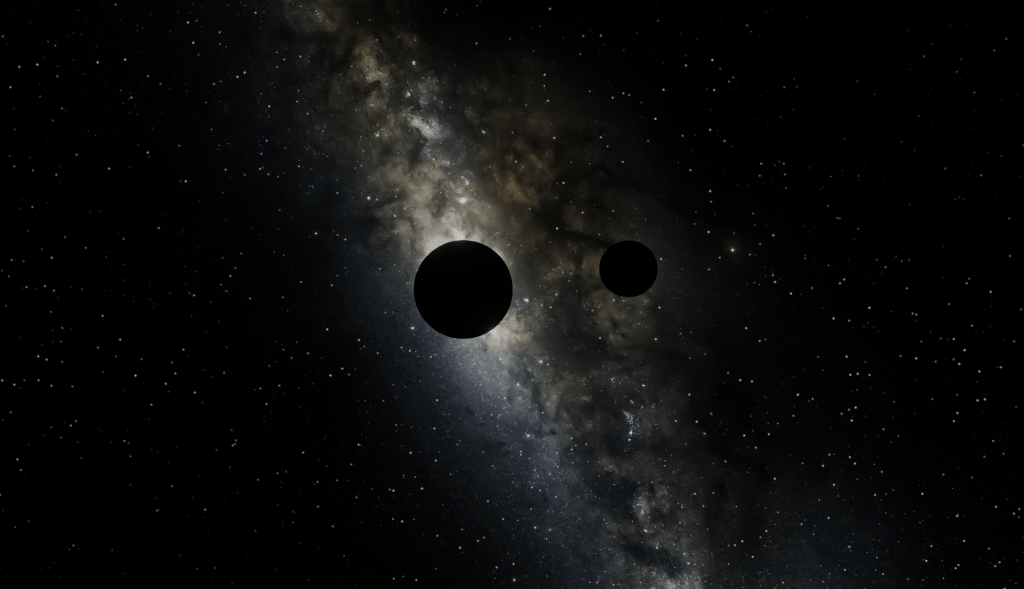
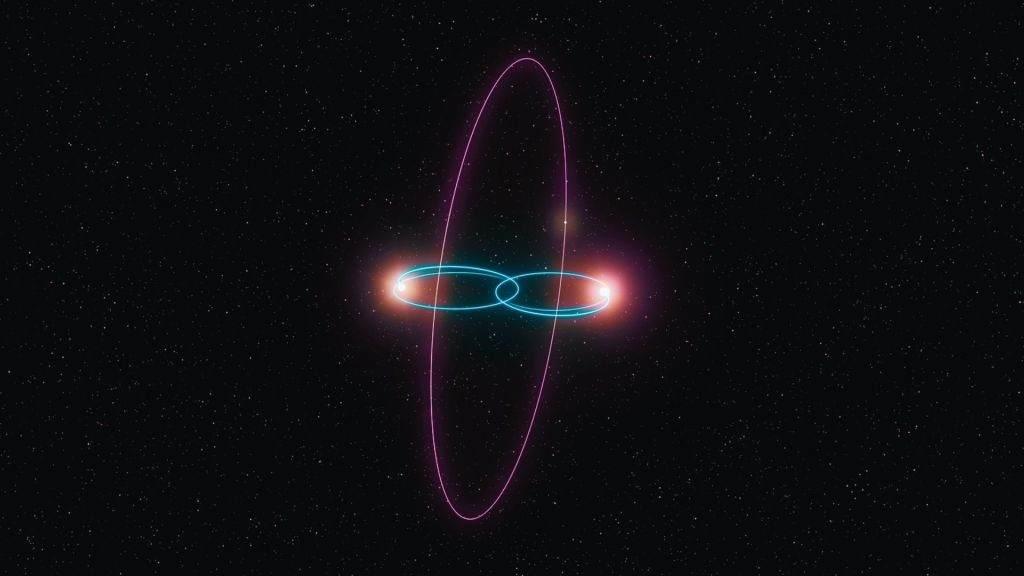
Illustration of a JuMBO system.
This is an significant result because it means the ejection mechanism is not physically impossible. So we know in theory that JuMBO-like systems can be made. The problem is what happens afterwards. The newly liberated binary is already weakly bound. It then enters the same crowded stellar environment that created it. Further encounters can disrupt it.
One 2024 dynamical study found that the observed population is difficult to reproduce through ejection alone without demanding an impractically high production rate. Another analysis concluded that the observed systems could potentially be related to ejection, but only under restrictive conditions.
So the flyby model solves one problem by creating another. It can explain how two planets escape together. It struggles to explain how enough of those pairs remain gravitationally bound.
The Second Possibility: They Were Never Planets
This is where the story becomes considerably more interesting. A JuMBO does not have to be a planet that was assembled in the leftover material surrounding a star. It could be the remnant of a process that looks much more like star formation.
Stars form when dense regions within molecular clouds collapse under gravity. The collapsing material can fragment into multiple objects. Binary formation is therefore not an exotic side effect of star formation. It is a natural outcome of fragmentation and angular-momentum redistribution. The difficulty is mass.
Theoretical models place a lower limit on how far ordinary gravitational fragmentation can proceed. Cooling, pressure and opacity eventually interfere with the collapse of increasingly small gas fragments.
The JuMBO candidates sit around or below this theoretical minimum. If they are genuine planetary-mass objects, something has to push star-like fragmentation into a regime where it normally should not go. One proposed solution is that the objects formed in the cluster itself, rather than inside planetary systems. In this picture, a JuMBO is essentially a failed stellar binary.
Two fragments begin collapsing together. They would normally accrete additional gas and grow into stars or brown dwarfs. But something prevents that growth. The resulting pair remains at planetary mass. The attraction of this model is conceptual simplicity. It does not need to manufacture a planetary binary and then eject it, it creates the pair from the beginning.
The Photoerosion Model
Orion provides a particularly interesting way of stopping a stellar embryo from becoming a star: Massive stars. The Trapezium contains powerful ultraviolet sources, including the massive star system θ¹ Orionis C. Its ionising radiation can strip gas from nearby structures in the star-forming cloud.
This process is called photoerosion. The basic sequence is straightforward. A prestellar core begins to collapse and fragment. If it were left alone, the fragments could continue accreting gas and eventually become much more massive objects. But intense Lyman-continuum radiation from nearby massive stars ionises gas on the exposed surface of the core. The ionised material heats up and flows away.
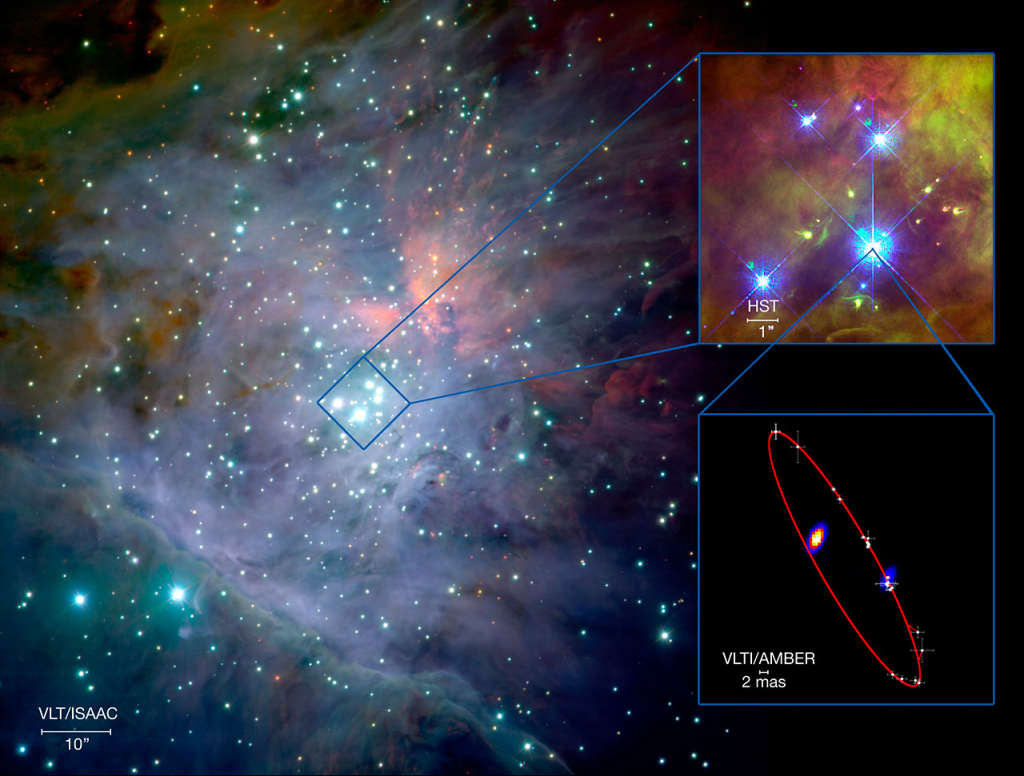
The Theta 1 Orionis C system.
The core loses its reservoir, and the growth stops. Diamond and Parker proposed in 2024 that a fragmenting core exposed to this radiation could therefore produce a binary system whose components are left with planetary or brown-dwarf masses. Their calculations found that the resulting masses can fall within the JuMBO range, while the binary separations can inherit the scales expected from fragmentation of more massive stellar binaries.
This model has an appealing feature. The binary relationship is established before the objects become low mass. The objects are not two planets somehow finding each other in interstellar space. They are two pieces of a collapsing cloud that have had their growth prematurely terminated. There is, however, a stellar environment problem.
The photoerosion mechanism works most efficiently inside the ionised regions around massive stars, whereas many of the observed JuMBO candidates lie outside those regions. The proposed solution is dynamical evolution: the objects could have formed closer to the massive stars and subsequently moved outward. This remains a model, not an observationally established history.
The Tight-Binary Solution
There is another way to reconcile wide binaries with a hostile environment. A 2024 dynamical study proposed that JuMBOs could initially form as relatively tight binaries, with separations around 10 to 20 astronomical units. Stellar encounters in the cluster could then gradually pump up their orbital separations.
This matters because a tighter binary is harder to destroy, or uncouple. A close pair has a deeper gravitational potential well. Passing stars can still perturb it, but the binary is not as vulnerable as a pair separated by hundreds of astronomical units.
Occasionally, however, an encounter can deliver an energy kick comparable to the binary’s binding energy. The orbit expands. Its eccentricity changes. The system becomes wider. A succession of encounters can populate a distribution of wider orbits.
The present-day JuMBO population could therefore be the dynamically processed remnant of a much tighter primordial population. This reverses the usual question, and instead of asking:
How did such an extraordinarily wide binary form?
We have to ask:
How did an initially tighter binary become this wide without being destroyed?
That is a considerably more tractable dynamical problem. However, it still requires the underlying binaries to exist in the first place.
A More Fundamental Possibility
There is another possibility that deserves more attention. The objects may not all be the same kind of thing. The term JuMBO sounds like a physical category. It is not. It is a label attached to objects that, based on JWST imaging and evolutionary models, appear to be planetary-mass binaries.
KL Luhman’s independent analysis of the Orion JWST data found that most of the previously identified JuMBOs were not convincing substellar members of the Orion Nebula Cluster. Their colours instead suggested reddened background sources, while other candidates lacked sufficient signal-to-noise or detections across enough filters to determine their nature.
That is not a minor technical objection. It attacks the premise on which the theoretical crisis was constructed. If many of the apparent JuMBOs are background stars, then there is no need to invent a mechanism capable of producing dozens of planetary binaries. This is precisely why spectroscopy matters.
Photometry tells astronomers how bright an object is in different infrared bands. Spectroscopy can reveal molecular absorption features and, crucially, signatures of temperature, surface gravity and membership.
A young, low-gravity planetary-mass object should not look spectroscopically identical to an unrelated reddened background star. Webb therefore has an unusual task here, it has to establish whether the population of objects discovered are actually JuMBOs.
JuMBO 24
Then there is the strangest object in this entire story. JuMBO 24 became the only member of the proposed population associated with a radio source.
Archival observations from the Karl G Jansky Very Large Array revealed radio emission at 6.1 and 10 GHz. The source produced roughly 50 microjanskys of emission and remained remarkably steady over observations spanning years.
Under the original JWST interpretation, JuMBO 24 consists of two approximately equal objects, each around 11.5 Jupiter masses, separated by about 28 astronomical units. That makes it unusual even within the unusual population. It has one of the smallest projected separations and the largest combined mass among the proposed JuMBOs.
The radio detection was intriguing because planetary-mass objects are not expected to be ordinary radio sources. Radio emission from ultracool dwarfs can arise through magnetic processes, including coherent electron-cyclotron maser emission and gyrosynchrotron processes. But the JuMBO 24 observations did not immediately fit the simplest non-thermal picture.
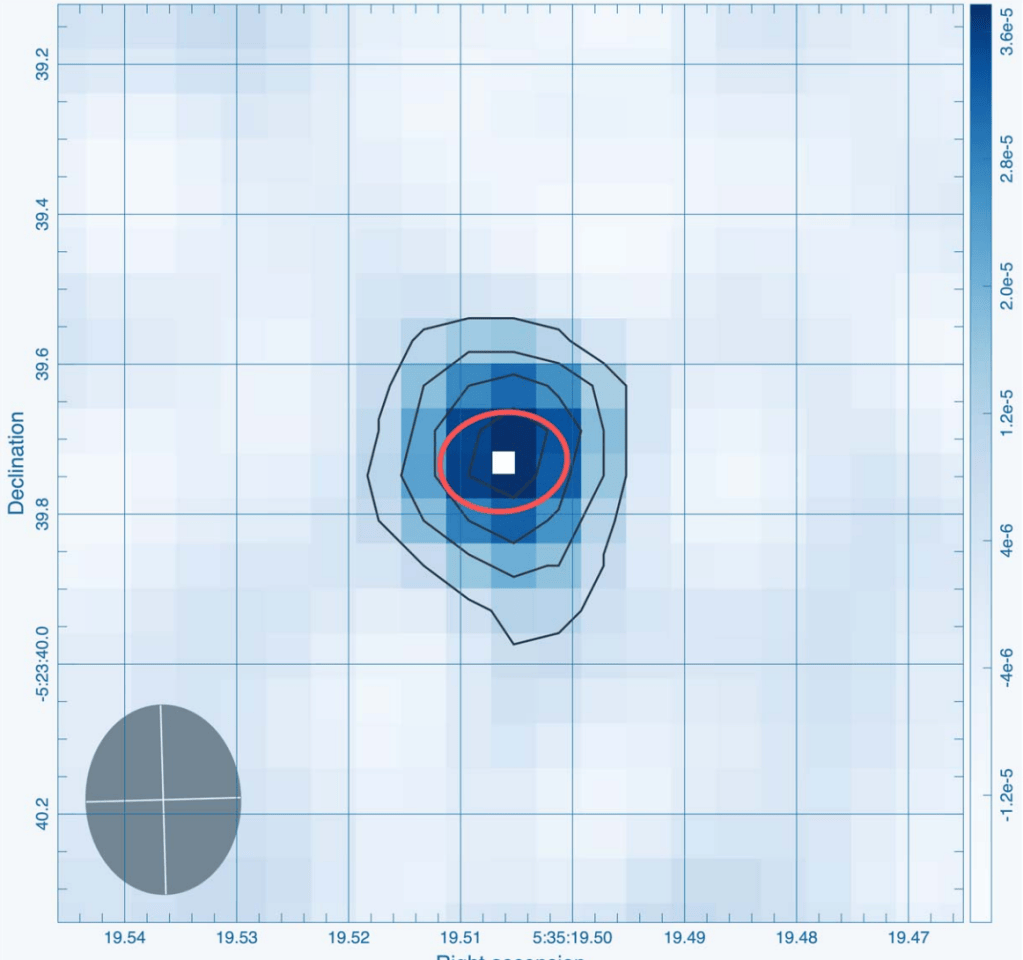
VLA image of the 6.1 GHz emission from JuMBO 24.
The radio flux was unusually steady. There was no strong detectable circular polarisation. And high-resolution observations failed to identify the sort of compact radio source that would be expected from a single powerful non-thermal emitter. The emission appeared consistent with contributions from both components, although the observations did not uniquely establish the mechanism.
Then came the motion constraint. Radio astrometry showed essentially no detectable proper motion over the available baseline. The 2025 analysis placed an upper limit of approximately 6 km/s on the plane-of-sky velocity, substantially tightening an earlier limit of about 15 km/s. The authors noted that this favours an origin resembling that of stars, such as formation from a relatively stationary collapsing core, rather than a high-velocity ejection.
If the object really is a JuMBO, that is an important clue. But there is a complication too large to bury in the footnotes. JuMBO 24 itself has also been caught inside the wider controversy. The 2025 radio study explicitly noted that the planetary interpretation remains disputed and that Luhman’s analysis identified the object as consistent with a reddened background source rather than a young planetary-mass member. So the radio source does not currently rescue the JuMBO hypothesis. It makes the object more interesting while leaving its identity unresolved.
The Naming Problem
This is where the JuMBO story becomes bigger than one collection of strange objects in Orion. Astronomy has traditionally used several overlapping concepts to classify low-mass objects.
A star is an object massive enough to sustain hydrogen fusion.
A brown dwarf is too small for sustained hydrogen fusion but may have formed through gravitational collapse in a molecular cloud.
A planet is generally associated with formation within a circumstellar disc, although the formal definition becomes less useful for free-floating objects.
The difficulty begins at the bottom of the mass distribution. An isolated object with five Jupiter masses could have formed inside a disc and been ejected. Or it could have formed directly through cloud fragmentation. Those two objects could have essentially the same mass and temperature while having completely different origins. Mass alone cannot tell us which story happened.
This is why the distinction between planetary-mass object and planet is important.
A planetary-mass object is a statement about mass. A planet is also a statement about physical origin and dynamical history, although those definitions become increasingly awkward for free-floating bodies.
The JuMBO problem pushes that ambiguity one step further. If two planetary-mass objects form together through gravitational fragmentation, calling them planets may describe their mass but not their formation. They could be closer in origin to a binary star than to Jupiter.
The Real Crisis
The original JWST result was sometimes presented as though astronomy had discovered an entirely new class of objects and immediately overturned planet-formation theory.
That is too strong. What JWST actually did was identify a population of candidate planetary-mass objects and an unexpectedly large number of apparent wide pairs. That observation generated a set of theoretical problems.
Since then, those problems have split into two. The first is observational:
Are the JuMBO candidates genuinely young planetary-mass objects in Orion?
The second is theoretical:
If they are, how were they formed and how did they survive?
Those questions must be answered in that order. There is little value in constructing increasingly elaborate formation models for objects that may turn out to be background stars. Yet the theoretical work remains valuable because it identifies what observations should look for.
An ejection origin predicts characteristic orbital eccentricities and relationships between binary separation and the original planetary architecture. A primordial or photoerosion origin predicts a different relationship between the binary separation, mass and location within the cluster. Dynamical expansion from tighter binaries predicts that the observed wide systems should be the evolved tail of a more compact population. All models must confront the same fact:
wide planetary-mass binaries are extremely vulnerable to stellar encounters.
That makes their survival rate a powerful diagnostic tool.
What Would Settle the Argument?
Several observations could turn the current argument into a much cleaner test.
First, spectroscopy.
The atmospheric chemistry of a genuine young planetary-mass object should reveal low surface gravity and molecular absorption associated with cool atmospheres. JWST spectroscopy can determine whether the faint candidates have the physical characteristics expected for young substellar objects.
Second, proper motions.
Objects belonging to the Orion Nebula Cluster should share its characteristic motion. A background object at a different distance should not necessarily do so.
Third, radial velocities and membership diagnostics.
The combination of motion, gravity-sensitive spectral features and atmospheric properties can distinguish cluster members from unrelated foreground or background objects.
Fourth, a larger sample.
If JuMBOs are a genuine product of star formation, astronomers should eventually find comparable systems in other young clusters.
That comparison would be decisive. If wide planetary-mass binaries appear predominantly in environments like Orion, where massive stars and intense radiation dominate, that would support formation mechanisms involving cluster-specific physics such as photoerosion. If they appear broadly across young clusters, a more universal formation mechanism becomes more attractive. If they disappear under spectroscopic scrutiny, the problem largely collapses. And if a smaller but incontrovertible population survives, that may be even more interesting than the original claim.
Worlds Without Stars
There is a temptation to treat the JuMBO story as another example of JWST discovering something that should not exist. That framing misses the more interesting point. Science does not become interesting because an observation violates a rule. It becomes interesting because the observation tells us that the rule was incomplete, the measurement was misunderstood, or the assumptions connecting the two were wrong.
JuMBOs currently sit at that intersection. The original JWST survey showed that the planetary-mass end of the Orion population extends much farther than expected and reported an apparent population of wide binaries.
The subsequent literature has produced several competing explanations: planetary ejection, primordial formation, dynamical expansion of tighter binaries and photoerosion of fragmenting prestellar cores. None has emerged as a demonstrated solution. Dynamical studies have also shown that the extreme fragility of wide binaries is itself a major constraint.
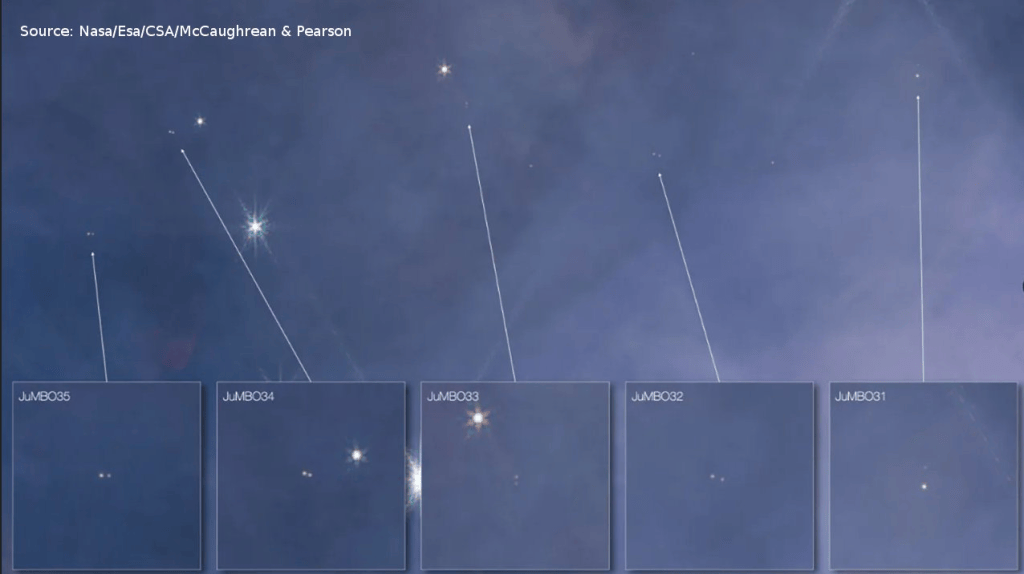
Disputed Trapezium Cluster JuMBOs.
And the observational foundation remains under examination. The important result may ultimately be that the Universe does not care about the categories we use to organise it. Planet, brown dwarf and star are human classifications applied to a continuous distribution of mass, chemistry, gravity and formation history.
At one end, a collapsing cloud makes a star. At another, a disc builds a planet. Somewhere between those processes, nature can produce objects whose masses overlap even when their origins do not. If the JuMBOs survive detailed spectroscopic scrutiny, they will represent one of the most direct tests yet of how far gravitational fragmentation can descend into the planetary-mass regime.
If most of them turn out to be background stars, the lesson will be different but equally useful: even JWST’s extraordinary infrared vision cannot turn a photometric candidate into a physical object without independent confirmation.
Image Credits:
Trapezium Cluster: ESO/IDA/Danish 1.5 m/R.Gendler, J.-E. Ovaldsen, and A. Hornstrup
Theta 1 Orionis C: ESO/S.Kraus et al., M.McCaughrean et al. (AIP)
JuMBO 24: arXiv:2401.04905 [astro-ph.EP]
JuMBOs: NASA, ESA, CSA, STSCi, Samuel G Pearson and Mark J McCaughrean
Sources:
Discovery paper
- Jupiter Mass Binary Objects in the Trapezium Cluster
Pearson & McCaughrean (2023)
https://arxiv.org/abs/2310.01231
Formation and dynamical evolution
- The origin and evolution of wide Jupiter Mass Binary Objects in young stellar clusters
Portegies Zwart & Hochart (2023/2024)
https://arxiv.org/abs/2312.04645
Journal: https://scipost.org/SciPostAstro.3.1.001 - Floating binary planets from ejections during close stellar encounters
Wang, Perna & Zhu (2023/2024)
https://arxiv.org/abs/2310.06016
Journal: Nature Astronomy https://www.nature.com/articles/s41550-024-02239-2 - Formation of Jupiter-Mass Binary Objects through photoerosion of fragmenting cores
Diamond & Parker (2024)
https://arxiv.org/abs/2410.09159
Journal: ApJ https://iopscience.iop.org/article/10.3847/1538-4357/ad8644 - Dynamics of Binary Planets within Star Clusters
Huang, Zhu & Kokubo (2024)
https://arxiv.org/abs/2407.04261
Journal: ApJL https://iopscience.iop.org/article/10.3847/2041-8213/ad8925 - Evolution of Extremely Soft Binaries in Dense Star Clusters: On the Jupiter Mass Binary Objects
Wang, Perna, Zhu & Lin (2024)
https://arxiv.org/abs/2407.20416 - Why Wide Jupiter-Mass Binary-Objects Cannot Form
Portegies Zwart & Hochart (2025)
https://arxiv.org/abs/2507.11786
Journal: Nature Astronomy https://www.nature.com/articles/s41550-025-02609-4
Follow-up observations
- A Radio Counterpart to a Jupiter-Mass Binary Object in Orion
Rodríguez, Loinard & Zapata (2024)
https://arxiv.org/abs/2401.04905
Journal: ApJL https://iopscience.iop.org/article/10.3847/2041-8213/ad18ac - Upper Limits to the Proper Motions of JuMBO 24
https://arxiv.org/abs/2504.15519
Related / later work
- Exploring the Enigmatic JuMBOs: Metallicity-Driven Fragmentation, Binary Assembly, and Survival
Kriger (2026)
https://zenodo.org/records/18728940 - Jupiter Mass Binaries and Cosmic Ray Viscosity
Katz (2023/2024)
https://arxiv.org/abs/2312.10834

Leave a comment