Earth is four and a half billion years old. Modern humans have existed for only a fraction of that time, and industrial civilisation has occupied an almost imperceptible sliver of the planet’s history. If Earth’s geological past were compressed into a single year, humanity’s industrial age would arrive in the final seconds of 31 December. That disparity raises an unsettling question. Could a technologically advanced species have existed on Earth millions of years before humans, leaving behind a civilisation that vanished so completely that its existence became almost impossible to recognise?
This idea belongs to a scientific frontier connecting geology, astrobiology, planetary science and the search for extraterrestrial intelligence. It asks how scientists would recognise an industrial civilisation separated from us by millions of years, after erosion had dismantled its cities, oceans had swallowed its coastlines and geological processes had recycled its surface.
The question extends beyond Earth. If technological life arose on another world in our Solar System before humanity appeared, could its machines, habitats or probes still exist somewhere in the darkness? The Moon, Mars and the gravitationally stable Lagrange points of planets offer possible places to investigate, the last because any probes or spacecraft may remain there nearly perpetually.
These possibilities remain speculative. There is no confirmed evidence that a pre-human technological civilisation existed on Earth or that an extraterrestrial civilisation left artefacts in the Solar System. Yet the underlying scientific question is serious: what physical traces can a technological species leave behind, and how long can those traces survive?
The Silurian Hypothesis
In 2018, astrophysicist Adam Frank and climate scientist Gavin Schmidt posed a provocative question: would an industrial civilisation that existed millions of years ago leave a recognisable geological signature today?
Their thought experiment became known as the Silurian Hypothesis, a name borrowed from the fictional reptilian civilisation in the television series Doctor Who. The researchers were interested in the physical evidence an ancient industrial society might leave behind, rather than in proposing that such a society actually existed.

The Silurians from Doctor Who. (Image Credit: BBC).
A civilisation can disappear as a collection of buildings and machines while leaving measurable changes in the planet’s chemistry. Industrial activity alters carbon flows, redistributes elements, manufactures persistent compounds and releases energy on scales that natural ecosystems rarely produce in the same combinations.
Modern industrial civilisation has already begun imprinting these changes on Earth’s geological record. Future sediments will contain evidence of fossil-fuel combustion, synthetic materials, nuclear activity and the transformation of natural ecosystems. Given sufficient time, these traces could become a distinctive horizon separating the industrial era from the geological ages that preceded it.
An ancient civilisation would pose the same detection problem in reverse. Researchers would need to distinguish its industrial footprint from the far larger catalogue of natural geological and biological processes.
The Erasure Problem
Buildings and machinery are fragile on geological timescales. Rain, wind, chemical weathering, plant growth and microbial activity dismantle structures, while rivers transport their remains into sedimentary basins. Metals corrode, polymers degrade and buried materials react with groundwater. Even concrete eventually breaks down.
A city abandoned for several thousand years might retain foundations, buried infrastructure and fragments of manufactured materials. After millions of years, those traces could become difficult to distinguish from natural deposits. Tectonic deformation, metamorphism and erosion would further scramble the evidence.
The ocean floor presents an even greater challenge. Earth’s oceanic crust forms at mid-ocean ridges and returns to the mantle through subduction. Over geological time, this process recycles much of the oceanic crust, destroying the original context of anything deposited on it.
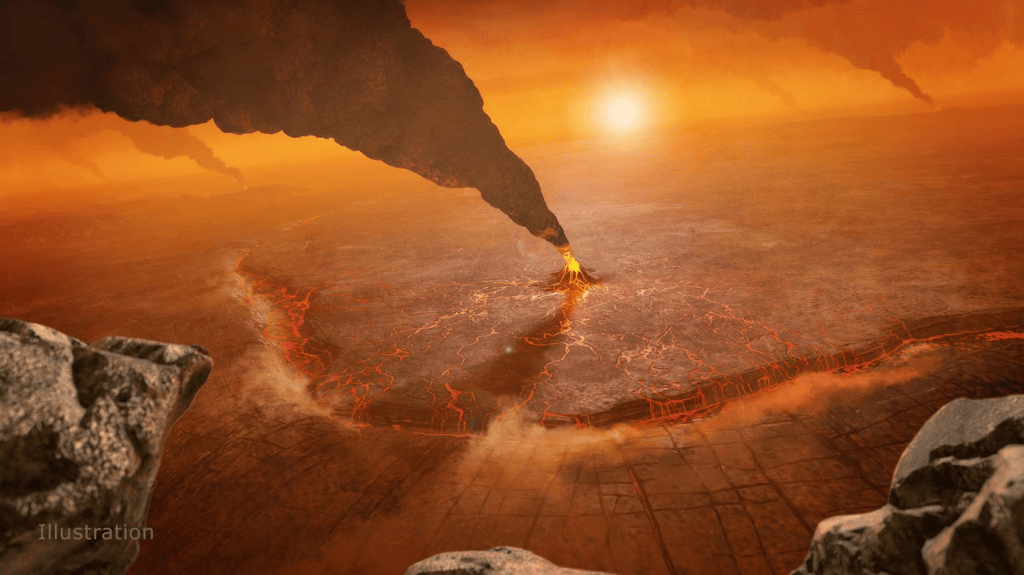
Illustration of the Quetzalpetlatl Corona in the southern hemisphere of Venus with active volcanism and a subduction zone. (Image Credit: NASA/JPL-Caltech/Peter Rubin)
Continental crust can preserve rocks for billions of years, but its surface undergoes repeated cycles of uplift, erosion, burial and deformation. A civilisation occupying a continent would leave a more favourable geological archive than one concentrated on young oceanic crust, although preservation would remain highly uneven.
The result is a geological blindspot. Earth’s surface can preserve traces of ancient life while erasing most evidence of the societies that produced it.
The Fingerprint in the Rocks
If buildings disappear, chemistry may survive. Industrial civilisation changes the planet by moving materials between reservoirs that normally exchange them slowly. Burning fossil fuels transfers ancient carbon into the atmosphere. Fertiliser production introduces reactive nitrogen into agricultural ecosystems. Mining concentrates metals from dispersed ores, while manufacturing produces chemical compounds that natural organisms have never encountered in comparable quantities.
Sediments can preserve these changes long after the original industrial infrastructure has vanished.
The combustion of coal, oil and natural gas releases carbon that plants removed from the atmosphere millions of years ago. This fossil carbon contains a different proportion of carbon isotopes from the carbon circulating through the modern biosphere. As industrial emissions accumulate, they shift the isotopic composition of atmospheric carbon dioxide and the oceans.
This change, known as the Suess effect, provides a measurable signature of fossil-fuel use. Carbonates, organic matter and other sedimentary materials can preserve aspects of the altered carbon cycle, allowing future researchers to reconstruct the scale and timing of the disruption.
Nitrogen offers another line of evidence. Industrial fertiliser production converts atmospheric nitrogen into chemically reactive forms that crops can absorb. Agriculture, sewage discharge and the combustion of fossil fuels redistribute nitrogen through soils, rivers, coastal waters and the atmosphere.
These processes change nitrogen cycling and can alter the isotopic composition of sedimentary organic matter. The resulting patterns depend on local ecology, oxygen availability and the sources of nitrogen involved. An ancient industrial signal would therefore require careful reconstruction of its environmental setting.
Neither carbon nor nitrogen alone provides an automatic diagnosis of civilisation. Together with other chemical changes, however, they could help identify an episode of unusually rapid planetary transformation.
Synthetic Chemistry
Industrial chemistry creates materials that differ from the products of natural biological activity. Plastics, persistent organic pollutants and other synthetic compounds can accumulate in sediments, while their breakdown products may survive after the original molecules disappear.
Polychlorinated biphenyls, or PCBs, and certain per- and polyfluoroalkyl substances, known collectively as PFAS, illustrate the problem. Their persistence and unusual chemical structures can make them valuable indicators of industrial contamination. Some compounds degrade under particular environmental conditions, so their long-term preservation depends on burial, temperature, oxygen exposure and the surrounding mineral chemistry.
Microplastics provide another distinctive signature of modern industrial activity. Their particles can enter marine and terrestrial sediments, although their shapes and compositions may change as they weather and fragment. Over millions of years, the original particles could become unrecognisable, leaving chemical residues or altered materials instead.
The stereochemistry of organic compounds may offer additional clues. Life on Earth strongly favours particular molecular configurations, including the widespread use of L-amino acids in proteins. Industrial synthesis can produce mixtures of molecular forms or polymers with structures unlike those generated by known biological pathways.
An unusual molecular distribution could therefore prompt questions about artificial manufacture. Yet no single pattern of molecular handedness would establish an industrial origin. Abiotic chemistry can also produce mixtures of molecular configurations, and ancient materials can undergo chemical alteration after burial.
The strongest evidence would come from a collection of synthetic compounds, unusual molecular structures and geological changes that converge on the same period.
Radioactive Relics
Nuclear technology introduces another class of potential technosignature. Nuclear weapons testing and reactor operations have released radionuclides into the environment, producing deposits that can be identified through their decay products and isotopic composition.
Some radionuclides decay rapidly and serve as markers of recent activity. Others persist much longer, although their usefulness depends on their production pathways, initial abundance and the ability to distinguish them from natural sources.
Plutonium isotopes, iodine-129 and other long-lived radioactive products can reveal aspects of nuclear activity. Their presence in ancient rocks would require careful analysis of geological context and possible natural production mechanisms.
The detection of a radioactive anomaly would be only the beginning. Researchers would need to determine whether its isotope ratios, spatial distribution and associated elements could arise from natural nuclear processes or whether they pointed towards a technological source.
Industrial civilisation also changes the distribution of metals. Mining and smelting concentrate elements, while manufacturing redistributes them across the environment. Lead, chromium and platinum-group metals can accumulate in sediments around industrial activity, although natural ore deposits, volcanic emissions and hydrothermal systems can produce overlapping signatures.
The critical clue would be the combination: unusual elemental concentrations, isotopic disturbances, synthetic compounds and evidence of rapid environmental change within the same geological interval.
Nature’s False Positives
Earth has undergone dramatic climatic disruptions without the intervention of an industrial civilisation. Any search for an ancient technological signature must therefore account for natural events capable of producing similar geochemical patterns.
The Paleocene–Eocene Thermal Maximum, around 56 million years ago, offers a particularly important comparison. During this episode, global temperatures rose sharply, large quantities of carbon entered the ocean–atmosphere system and marine ecosystems experienced major changes. The geological record preserves a pronounced negative carbon-isotope excursion associated with the event.
Several mechanisms have been proposed to explain the carbon release, including volcanic activity and the mobilisation of carbon stored in sediments. Their relative contributions remain subjects of scientific investigation.
The episode demonstrates how a major carbon-isotope disturbance can arise through natural processes. A similar excursion in an older rock formation would therefore be insufficient to establish industrial activity.
Ocean deoxygenation, ecological disruption and rapid warming are equally ambiguous. These phenomena can accompany large carbon releases from volcanic, geological or other natural sources.
Researchers would need to look for a more specific association of evidence. Synthetic industrial compounds, unusual distributions of refined materials and a coherent suite of isotopic anomalies could strengthen an artificial-origin interpretation. The absence of such evidence would weaken it, although geological destruction could also remove some of the original signatures.
The problem resembles the search for life beyond Earth. A single atmospheric gas can have biological and non-biological origins. Scientists gain confidence when several independent observations converge on an explanation that competing models struggle to reproduce.
For ancient technological civilisation, the decisive question is whether the geological record contains a combination of features that natural processes cannot adequately explain.
More Than One Technological Species?
The Silurian Hypothesis also challenges an assumption that often goes unexamined in discussions of intelligent life: that technological civilisation emerges only once during the lifetime of a habitable planet.
Earth has hosted life for billions of years. Complex animals appeared relatively late, and technological civilisation emerged later still. Evolution has repeatedly transformed ecosystems, but the precise circumstances that produce a species capable of industrial activity remain uncertain.
If technological intelligence evolved independently more than once on Earth, each civilisation would occupy a different chapter of planetary history. Its industrial footprint might have been erased, buried or dispersed long before another technological species appeared.
This possibility changes the way scientists could interpret the long history of a habitable world. The number of technological civilisations that emerge over a planet’s lifetime could differ from the number present at any one moment.
That distinction is relevant to the search for extraterrestrial intelligence. The Drake Equation estimates the number of communicating civilisations in the Galaxy by combining factors associated with star formation, planetary systems, life, intelligence, technology and civilisation longevity. The prospect of repeated technological emergence on a single planet raises questions about how those factors should be interpreted across billions of years.
However, the possibility remains hypothetical. Earth’s evolutionary history has produced no accepted evidence of a pre-human industrial species. The fossil record contains extensive evidence of earlier life, including the evolutionary history of animals, but no confirmed geological signature of an ancient technological civilisation.
The scientific value of the hypothesis lies in defining what evidence would be required to investigate the idea. It converts an extraordinary possibility into a set of questions about preservation, chemistry and detection.
And Earth is only one place to look.
The Archaeology of Other Worlds
Earth is a difficult place to preserve ancient machinery. Its atmosphere corrodes exposed metals, its oceans bury coastlines and its geological activity continually reshapes the surface. Elsewhere in the Solar System, the conditions are different.
The Moon has no substantial atmosphere, no global hydrological cycle and no active plate tectonics. Its surface still records impacts accumulated over billions of years. Mars has a more complicated history, including volcanism, erosion and the movement of water, but large portions of its ancient crust remain intact.
These environments offer a different kind of archaeological archive. A structure exposed on the Moon could endure for geological periods, gradually accumulating impact damage, radiation exposure and micrometeorite erosion. A buried object might fare better, protected by regolith from some of the processes that would destroy it on Earth.
The Lunar Archive
The Moon is an attractive target for the search for extraterrestrial artefacts because its surface preserves ancient geological features with remarkable fidelity. Impact craters, lava plains and ejecta deposits provide a record of events stretching back billions of years.
A technological object deposited on the surface would gradually accumulate damage. Micrometeorites could pit exposed surfaces, while larger impacts might bury or destroy nearby structures. Solar ultraviolet radiation and charged particles would alter exposed materials. Nevertheless, the absence of wind, flowing water and an active biosphere would allow some objects to survive far longer than comparable artefacts on Earth.
Burial could extend their survival. Lunar regolith, the layer of loose material produced by billions of years of impacts, can cover older surfaces and preserve objects beneath subsequent deposits. An ancient structure might therefore survive below the visible landscape, hidden from conventional orbital imaging.
The challenge is finding it.
The Lunar Reconnaissance Orbiter has mapped much of the Moon at high resolution, revealing surface features, landing sites and geological structures. Orbital imagery can identify unusual shapes, disturbed terrain and objects that warrant closer inspection. Radar and other remote-sensing techniques can investigate selected subsurface environments, although their ability to detect an individual buried artefact depends on its size, depth and material properties.
Geometric features deserve particular caution. Impact processes, fractures, shadows and overlapping geological structures can produce shapes that appear artificial in images. A convincing candidate would need repeat observations, detailed topographic analysis and, ideally, measurements from another instrument or a surface mission.
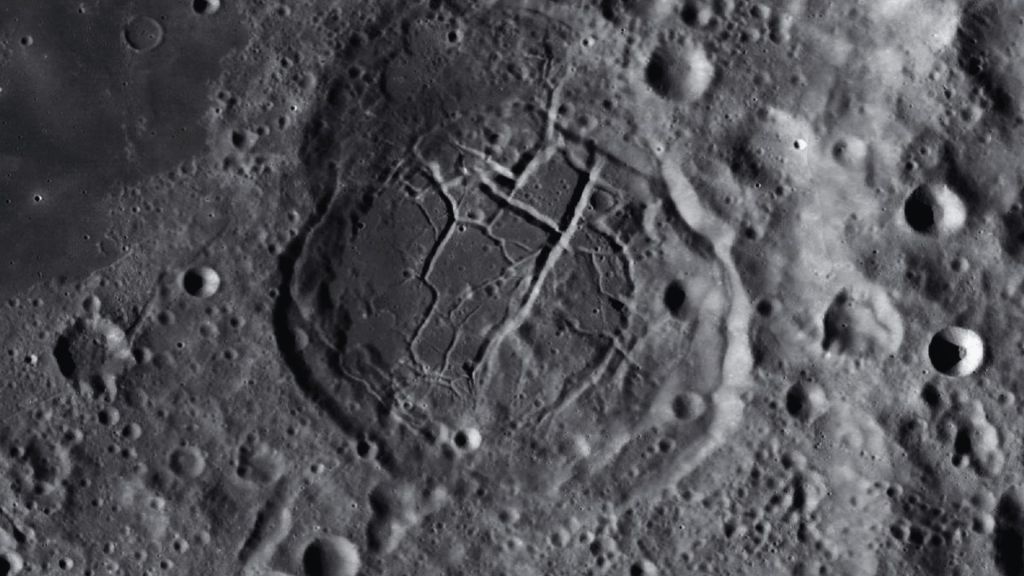
The Paracelsus C crater region and other locations discussed in searches for geometric anomalies illustrate the distinction between identifying an unusual feature and establishing its origin. No accepted discovery has demonstrated an extraterrestrial technological structure on the Moon.
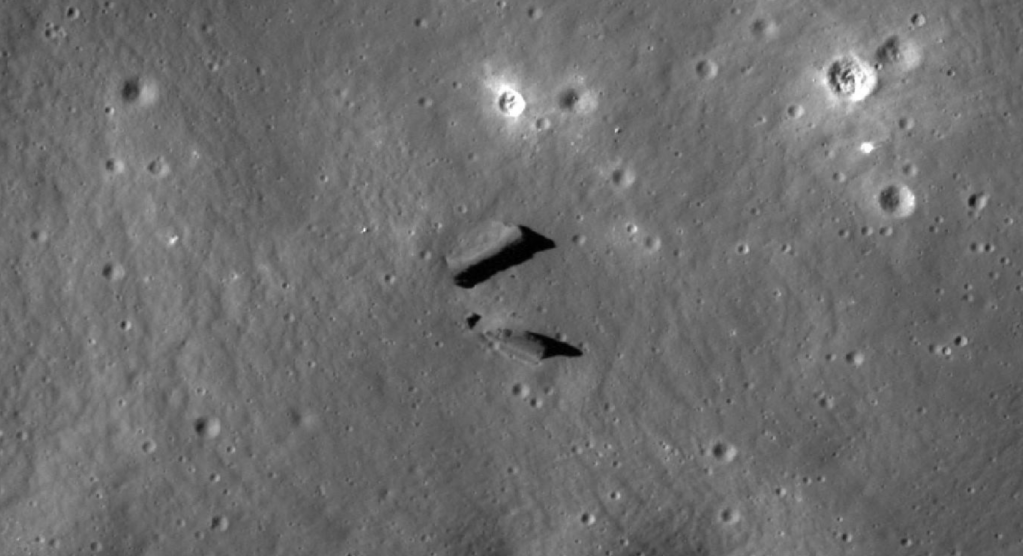
Unusual structures within the Paracelsus C crate on the lunar far side. (Image Credit: ACT/LROC).
Mars offers a more varied archaeological environment. Rivers once crossed parts of its surface, lakes occupied ancient basins and groundwater altered rocks beneath the soil. Wind continues to move dust, while volcanic activity and impact processes have reshaped the landscape.
These processes complicate the search for ancient artefacts, but they also create opportunities for preservation. Sediments can bury structures, while rocks can shield materials from radiation and surface erosion. Subsurface environments may preserve ancient organic compounds and other evidence that would degrade rapidly at the surface.
An extraterrestrial mining operation, if one had ever occurred on Mars, could theoretically leave several kinds of traces. Excavated terrain might interrupt natural geological patterns. Refined minerals could occur in unusual concentrations, and discarded materials might survive beneath later deposits.
Each proposed signature would need to be compared with known geological mechanisms. Volcanism can concentrate metals, impacts can expose deep rock and natural erosion can produce sharp-edged formations. A geometric depression or an unusual mineral deposit would therefore be an archaeological candidate only after researchers had excluded plausible natural explanations.
Mars also presents a biological complication. Any search for ancient technology would take place on a planet where scientists are investigating whether microbial life ever existed. Organic molecules could have biological, abiotic or technological origins. Establishing their source would require chemical context, mineralogical evidence and a detailed understanding of the surrounding environment.
The search for artefacts and the search for ancient life could ultimately reinforce each other. Both depend on understanding how materials survive, move and change over geological time.
The Silent Machines
A civilisation capable of interplanetary travel might leave behind something more durable than a building: an autonomous machine.
In 1960, physicist Ronald Bracewell proposed that an extraterrestrial civilisation could send a robotic probe to another star system to establish contact with its inhabitants. Rather than transmitting a signal that might pass unnoticed, such a probe could observe a developing civilisation and communicate when it detected signs of technological maturity.
The idea belongs to a broader family of proposed interstellar probes, including self-replicating machines associated with mathematician John von Neumann’s work on self-reproducing automata. These concepts remain theoretical in the context of extraterrestrial exploration. No confirmed autonomous probe of extraterrestrial origin has been found.
Yet the underlying search strategy is worth considering. A machine could remain in a planetary system long after the civilisation that built it had disappeared. Its power source might fail, its communications equipment might become silent, and its original mission could become impossible to reconstruct. The physical object might nevertheless survive.
Gravitational Hideaways
Where would an autonomous probe linger?
One possibility is a gravitationally stable region. In the restricted three-body problem, certain configurations allow a small object to maintain a stable position relative to two larger bodies. These locations are known as Lagrange points.
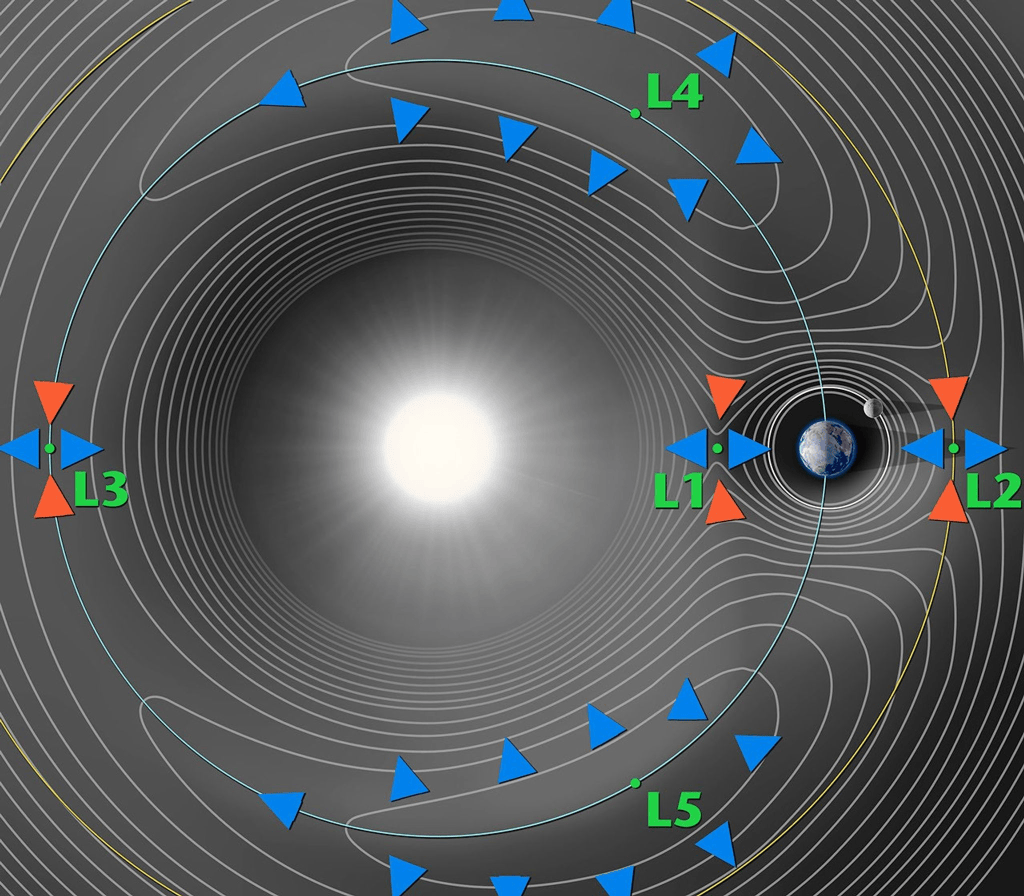
The Lagrange points in the Sun-Earth system. (Image Credit: NASA).
The Sun-Earth system has five such points, although their stability differs. The triangular points, L4 and L5, can support stable configurations under suitable conditions. The collinear points, L1, L2 and L3, are generally unstable, requiring active station-keeping for a spacecraft to remain near them.
A probe could also occupy a suitable halo orbit, a co-orbital trajectory or an orbit around a small Solar System body. Each location offers different advantages and disadvantages for communication, observation and long-term survival.
The search would have to account for orbital dynamics. A machine left in an unstable orbit millions of years ago might have drifted away or collided with another object. Radiation, micrometeorite impacts and component degradation could also compromise its operation.
Even so, a dormant probe might retain a physical signature after its electronics ceased functioning. A reflective surface, an unusual thermal response or a metallic object with a trajectory inconsistent with a natural body could provide an initial clue.
The difficulty lies in distinguishing such an object from the growing population of human-made satellites, rocket stages and debris.
The Smallest Technosignatures
An extraterrestrial artefact could be surprisingly small. Advances in engineering have repeatedly reduced the size of sensors, processors and communication systems. A probe designed for a narrow task might require far less hardware than a spacecraft built to transport people.
The Barrow Scale, proposed by physicist John D. Barrow, describes a different but related idea: advanced civilisations might increasingly manipulate nature at smaller scales, progressing from large structures towards molecular, atomic and subatomic control. It is a conceptual framework for thinking about technological development, rather than a predictive law establishing that advanced civilisations must build microscopic probes.
The implication for space archaeology is straightforward. A search restricted to large spacecraft could miss small autonomous instruments, while a search designed to detect only active transmitters could overlook dormant machines.
However, reducing the size of a probe creates engineering trade-offs. Small objects have limited room for power generation, shielding, communications equipment and propulsion. Long-term survival depends on their intended function, the environment and the materials available to their builders.
A metre-scale probe is a conceivable engineering concept. Its survival over millions of years would depend on design choices that we cannot confidently predict for an unknown civilisation. There is no established universal size limit for ancient extraterrestrial artefacts.
The more fundamental question is whether our search methods are sensitive to the range of objects that could plausibly exist.
Measuring the Search
Searching the Solar System for ancient technology presents a problem of scale. Astronomers can survey enormous numbers of distant stars, but they may detect only the brightest or most energetic technosignatures. Nearby artefacts are potentially easier to examine in detail, yet the area and volume requiring inspection remain immense.
Researchers need a way to compare these strategies.
The ichnoscale, developed as a framework for classifying technosignatures, relates the technological footprint of a signal to the number of targets that can be searched. Its underlying principle is that the largest artificial structures tend to be detectable across greater distances, while small objects generally require closer and more sensitive observations.
A civilisation that constructs an enormous energy-collecting structure around a star could produce a signature visible from many light-years away. A small probe hidden on an asteroid would require a different search strategy, probably involving observations within our own planetary system.
Neither approach dominates every category of search. Distant observations can cover many targets efficiently, while local investigations can examine individual candidates at much greater resolution.
The relevant trade-off involves detectability, search volume, observation time and the number of places where an artefact might exist. A small local object may be physically accessible but difficult to locate. A large distant structure may be easier to recognise but far rarer, or may produce signatures that resemble natural astrophysical processes.
The framework encourages researchers to compare searches using explicit assumptions about the size, brightness, behaviour and distribution of the objects they hope to detect.
The search becomes more complicated when human technology occupies the same observational environment.
Earth’s satellites reflect sunlight, producing moving points of light that can appear in astronomical images. Rocket bodies and fragments of space debris can also enter survey data. These objects complicate the identification of unusual transients, particularly when researchers examine historical observations or search for brief optical events.
Earth’s shadow offers a possible way to reduce some of this interference.
The planet’s umbra extends into space as a cone. Objects within it receive little or no direct sunlight, although scattered light and illumination from other sources can remain. At geosynchronous distances, the shadow occupies a substantial but limited region of orbital space.
Astronomers could use the geometry of the shadow to help classify candidate objects. A conventional satellite relying on reflected sunlight should become much fainter when it enters Earth’s umbra. An object producing its own light might remain visible, depending on its luminosity and viewing geometry.
This would be a filtering technique, not a definitive test for extraterrestrial origin. Human spacecraft can emit light, and natural objects can exhibit transient activity. Moreover, an object’s passage through shadow must be established from its trajectory and observing conditions.
Large sky surveys, including the Zwicky Transient Facility, provide extensive datasets in which moving objects and optical transients can be identified. A systematic search could compare candidate events with known satellites, orbital predictions and the expected behaviour of reflected sunlight.
The goal would be to isolate unexplained observations worthy of further investigation.
Light carries information about the surfaces from which it reflects. When sunlight strikes a rocky asteroid, ice-rich body or metallic object, the reflected light has a characteristic distribution of wavelengths and polarisation states.
Polarimetry measures the orientation and degree of polarisation in light. Minerals, rough surfaces, fine particles and metallic coatings can produce different polarimetric behaviours. Spectroscopy, meanwhile, identifies materials through their wavelength-dependent absorption and reflection.
Combining these methods could help identify unusual surfaces among asteroids and other small Solar System bodies. A highly reflective coating, a manufactured material or a smooth surface could produce optical properties that differ from those expected for the surrounding natural population.
Specular reflection offers another possible clue. A smooth surface can direct a concentrated glint towards an observer when its orientation is favourable. Repeated glints from an object with a suitable rotation or orbit could help constrain its shape and surface properties.
Yet nature produces reflective minerals, unusually smooth ice and complex polarimetric signatures. A metallic-looking spectrum would not establish that an object had been manufactured, and an artificial surface could become heavily degraded over millions of years.
The strongest candidate would combine several independent anomalies: unusual spectroscopy, polarisation inconsistent with comparable natural bodies, a constrained shape and orbital behaviour that justified closer examination.
The Problem of False Discoveries
Every search for rare phenomena encounters an uncomfortable statistical problem. The more observations researchers collect, the more likely they are to encounter unusual-looking data, even when no new physical phenomenon exists.
The problem becomes acute when astronomers examine old photographic plates for unexplained optical transients.
Photographic surveys conducted before the launch of Sputnik in 1957 provide a historical record of the sky before artificial satellites became a major source of moving optical objects. Researchers have examined archival plates for brief points of light that appear in one exposure but vanish in others.
Some reported candidates have been interpreted as possible evidence of unusual objects in Earth orbit. Others have been associated with speculative ideas about artificial satellites or nuclear-era activity.
However, photographic plates contain instrumental artefacts. Emulsion defects, dust, scratches and scanning errors can generate apparent sources. Image quality can also vary across a plate, creating spatial patterns that resemble clusters of astronomical events.
Telescope scheduling introduces another complication. Different fields were photographed at different times, with varying exposure lengths and observing conditions. If a particular class of observation happens to coincide with an external event, an apparent correlation can emerge without any physical connection.
These effects can create patterns that look meaningful when researchers analyse them after the fact. A cluster of apparent transients near the edge of a photographic plate, for example, could reflect the behaviour of the emulsion rather than the distribution of objects in space.
An unusual pattern is a reason to investigate the data, not evidence that the proposed explanation is correct. A credible search must account for the way the observations were produced, the imperfections of the instruments and the statistical likelihood of false detections.
Suppose a historical image contains a point of light absent from neighbouring exposures. Several explanations are possible: a transient astronomical event, a moving object, a defect in the photographic emulsion or an error introduced during digitisation.
Researchers would first need to inspect the original plate, where available, using microscopic analysis and a detailed understanding of its photographic characteristics. They would compare the candidate with other observations from the same plate and with the surrounding region of the detector.
Historical records could then establish whether the feature appeared under similar conditions elsewhere. Investigators would also need to consider exposure times, telescope movements and known astronomical sources.
For a newly detected candidate, simultaneous observations from multiple telescopes could provide a stronger test. Parallax measurements, which reveal the apparent displacement of an object when viewed from different positions, can help determine its distance. Observations separated by time can establish whether it moves consistently with a satellite, asteroid or distant astronomical source.
A genuine object would need to survive these tests before researchers could investigate its origin.
Even then, identifying a physical object and identifying its manufacturer would remain separate problems. Artificial origin would require evidence beyond the mere fact that an object exists.
How Much Have We Searched?
A negative search result is useful only when researchers know what the search could have detected.
Astronomers may have examined large portions of the lunar surface without having systematically searched every location for every possible class of artefact. The same applies to Mars, asteroids and the gravitationally stable regions of the Earth–Moon system.
Researchers therefore need to estimate search completeness: the fraction of a defined population of potential objects that a survey would have been capable of detecting.
The calculation depends on the target. A large, reflective structure on an exposed lunar plain is easier to detect than a small, dark object buried beneath regolith. A probe transmitting a powerful radio signal is easier to identify than one that has remained dormant for millions of years.
Bayesian reasoning provides a framework for updating the probability of a hypothesis as observations accumulate. In a search for ancient artefacts, the method can incorporate the probability that an object exists, the chance that it would survive and the likelihood that the search would detect it.
A survey that covers an entire region at sufficient resolution can place meaningful limits on the presence of objects matching its detection criteria. A survey that covers only a small fraction of the relevant search space provides a much weaker constraint.
The distinction is particularly important when comparing Earth with the Moon and Mars.
Earth has been extensively surveyed through geological mapping, satellite imagery, archaeology and environmental sampling. Yet its geological processes can erase or obscure evidence, and coverage varies enormously between surface environments and geological depths.
The Moon has been imaged extensively from orbit, but imaging resolution, illumination, surface coverage and the ability to detect buried objects limit the search. Mars has been mapped by multiple orbiters, yet its surface and subsurface remain incompletely explored. The Earth–Moon Lagrange regions present a different challenge: small objects can be difficult to detect against the background of space, and orbital stability does not guarantee that an ancient object remains in its original location.
Consequently, claims about search completeness must specify the size, reflectivity, depth and location of the objects under consideration. A numerical estimate for exposed, reflective objects cannot automatically be applied to dark or buried artefacts.
The broad conclusion is clear: the absence of a confirmed discovery does not establish that every plausible search location has been examined. It also does not establish that artefacts exist in the unsearched regions. Both conclusions require evidence.
The Next Archaeological Frontier
Future missions could improve the search by combining high-resolution imaging with spectroscopy, thermal measurements and subsurface investigations. Lunar landers and rovers could examine unusual features identified from orbit, while sample-return missions could provide detailed laboratory measurements of materials whose origins remain uncertain.
On Mars, drilling and subsurface sampling could investigate deposits that preserve ancient environmental records. Better orbital surveys could identify geological anomalies for targeted examination. Small-body missions could characterise unusual asteroids in greater detail, helping researchers distinguish natural mineralogy from possible manufactured surfaces.
The most useful advances may come from methods developed for other scientific purposes. Planetary scientists already search for buried ice, ancient water, organic compounds and unusual mineral deposits. Astrobiologists investigate chemical disequilibrium and the limits of biological preservation. Archaeologists reconstruct human activity from fragmented materials and disturbed landscapes.
These disciplines share a common challenge: reconstructing an invisible history from surviving traces.
A serious search for ancient technology would need to adopt the same evidentiary discipline. Researchers would have to define what counts as an artefact, model how it might survive, identify where it could be found and establish how its properties would differ from natural objects. They would also need to publish detection limits and false-positive rates so that other teams could reproduce the results.
The search would be most persuasive when it produced a candidate that could be examined independently, with multiple observations supporting an artificial origin and no plausible natural explanation accounting for the full set of evidence.
The Civilisations We Cannot See
Earth’s geological record contains evidence of extraordinary biological and environmental transformations. It preserves traces of organisms that lived hundreds of millions of years ago, records ancient mass extinctions and reveals episodes when the planet’s climate changed radically.
It also demonstrates the limits of preservation. Entire ecosystems can disappear from the fossil record, while erosion and tectonics destroy the context needed to reconstruct ancient events.
A technological civilisation would leave a different kind of imprint. Its buildings might vanish, its machinery might corrode and its settlements might become indistinguishable from natural terrain. Yet its industrial activity could alter sediments, redistribute elements and produce chemical compounds that survive long after the society itself has disappeared.
Whether such a signature could remain recognisable after millions of years depends on the scale of the activity, the environment and the preservation of the relevant materials. The geological record offers a way to investigate the question without assuming that an ancient civilisation existed.
Beyond Earth, the possibility becomes even more intriguing. The Moon preserves ancient surfaces, Mars contains geological archives of its early history, and the Solar System holds countless small bodies whose interiors and surfaces have never been examined closely. An ancient machine could conceivably occupy one of these environments, waiting to be found.
But possibility and evidence remain separate. No confirmed discovery has established that a technological species preceded humanity on Earth, or that an extraterrestrial civilisation left machines in our cosmic neighbourhood.
The scientific challenge is to determine how thoroughly we can test these possibilities. Every new survey improves our knowledge of the places examined, while every unexplained anomaly demands a more rigorous investigation.
Humanity has begun to search the universe for evidence of other minds. Perhaps the first evidence we recognise will arrive as a distant signal from another star. Perhaps it will emerge from the chemistry of an ancient rock, or from an object whose trajectory reveals that it was built rather than born.
The deeper question is whether a civilisation can vanish without erasing every trace of its existence. Somewhere between the geological memory of Earth and the silent surfaces of other worlds lies the answer.
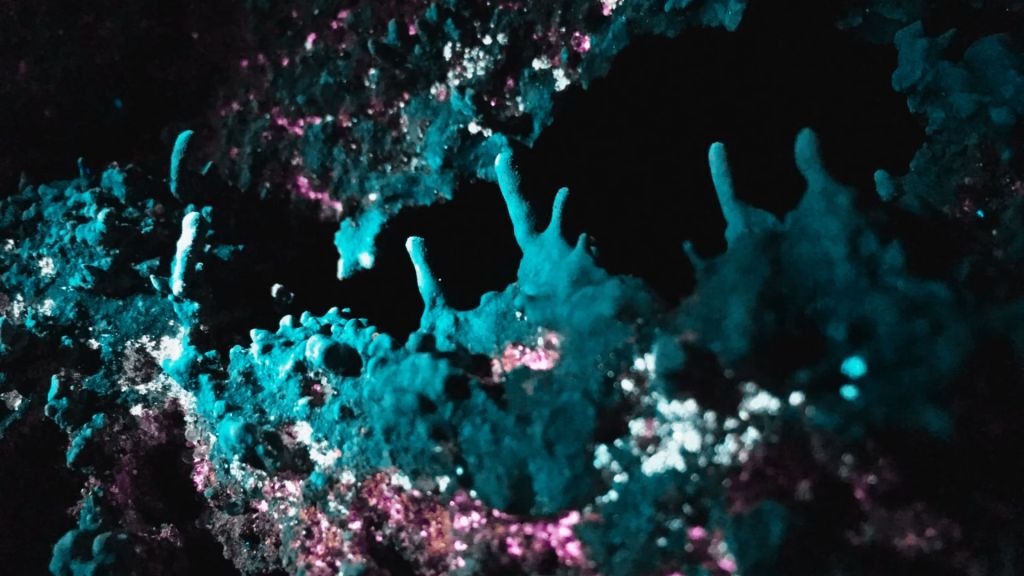
Cover Image: Ultraviolet light highlights different microbes in a cave on Earth. (Image Credit: NASA).
References:
Prior indigenous technological species
On the likelihood of non-terrestrial artifacts in the Solar System
Footprints of alien technology
The Search for Extraterrestrial Artifacts (SETA)
SETI: the argument for artefact searches
Concepts for future missions to search for technosignatures
A cost-effective search for extraterrestrial probes in the Solar system
Microplastics and the Anthropocene: Towards a new class of planetary markers

Leave a Reply