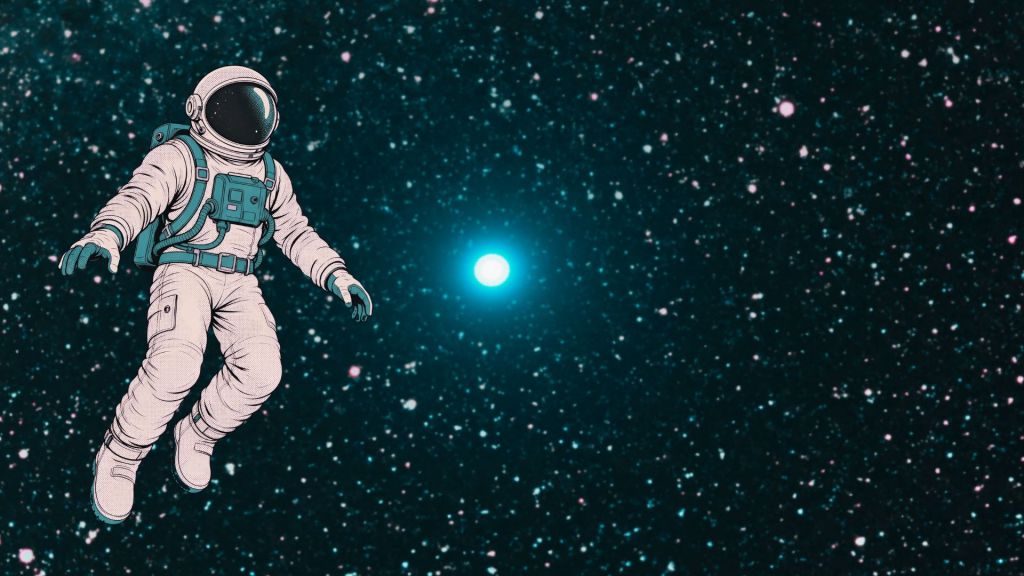
A white dwarf is the burnt-out core of a dead star, compressed into an object scarcely larger than Earth. Most shine in shades of white and blue. Under the extraordinary pressures of their atmospheres, some acquire colours that do not seem to belong to stars: salmon pink, deep purple, chartreuse green and electric cyan. A new study shows how the chemistry of these stellar remnants can transform the light reaching our eyes, revealing hidden colours among the ashes of dead stars.
The research, led by Mark A Hollands at the University of Warwick with Boris T Gänsicke, Pier-Emmanuel Tremblay and Detlev Koester, reconstructs how known white dwarfs would appear if their stellar discs could be resolved from close range. The study, Any colour you like: The diverse chromaticities of white dwarfs, combines stellar atmosphere models with the science of human colour perception to investigate an unusual question: what colour would these stars actually be to an observer looking directly at them?
The answer lies in the physics of light itself. The colours of stars are primarily established by their temperatures, but the chemical composition and extraordinary density of a white dwarf’s atmosphere can rewrite that rule.
The Cosmic Optical Illusion
For generations, astronomy has relied on a straightforward relationship between stellar temperature and colour. Cooler stars tend to be orange and red, while hotter stars appear white or pale blue. The Sun, sitting in-between these two extremes, is actually green! The atmospheres of stars modify the light they emit, but for ordinary stars these changes generally leave the overall colour close to that of an idealised thermal radiator, known as a blackbody.
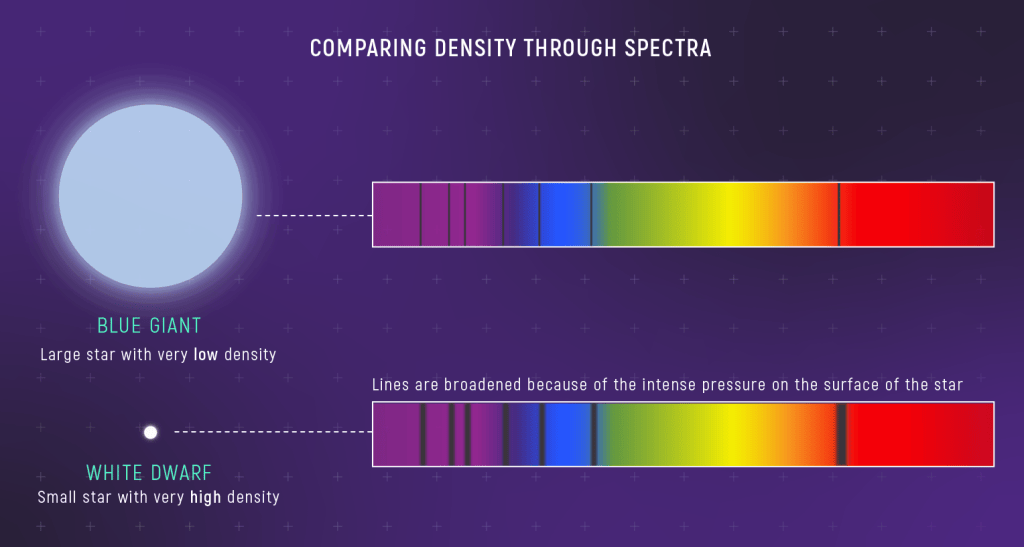
The spectra of a blue giant and a white dwarf differ markedly in the width and sharpness of their absorption lines, which reveal differences in atmospheric density: in denser gas, frequent collisions and strong electric fields (pressure or Stark broadening) produce broad, shallow lines, while lower-density gas yields narrow, sharp ones. A white dwarf, packing roughly a solar mass into an Earth-sized volume, has an extraordinarily dense, high-pressure atmosphere that broadens its absorption lines dramatically, whereas a blue giant’s extended, low-density atmosphere produces much narrower and clearer lines; a white dwarf can be on the order of 100 million times denser than a blue giant, accounting for this contrast. (Image Credit: NASA, ESA, CSA, Leah Hustak (STScI)).
Astronomical images often translate measurements from different wavelength bands into red, green and blue pixels. The Sloan Digital Sky Survey, for example, maps its i, r and g filters onto the red, green and blue channels of an image. This technique makes faint objects easier to study and reveals differences in their spectra, including features that human eyes could never see directly.
The resulting colours serve a scientific purpose, but they do not necessarily reproduce what an object would look like to a human observer. A filter records light within a selected wavelength range; a computer then assigns that measurement a display colour. The final image can therefore reflect the conventions of astronomical imaging as much as the object’s actual appearance.
To reconstruct a star’s perceived colour, Hollands and his colleagues turned to colour science. They integrated each stellar spectrum against the CIE 1931 XYZ colour-matching functions, a mathematical description of how the human visual system responds to visible wavelengths. They then converted the results into standard red, green and blue values using the sRGB colour space employed by ordinary computer displays.
This procedure reduces the information contained in a spectrum to a reproducible estimate of its visible colour. It also allows researchers to compare stars whose spectra depart dramatically from the smooth curves expected of thermal radiation.
The result is a more direct way to explore the appearance of stellar remnants. Some white dwarfs follow the expected temperature-colour relationship. Others possess atmospheres that filter their light so aggressively that their apparent colours move into unfamiliar territory.
Liquid Skies
Ordinary stars possess atmospheres whose optical properties generally preserve the broad shape of their thermal spectra. White dwarfs can develop much more extreme conditions, particularly as they cool and their outer layers become increasingly dense.
In the coolest known examples, atmospheric densities can approach one gram per cubic centimetre, comparable to the density of liquid water. Under these conditions, atoms and ions interact with their surroundings so intensely that the familiar spectral features of individual elements can spread across hundreds of nanometres.
A spectral line appears when atoms absorb or emit light at particular wavelengths. In a ‘dilute’ atmosphere, these features occupy relatively narrow regions of the spectrum. Inside an ultra-dense white dwarf atmosphere, surrounding helium atoms can perturb the energy levels of other atoms, producing enormously broadened and sometimes asymmetric absorption features.
Molecules introduce another layer of complexity. Carbon-bearing molecules absorb light across broad wavelength bands, while collisions between hydrogen and helium molecules can suppress infrared radiation and extend their influence into visible wavelengths.
These processes change the balance of red, green and blue light reaching an observer. The star continues to radiate energy according to its physical conditions, but its atmosphere selectively removes portions of that radiation before it escapes into space.
The result can be a star whose perceived colour bears little resemblance to what its surface temperature alone would suggest.
Salmon Pink and Purple
Some white dwarfs classified as DQ contain carbon in their atmospheres. Convection can transport carbon from deeper layers towards the surface, where carbon molecules produce characteristic absorption features known as the C₂ Swan bands.
In cooler DQ white dwarfs, these bands can become strongly distorted. Extreme atmospheric densities alter the molecular absorption, while powerful magnetic fields can contribute further complications. The resulting spectra can suppress large portions of the visible range, shifting the perceived colour towards pink, purple or salmon.
One of the most striking examples is WD J1011+2845. Also known as LHS 2229, this nearby remnant lies about 48 light-years from Earth and has an estimated effective temperature of just 4,300 kelvin.
Its spectrum contains deep, distorted ‘Swan bands’ (groups of absorption lines produced by the carbon molecule C₂. They appear when light passes through carbon-rich gas and carbon molecules absorb specific wavelengths, leaving characteristic patterns in the spectrum), probably shaped by the combination of atmospheric density and a strong magnetic field. Much of its visible output is concentrated at wavelengths longer than 600 nanometres, while light between 400 and 600 nanometres is heavily suppressed.
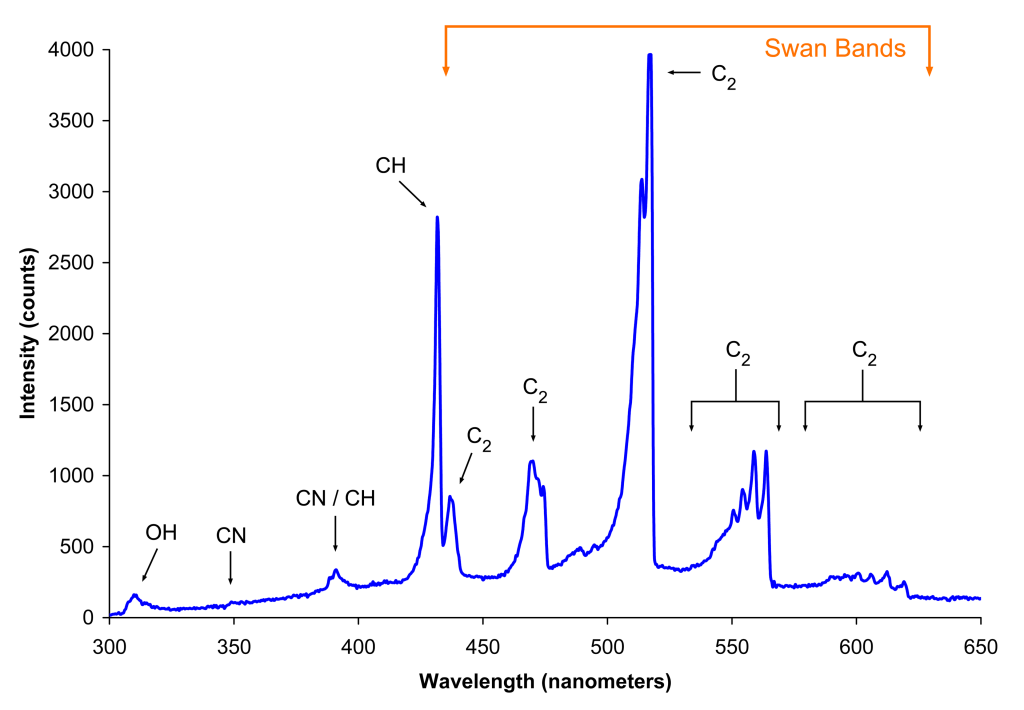
Swan bands in the spectrum of a butane torch. (Image Credit: Deglr6328/CC-BY-SA 3.0)
That spectral imbalance produces a deep salmon-pink appearance. The researchers identify it as a candidate for the reddest star known in terms of perceived colour, illustrating how molecular absorption can push a stellar remnant far from the conventional colours of thermal radiators.
Chartreuse Green
White dwarfs can also carry chemical evidence of planetary systems that survived their host stars’ deaths. Their intense gravity can tear apart asteroids and other rocky bodies that venture too close, drawing the resulting debris into the stellar atmosphere. Astronomers call this process ‘pollution’ because the accreted material introduces elements heavier than hydrogen and helium.
These elements can leave distinctive fingerprints in the spectrum. In sufficiently cool, helium-rich white dwarfs, metal absorption features broaden dramatically, changing the star’s overall colour.
The standout example is WD J1330+6435. Its atmosphere contains lithium and sodium, alongside other metals. Strong absorption at violet and orange wavelengths reshapes the spectrum, leaving a relative excess of light around 500 nanometres. The resulting colour is a vivid chartreuse green.
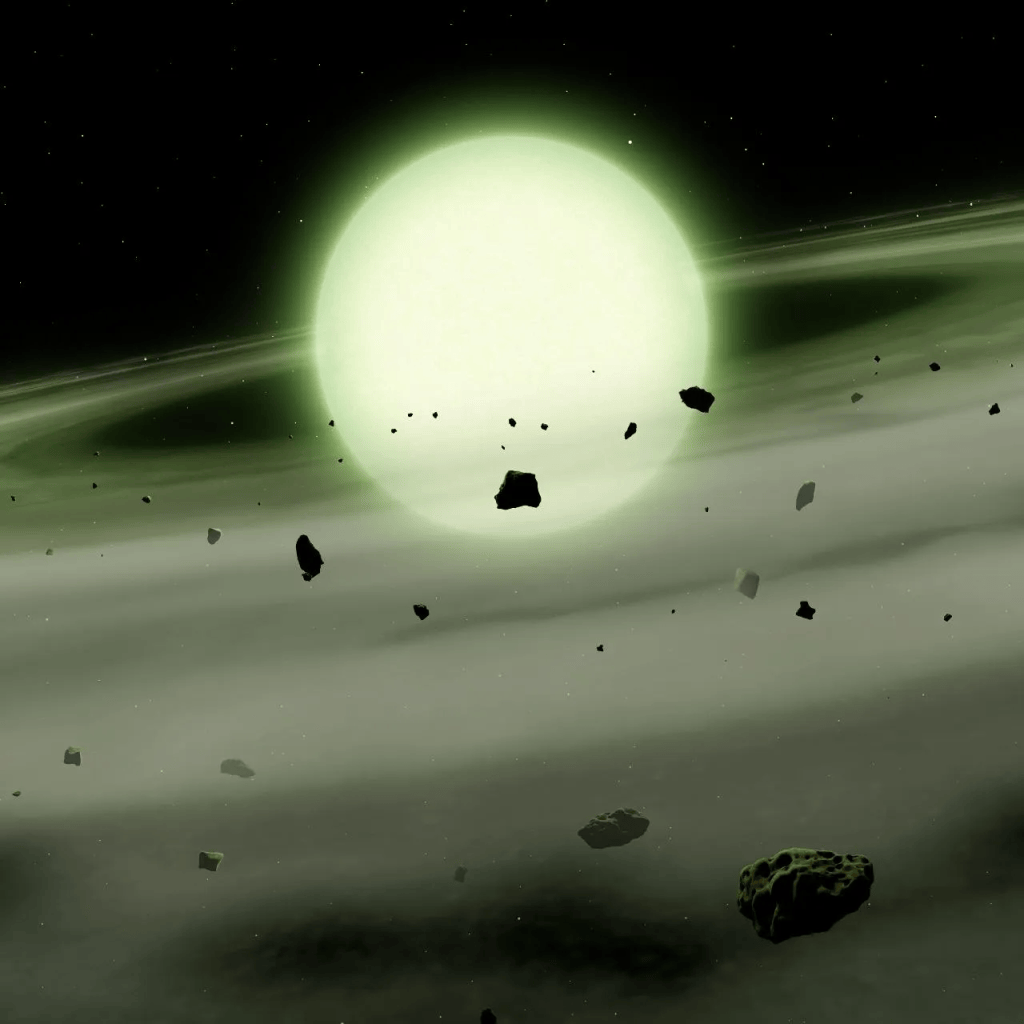
The cool white dwarf WDJ1330+6435 has accreted sodium-rich rocky debris from its planetary system into its atmosphere, where the extreme density broadens the sodium absorption so that it removes light across a wide span of yellow, orange, and red wavelengths; with those colors suppressed, the remaining light gives the star a distinctive ghostly green appearance. (Image Credit: Credit: Mark A Garlick/University of Warwick).
The researchers describe it as the first known green star in astrophysics, noting that no other star had previously been claimed to possess a green hue. They also acknowledge that its spectrum is somewhat noisy, leaving room for small revisions to the precise colour. The findings are supported by an earlier model that produced a similar green appearance, supporting the interpretation.
The green hue carries a further implication. It links the chemistry of a dead star to the destruction of rocky material around it. The metals in its atmosphere preserve evidence of planetary debris, while the unusual colour reveals how that material alters the radiation escaping from the remnant.
Electric Blue
One of the most counterintuitive objects in the study is WD J2356−2054. Its effective temperature is approximately 4,000 kelvin, yet its modelled appearance is vividly blue.
The explanation lies in an exceptionally strong sodium absorption feature. The sodium line, broadened by interactions with surrounding helium, removes much of the visible radiation across the central optical spectrum. Absorption from magnesium hydride and a related sodium-helium molecular feature further shapes the spectrum.
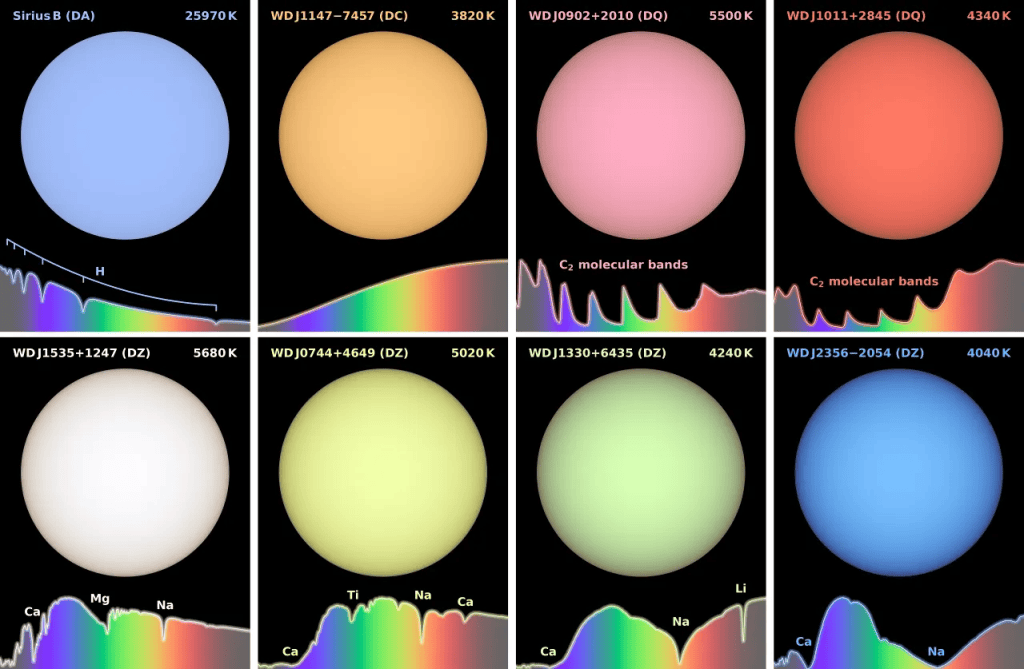
These colour-accurate simulated images of white dwarfs illustrate how atmospheric composition and temperature produce a surprising range of hues: Sirius B, the nearest white dwarf, appears pale blue because of its hot hydrogen atmosphere, while the much cooler WDJ1147-7449 shows a featureless spectrum and an orange colour; in other cool objects, convective envelopes dredge carbon from the core into dense helium-dominated atmospheres, where diatomic carbon molecules create various pink tones; and accretion of rocky debris from planetary systems enriches still other cool helium atmospheres with elements such as calcium, magnesium and sodium, whose varying abundances and the stars’ temperatures yield further colours, including green. In reality all of these stars would be many millions of times brighter than can be shown on screen. (Credit: Mark Hollands/University of Warwick)
The remaining visible output is weighted towards wavelengths around 450–500 nanometres, producing the striking blue colour. The star is therefore bluer than a pure Rayleigh–Jeans spectrum, the short-wavelength approximation to thermal radiation, despite its relatively low temperature.
A related process explains why some ultra-cool white dwarfs appear cyan. In atmospheres containing mixed hydrogen and helium, collisions between hydrogen molecules and helium atoms induce absorption that would be absent from isolated molecules. This collision-induced absorption can suppress infrared radiation and, in sufficiently cool objects, extend into the red end of the visible spectrum.
The surviving light becomes relatively richer in blue and cyan wavelengths. Together, these stars demonstrate that colour can reveal the chemical architecture of an atmosphere as clearly as a spectrum reveals its individual absorption features.
A Star Seen Up Close
What would happen if an astronaut could approach one of these stellar remnants closely enough to resolve its surface?
The answer introduces another complication. A star’s disc does not emit light uniformly. Its centre generally appears brighter than its edge, a phenomenon called limb darkening. Light emerging at different viewing angles travels through different atmospheric depths, sampling different temperatures and chemical conditions.
For a white dwarf, those variations can change both brightness and colour.
In the modelled image of WD J1330+6435, the centre appears a vivid green. Towards the edge, the colour becomes progressively less saturated before shifting to orange in the outermost part of the disc.
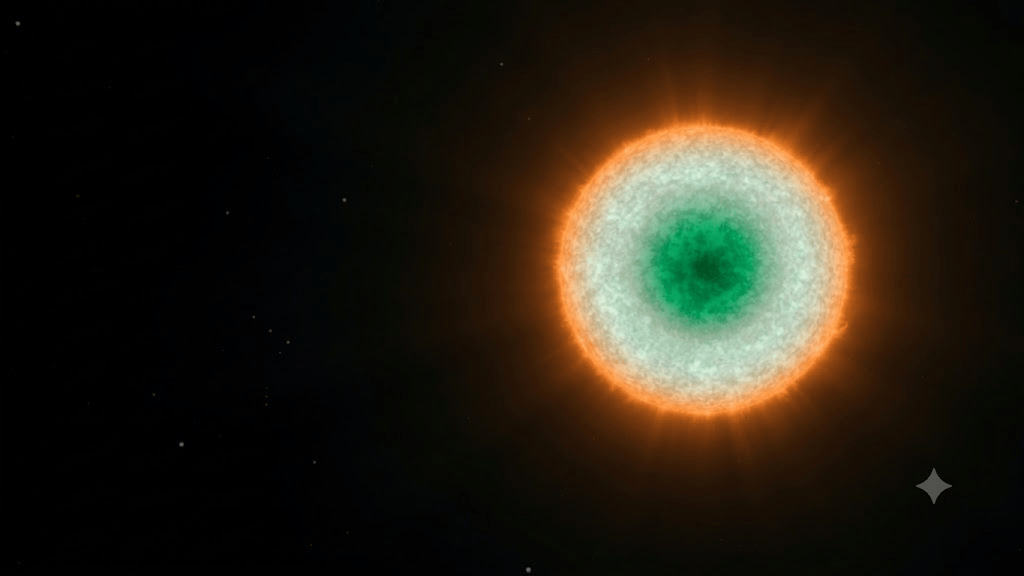
NASA/SVS illustration of white dwarf modified using Gemini.
The effect arises because the relative contributions of the red, green and blue channels change with viewing angle. The same atmosphere that produces an unusual overall spectrum can therefore generate a spatially varying palette across the stellar surface.
Other white dwarfs show different patterns. Some develop golden rims around nearly white centres, while others retain a vivid blue appearance across the disc. Their detailed appearance depends on the interplay between temperature, composition, atmospheric opacity and viewing geometry.
These images are model-based reconstructions from stellar atmosphere calculations. They show how a resolved disc could appear to an observer under the study’s colour-rendering assumptions, rather than photographs taken from nearby spacecraft.
The apparent colours in these reconstructions also conceal an extraordinary difference in brightness. A white dwarf’s surface can reach a modelled luminance of approximately 5.1 × 10¹⁰ candelas per square metre under the conditions considered by the researchers.
Computer displays cannot reproduce such stellar surface brightness. The researchers therefore normalise the colour channels to show the relative proportions of red, green and blue light, preserving the estimated chromaticity while bringing the result within the display’s limits.
The colours are consequently intended to represent hue rather than the literal visual intensity of a nearby star. An astronaut approaching a white dwarf would face an environment of overwhelming radiation and heat, not a softly glowing object comparable in brightness to a screen.
The exercise instead reveals how much information can be recovered from a spectrum, even when the physical experience of seeing the source directly remains beyond our reach.
The White Dwarf Census
The exotic examples raise an obvious question: how common are these unusual colours?
To answer it, the researchers examined a volume-limited sample of 152 white dwarfs within 20 parsecs, or about 65 light-years, of the Sun. A volume-limited survey includes objects because they fall within a defined region of space, reducing the bias that favours intrinsically bright objects in surveys selected by apparent brightness.
The sample contains white dwarfs spanning a broad range of temperatures and atmospheric compositions. Most follow the expected relationship between temperature and colour, clustering close to the blackbody locus in the colour-science diagrams.
Only five objects depart substantially from this relationship under the study’s chosen threshold: two metal-rich white dwarfs with yellow hues and three carbon-rich white dwarfs with pink colours. That corresponds to approximately 3.4 per cent of the sample.
White, After All
For the remaining 147 objects, the researchers calculated a median correlated colour temperature of 6,768 kelvin. The corresponding sRGB colour code is #F9F5FF, a very pale shade close to the standard display white point, which represents a colour temperature of approximately 6,500 kelvin.
Correlated colour temperature describes the blackbody colour that most closely resembles a given chromaticity. It is a useful measure for stars whose spectra remain close to thermal radiation, although it becomes unsuitable for objects whose unusual chemistry drives their colours far away from the blackbody sequence.
The result overturns a small but persistent visual bias. Hot white dwarfs are prominent in many brightness-selected samples and are frequently depicted with a blue tint. The local census, which includes a broader and more representative range of objects, shows that white is the more typical perceived colour.
The researchers also find substantial diversity within the ordinary population. Ninety-five per cent of the objects included in their colour-temperature distribution fall between approximately 3,800 and 18,700 kelvin. White dwarfs can therefore span a broad range of temperatures while retaining colours close to the familiar white-to-blue-to-orange progression. On average, white dwarfs really are white.
The Colours of Stellar Death
A white dwarf preserves the final stages of a star’s evolution, but its atmosphere can also carry evidence of events that occurred long after its parent star left the main sequence. Carbon exposed by convection, metals accreted from disrupted planetary bodies and molecular absorption shaped by extreme density can all transform the light that escapes from the remnant.
The colours are rare, yet their significance extends beyond visual novelty. They demonstrate how the physics of dense matter governs the appearance of stellar objects, and how the debris of planetary systems can leave a measurable imprint on a dying star.
Future surveys and increasingly accurate atmosphere models may reveal further examples among the many white dwarfs still awaiting detailed characterisation. The researchers also show that the same calculations used to analyse stellar spectra can produce colour-accurate representations of resolved stellar discs, offering a new way to communicate the physics of these objects.
Cover Image: Artist’s Illustration of Sirius B NASA, ESA and G. Bacon (STScI), Canva
Link to Press Release: Green, pink and purple: astronomers reveal the surprising true colours of white dwarf stars


Leave a Reply