
The blackest body in the Solar System is the Sun, because it reflects almost none of the incident light. For all practical purposes, the Sun behaves like a theoretical blackbody, because nearly all of the radiation it emits is dependent on its temperature. Planck’s Law of Blackbody Radiation is a formula that allows us to determine the colours emitted by a star based solely on its temperature. The visible surface of the Sun, or the photosphere is about 5,500°C, and most of the light it emits is at 500 nanometers, which corresponds to the colour green.
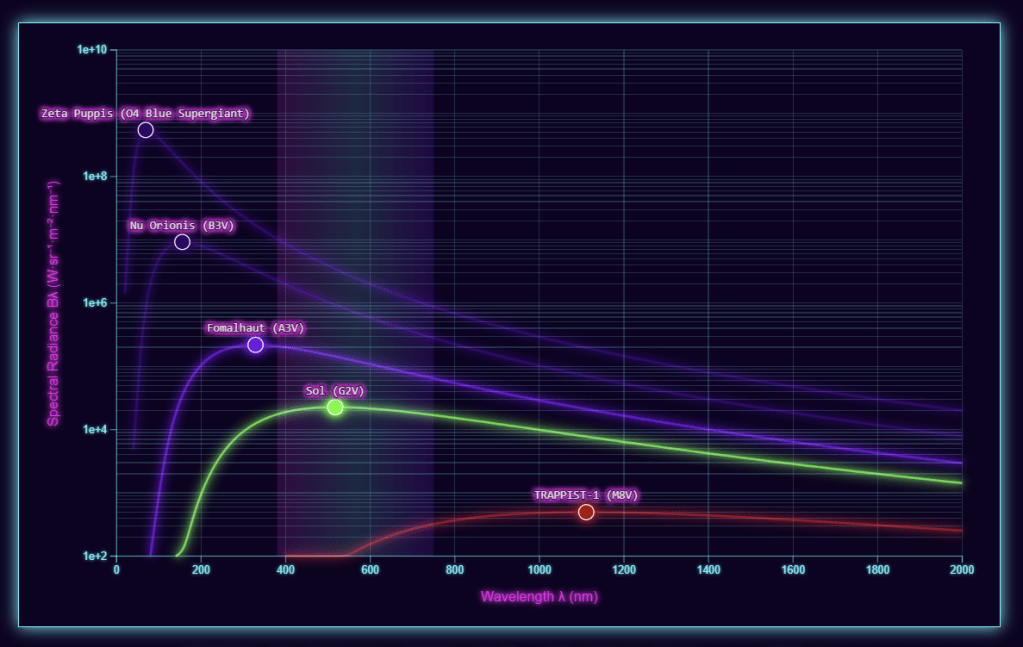
While most of the output from the Sun is green, it also radiates in other frequencies, and would appear a stark white colour in space. The atmosphere of the Earth, along with the suspended dust and aerosols scatters the blue and violet light. The phenomenon is known as Rayleigh scattering, and is responsible for blue skies as well as a yellow Sun. The reds, oranges and yellows pass easily through the atmosphere, resulting in the Sun appearing in those colours. As the atmosphere thickens, more of only the red passes through, resulting in the spectacular colours of sunsets.
Green Sun Green Earth
Planck’s Law, formulated by Max Planck in 1900, revolutionized our understanding of light and energy. It describes how a blackbody emits radiation across a spectrum of wavelengths, with the intensity peaking at a wavelength determined by its temperature. Rayleigh scattering, named after Lord Rayleigh, explains why the Sun’s appearance changes on Earth. Molecules in the atmosphere scatter shorter wavelengths (blue and violet) more effectively than longer ones (red and orange). The violet light is visible to humans, but less perceptible, and is mostly absorbed in the upper atmosphere.
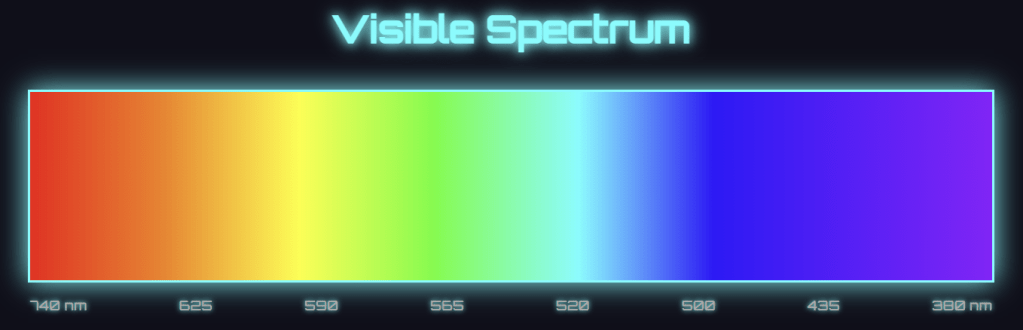
Life on Earth is tuned to the Green Sun. Photosynthetic organisms likely evolved to optimize energy capture, with chlorophyll’s absorption spectrum shaped by the Sun’s output. The reflection of green light may be an evolutionary tradeoff, allowing plants to avoid overheating or photodamage in bright sunlight while still using green light when needed. Many animals have visual systems tuned to green wavelengths. Birds, reptiles, and insects often have photoreceptors with peak sensitivity in the green range, which helps them navigate forests, detect prey, or identify mates.

The abundance of green light in the Sun’s spectrum, combined with its prominence in reflected light from plants, likely drove the evolution of visual systems that prioritize green sensitivity. Green sits right in the middle of the optical frequencies, with human vision particularly acute to the colour green. Green light penetrates deeper into water than red or blue light, which is why aquatic plants and algae (such as phytoplankton) rely on green light for photosynthesis in deeper layers of oceans or lakes. The Sun’s spectrum has been relatively stable for 4.6 billion years, allowing life to evolve in a consistent light environment where green light is prominent. This stability favored adaptations that exploit green wavelengths. In another five billion years, as the Sun ages, it will turn into a red giant. The Sun will then violently dump its outer layers, leaving behind a dense core, a white dwarf that will continue to shine in residual heat, before slowly dimming and fading over billions of years.




Leave a comment