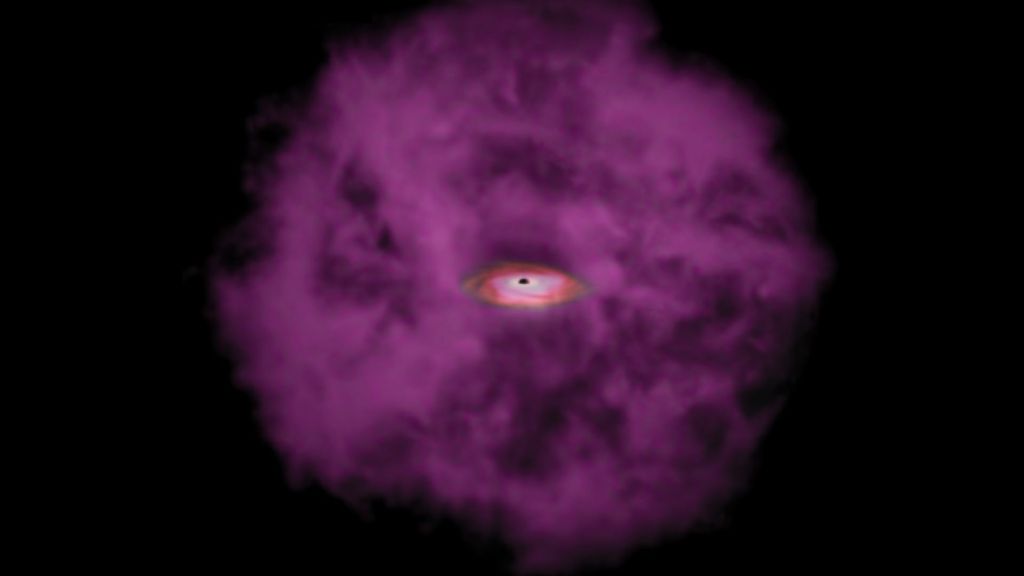
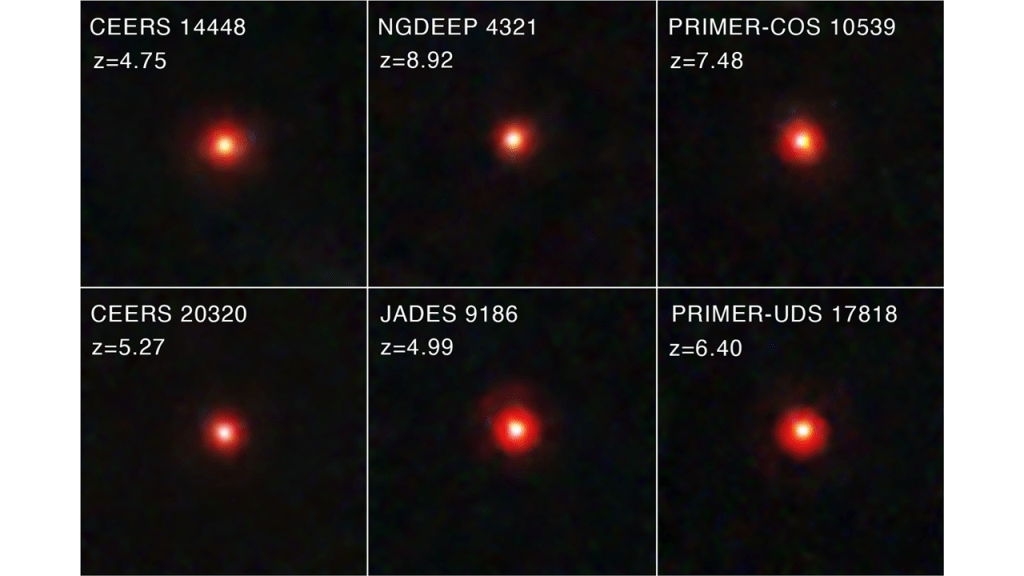
Shortly after the James Webb Space Telescope was launched, astronomers started spotting a number of mysterious objects from the distant or early universe known as Little Red Dots. They are compact sources and are surprisingly abundant. Scientists believe that they are supermassive black holes shrouded by gas, the primordial seeds of galaxies. The gas envelopes are similar to stellar atmospheres, with the objects behaving like quasi-stars (not to be confused with quasars, which are distant galaxies with active galactic nuclei that appear as point sources, like stars). These Black Hole Stars are powered by accretion. They may also be exotic Dark Stars, powered by dark matter annihilation.
The gas clouds surrounding Little Red Dots obscure emissions in X-rays and ultraviolet light. However, the typical actively feeding supermassive black holes shine brightly in both X-rays and Ultraviolet light. Astronomers combined new data from Webb, and a deep space survey previously conducted by Chandra, to study a Little Red Dot designated as 3DHST-AEGIS-12014, at a distance of 11.8 billion lightyears from the Earth. This object, unlike all the previously known LRDs, shines brightly in X-ray light. There are hints in the Chandra data that the X-ray dot varies in the X-ray brightness. Astronomers believe that this may be signs of a dissipating gas cloud, and that the X-ray Dot is a transition phase between LRDs that we see in the early universe, and the typical actively feeding supermassive black holes we see in the local universe.
Connecting the Dots
The newly discovered X-ray Dot exhibits most of the features of an LRD, and is small, red and located at a great distance. However, it glows brightly in X-rays. Scientists believe that the X-ray Dot is a transition phase, with patchy holes appearing in the surrounding gas cloud. This allows the energetic emissions from the tortured material falling into the central black hole to escape the cloud. As the cloud of gas rotates around the black hole, the patches grow denser and less dense, changing variations in the X-ray brightness from the object. Scientists need to confirm that the X-ray Dot is a Little Red Dot in the transition phase with future observations.
The X-ray Dot may be the first time that astronomers are getting a glimpse into the central engine that drives an Little Red Dot. The discovery also help confirm the nature of Little Red Dots, that they do, in-fact, contain a supermassive black hole in their cores. There were some competing theories that suggested that Little Red Dots were compact, star forming galaxies without a central supermassive black holes. There is an alternate idea for X-ray Dots where the growing supermassive black hole is veiled by an exotic type of dust, the likes of which astronomers have never seen before. The nature of Little Red Dots remains a mystery, with no single theory fitting all the observations. A paper describing the research has been published in the Astrophysical Journal Letters.
Image Credits:
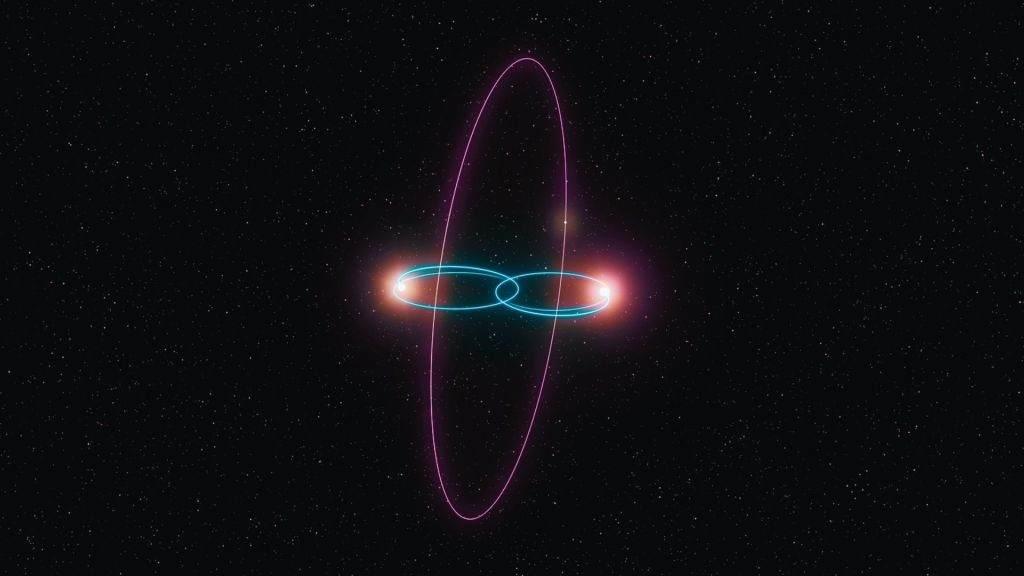
Illustration of X-ray dot: NASA/CXC/SAO/M. Weiss; adapted by K. Arcand & J. Major
Little Red Dots spotted by Webb: NASA, ESA, CSA, STScI, D. Kocevski (Colby College)

Leave a comment