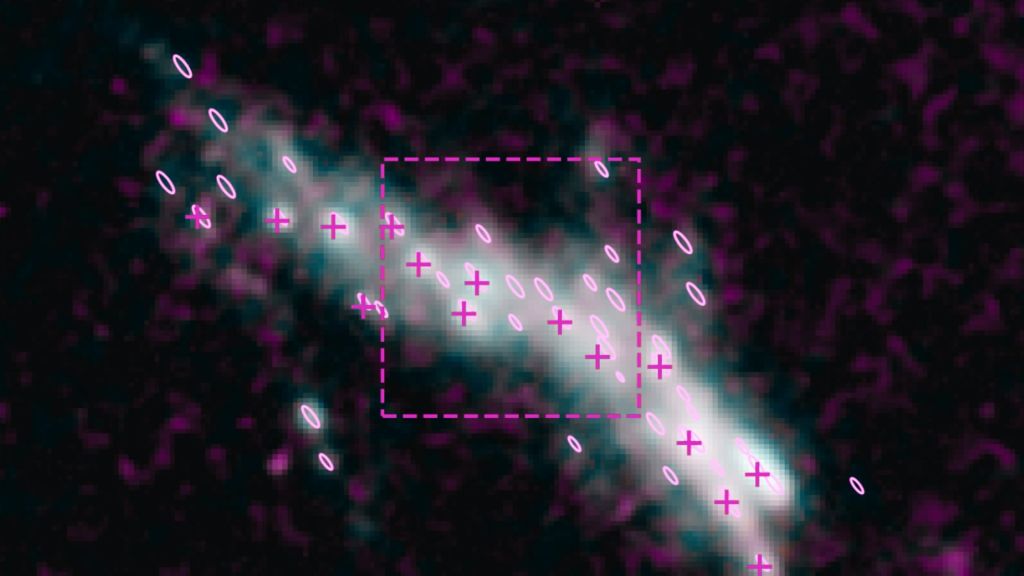
Far back in cosmic time, galaxies were turbulent places. When the Universe was between roughly one and four billion years old, many galaxies contained far more gas than their modern counterparts. That gas formed stars rapidly, while turbulence stirred the interstellar medium into enormous structures. Seen from a distance, some of these galaxies appeared to contain bright knots of star formation stretching across hundreds of parsecs or even a kiloparsec. Astronomers called them giant clumps.
For more than two decades, the nature of these structures has remained uncertain. A giant clump could be a genuinely coherent object, born when a gas-rich galactic disc became gravitationally unstable. Or it could be an illusion created by limited resolution: many smaller star-forming regions packed together so tightly that a telescope sees them as one enormous structure. A long-lived giant clump could migrate through its galaxy, transferring angular momentum and helping build a central bulge. A collection of smaller clumps would represent a very different kind of galactic evolution.
Now the James Webb Space Telescope has begun to reveal what lies inside these distant structures. A new analysis of 23 gravitationally lensed galaxies has been used to reconstruct 44 giant clumps and examined their internal stellar mass. The result points towards a surprisingly simple picture: smaller clumps inside a giant clump can be statistically explained as random members of the larger population of star-forming clumps in the galaxy. The giant clump may therefore be less like a single cosmic object and more like a hierarchy assembled from smaller pieces.
A Galaxy Made of Clumps
Star formation has a structure.
In nearby galaxies, stars tend to form within molecular clouds, which fragment into smaller clouds and eventually into star clusters. Structures can remain related across scales, creating a hierarchy in which large regions contain smaller concentrations of star formation.
The early Universe was different. Galaxies at redshifts above 1 contained much more gas, and that gas was consumed to form stars at higher rates. Turbulence was also stronger. These conditions made their discs susceptible to gravitational instability, producing large star-forming structures on scales of hundreds of parsecs to a few kiloparsecs.
Earlier observations with the Hubble Space Telescope commonly measured structures approaching a kiloparsec across, with stellar masses reaching hundreds of millions or even billions of solar masses. Their sizes were consistent with the characteristic gravitational fragmentation scale of gas-rich galactic discs.
Then gravitational lensing changed the view. A massive foreground galaxy cluster can bend and magnify light from a galaxy behind it. The effect acts like a natural telescope, allowing astronomers to resolve structures far smaller than ordinary observations of the distant galaxy would permit.
Lensed galaxies revealed star-forming clumps only about 100–300 parsecs across, with typical stellar masses around tens of millions to hundreds of millions of solar masses. Simulations and observations began suggesting that the enormous clumps seen at lower resolution could actually contain many of these smaller structures.
The problem was just resolution.
Astronomers were effectively looking at the same cosmic hierarchy through different windows.
The JWST Bridge
The SCALES project, or Star-Forming Clumps As Layered Emergent Structures, was designed to bridge those windows.
The first SCALES paper developed a method for separating compact clumps from the larger-scale emission surrounding them. The researchers analysed 23 moderately lensed galaxies at redshifts between 1 and 4 using JWST/NIRCam. Gravitational lensing magnified the galaxies by factors of roughly 2 to 9.
The researchers used a technique called difference-of-Gaussian decomposition. In simple terms, the image is examined at multiple spatial scales. Structures that appear strongly at smaller scales can be separated from broader emission surrounding them. This produces two components.
The first consists of compact clumps, typically around 100–300 parsecs across.
The second is called the extended component, or EC. It covers emission on roughly 0.5–1 kiloparsec scales that remains after the compact clumps are identified.
The EC is deliberately treated as a morphological component rather than a single physical object. Its light can include diffuse emission, clumps below the detection threshold and overlapping light from neighbouring clumps.
Put the compact clumps together with their surrounding EC, and the result resembles the giant clumps seen in lower-resolution observations.
The second SCALES paper then asked the crucial question: What is actually inside a giant clump?
Inside the Giant Clump
The researchers associated compact clumps with nearby extended components according to their spatial positions and sizes.
This produced 44 giant clumps. Each one became a kind of cosmic inventory. Instead of measuring a giant clump as a single unresolved blob, the researchers could estimate how its stellar mass was distributed among its constituent structures.
The result was striking.
In roughly 30 per cent of the giant clumps, one constituent clump contained more than half of the total stellar mass. Among giant clumps containing at least two sufficiently massive constituents, the two most massive clumps together supplied most of the mass in 56 per cent of cases. 2610.03867v1
This suggests that giant clumps can have strongly unequal internal mass distributions.
But the deeper question was whether that inequality contained evidence of a physical relationship.
If a giant clump were a coherent structure that somehow controlled the growth of its internal clumps, its constituent masses might show a distinctive pattern. The most massive sub-clump might consistently be more dominant than random statistics would predict.
The researchers tested exactly that.
A Cosmic Shuffle
Imagine taking all the clumps in a galaxy and writing their stellar masses on cards. Now shuffle the cards. Keep the positions of the clumps fixed, but randomly exchange their masses. A physically meaningful connection between a giant clump and the masses of its constituents should be disrupted by this procedure.
The SCALES team performed this experiment computationally.
They kept the spatial associations between clumps and extended components intact while randomly redistributing clump masses within each galaxy. They repeated the process 2,000 times and compared the resulting distributions with the real observations.
The observed giant clumps behaved like the shuffled versions. The median fraction of a giant clump’s mass contained in its most massive constituent was about 44 per cent in the observations and 53 per cent in the shuffled populations. The difference fell within the scatter produced by the randomised experiments.
A second statistical test reached the same conclusion. The observed configuration was consistent with random reassignment, with a reported p-value of 0.18.
The implication is subtle.
The researchers found no evidence that the stellar mass of a constituent clump carries additional information about the giant clump it inhabits, beyond what would arise naturally from the overall population of clumps in the galaxy.
In the language of the study, the internal mass distribution is consistent with random sampling of the galaxy’s clump stellar mass function.
The giant clump can therefore emerge from a population of smaller clumps without requiring those smaller clumps to have been specially tuned to the larger structure.
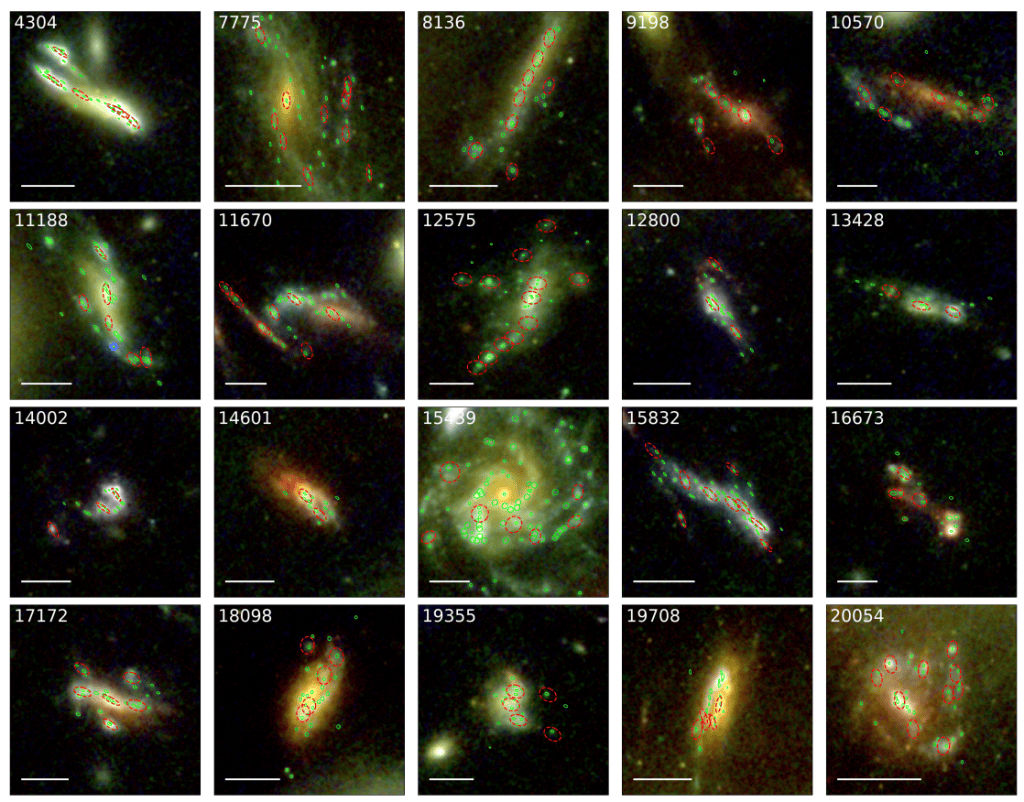
The Mass Break
The analysis uncovered another important feature. Astronomers often describe the clump stellar mass function with a power law: smaller clumps are more numerous, while increasingly massive clumps become progressively rarer. A commonly used slope is around 2.
The SCALES observations require something more complicated. The clump population shows a break around 10^7.4 solar masses. Below that mass, the distribution becomes shallower, with a slope between roughly 1.3 and 1.5 rather than the approximately 2 expected from a single scale-free distribution.
This matters because the extended component contains substantial stellar mass that cannot simply be ignored.
When the researchers combined the masses of lower-mass clumps with the EC mass and tested whether the hidden population could restore a universal slope of about 2, the answer remained no. Even under extreme assumptions, the recovered slope remained below 2.
The star-forming hierarchy therefore appears to contain a characteristic change in how stellar mass is distributed. The Universe is building structure across scales, but it is not doing so with a perfectly scale-free recipe.
Two Pictures, One Constraint
The result feeds into a long-running debate over what giant clumps actually represent.
One possibility is that giant clumps are physically coherent structures. In this picture, gravitational instability in a gas-rich galactic disc creates a large object containing smaller star-forming regions. Such structures could remain intact for long enough to migrate towards the galactic centre through dynamical friction, contributing to bulge growth and altering the structure of the host galaxy.
Another possibility is that giant clumps are emergent structures.
If many smaller clumps form within a turbulent galactic disc and their spatial concentration makes them appear as a single giant clump when viewed at kiloparsec resolution, the giant clump is then a property of the combined distribution rather than a single coherent physical entity.
The SCALES result fits naturally with both ideas. That is precisely where scientific restraint is crucial.
The observations constrain the internal mass distribution, but they do not determine whether giant clumps are long-lived bound structures or emergent associations. The models considered in the study make insufficiently specific predictions about the detailed distribution of mass among the constituent clumps to allow the observation to choose between them.
The next step is therefore spatial structure. The current work establishes how mass is distributed. The forthcoming work in the SCALES series is intended to examine how the constituent clumps themselves are distributed in space.
A Hierarchy Revealed
The SCALES model offers a way to connect the two observational regimes. If the constituents of a giant clump are random draws from the galaxy’s overall clump population, then a giant clump’s internal structure should change predictably with its total mass, which it does.
Lower-mass giant clumps are increasingly likely to have most of their stellar mass concentrated in a single constituent clump. More massive giant clumps are more likely to contain several substantial constituents. The observed trend agrees with the predictions of the random-sampling model, with the correlation between the mass fraction of the largest constituent and total giant-clump mass measured at −0.46 ± 0.16.
This produces a natural bridge between what astronomers previously regarded as two separate populations.
At sufficient observational depth, a low-mass giant clump may simply be a massive compact clump seen with higher resolution.
The boundary between the two begins to dissolve.
At the smallest scales, the first SCALES paper also found evidence that the roughly 100–300 parsec clumps themselves may contain still smaller, star-cluster-like structures. Their measured dynamics are difficult to reconcile with a simple picture in which each clump is a single monolithic object. A hierarchy of smaller components provides a possible resolution.
The emerging picture is therefore recursive.
Star clusters can inhabit smaller clumps.
Smaller clumps can inhabit giant clumps.
Giant clumps can inhabit turbulent galactic discs.
And the galaxy itself is part of the larger cosmic web.
The Galaxy as a Cosmic Hierarchy
There is something profound in what JWST is revealing here.
For years, the apparent size of these star-forming structures depended strongly on the telescope observing them. At one resolution, a galaxy contained enormous kiloparsec-scale clumps. At another, gravitational lensing exposed hundreds-of-parsecs structures inside them.
The SCALES analysis suggests these views can belong to the same hierarchy.
The first paper found that compact clumps between roughly 100 and 300 parsecs have a stellar-mass distribution capped around 10^8–10^8.5 solar masses, while their apparent evolution with redshift is strongly affected by observational selection. It also found evidence that these clumps contain smaller star-cluster-like substructures.
The second paper now shows that giant clumps can be assembled statistically from that population.
The cosmic structure of star formation may therefore resemble a vast nesting system, with each observational scale revealing another layer.
Yet the hierarchy has limits.
The researchers emphasise that their random-sampling result is a constraint on mass composition, rather than proof of complete self-similarity. The spatial arrangement of the clumps remains to be tested, and the current sample contains only 44 reconstructed giant clumps. A larger sample could reveal weaker physical ordering that the present observations cannot detect.
The mystery has therefore moved.
The question is no longer simply whether giant clumps are real.
They are clearly measurable structures.
The deeper question is how much of their identity comes from the physics of a single object, and how much emerges from the collective behaviour of many smaller objects.
JWST has begun to expose the architecture hidden inside distant galaxies. What appeared to be enormous stellar complexes may contain layers within layers, each governed by its own physical scale.
The Universe may build galaxies the same way it builds many things in nature: through structures nested inside structures, until something that looks like a single object from far away resolves into a hierarchy of smaller worlds.
And at every deeper scale, the galaxy becomes less like a collection of stars and more like a cosmic system still assembling itself.
Images Credits:
All the images are from the papers, arXiv:2610.03867 [astro-ph.GA] and arXiv:2610.03866 [astro-ph.GA]
Sources:
SCALES. II. The Internal Composition of Giant Star-Forming Clumps at z=1−4
SCALES. I. Bridging Lensed Clump – Giant Clump Scales in Lensed Galaxies at z=1−4

Leave a comment