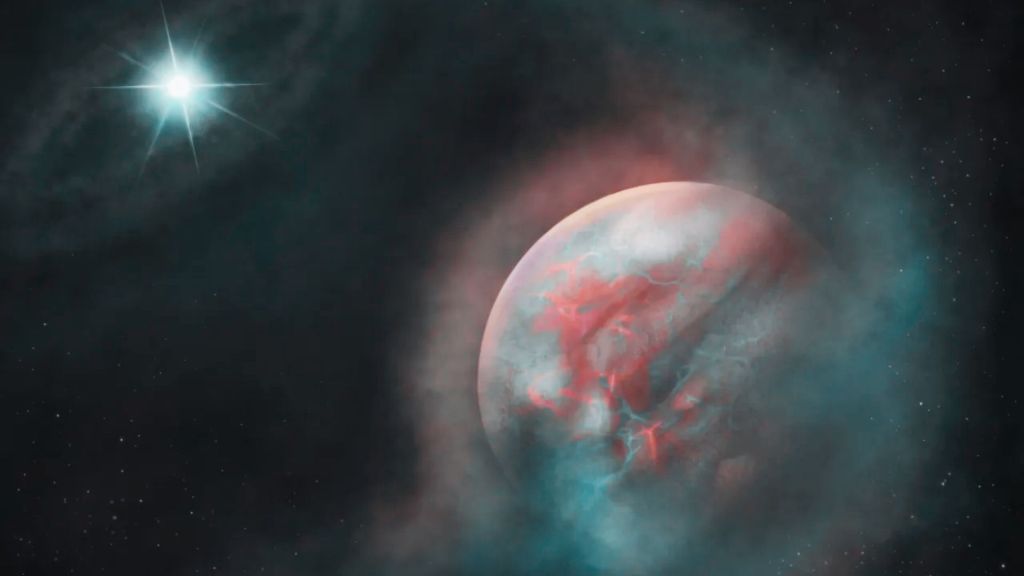
When a Sun-like star reaches the end of its life, it sheds its outer layers violently into space, leaving behind the core, known as a white dwarf. The supernova winds carry atoms forged during the star’s final stages, including elements created through slow neutron capture, or the s-process. Most of that material drifts away into the Galaxy. Around one particular white dwarf, some of it may have stayed behind, and coalesced into a new world.
Astronomers studying the hot, young white dwarf HS 0209+0832 have found an unusual chemical pattern in its atmosphere. The star is absorbing material enriched in carbon and heavy elements such as copper, zinc and, most strikingly, niobium, while the familiar rock-forming elements silicon and iron are strongly depleted. The composition resembles nothing in the Solar System.
The leading interpretation is extraordinary. The white dwarf may be feeding on the atmosphere of a giant planet formed from material expelled by the star’s own progenitor during its death. Such a world would belong to a second generation of planets, born after the original planetary system had already passed through stellar evolution.
TESS observations reveal a faint 4.4-day brightness cycle around the white dwarf, consistent with a close giant planet being heated and stripped by the intense radiation of its stellar remnant. The system offers a glimpse of a planetary world that may have been assembled from the ashes of dead star.
A Strange White Dwarf
HS 0209+0832 is a young white dwarf with an effective temperature of roughly 35,000 Kelvin and a cooling age of only about five million years.
White dwarfs are compact remnants left after stars shed their outer layers. Their immense gravity causes heavy elements to sink rapidly below the visible atmosphere. At the temperature of HS 0209+0832, helium should also disappear from the atmosphere within months.
Yet, helium is present. So are metals. The combination immediately points towards an external source continually delivering fresh material to the white dwarf. A far-ultraviolet spectrum obtained by the Hubble Space Telescope in 1999 had already revealed carbon, aluminium, silicon, calcium, titanium, nickel and zinc, along with roughly 100 unidentified absorption lines.
A quarter of a century later, the origin of those metals can be examined in the context of what astronomers have learned about polluted white dwarfs. Planetary debris is now a well-established explanation for metal enrichment in these stellar remnants. The new analysis revisited archival observations from Hubble, the Far Ultraviolet Spectroscopic Explorer and the Very Large Telescope, alongside Pan-STARRS and Gaia data.
That re-analysis identified many of the mysterious spectral features as copper and niobium. Niobium changed the story.
The Element That Gives It Away
Most planetary debris accreted by white dwarfs broadly resembles material found in the Solar System. Rocky bodies can be rich in silicon and iron. Icy bodies can carry large quantities of volatile elements such as carbon, nitrogen, oxygen and sulphur.
HS 0209+0832 looks different. The accreted material contains almost no iron and only traces of silicon, while nickel is extraordinarily abundant relative to iron. The measured nickel-to-iron ratio exceeds 2 by number, compared with roughly 0.05 in CI chondrites and the bulk Earth. Niobium is more than three orders of magnitude more abundant relative to calcium than in the Sun.
These elements belong to different parts of the nuclear story of a star. During the asymptotic giant branch, or AGB, phase, an evolved star becomes a factory for slow neutron-capture nucleosynthesis. Neutrons are absorbed gradually by atomic nuclei, building heavier elements. The resulting material is carried into the star’s outer layers and eventually expelled through powerful stellar winds.
The expelled material therefore carries a chemical signature of the star’s final evolutionary stages. A planet forming from that material would inherit the signature.
That is the basis of the second-generation interpretation. The authors’ stellar-evolution calculations show that AGB winds can strongly enhance trans-iron elements, with niobium and other s-process elements reaching enhancements of up to two orders of magnitude in some models.
HS 0209+0832 takes the idea into particularly strange territory. Its niobium abundance is even higher than the maximum predicted by the models used in the study. At the same time, strontium, which should accompany niobium in standard s-process calculations, is absent. The observed strontium-to-niobium pattern therefore exposes a second mystery nested inside the first one.
The discrepancy could point towards unusual nucleosynthesis in the progenitor star, or towards chemical processing inside the planet itself. The chemical trail leads backwards through time.
Planets After Stellar Death
A first-generation planet is assembled from the waste material that formed the host star, in the protoplanetary disc surrounding the young main-sequence star. A second-generation planet has a different origin story.
Its star has already lived its main sequence life. It has expanded into a giant, processed material in its interior, and expelled its outer layers. Some of that material can then gather into a new disc. From that disc, planets could potentially form around the newly created white dwarf. The physics remains theoretical in several respects, but the necessary conditions are known to exist.
Post-AGB stars are known to possess circumstellar discs. Binary interactions can produce a common-envelope phase in which a companion moves through the giant star’s extended atmosphere. The interaction can eject the envelope and leave material in a disc around the surviving stellar remnant.
A second-generation giant planet could then form from this reservoir, potentially through direct gravitational collapse.
Another route produces a stranger object. A planet from the original system could survive the giant phase and later encounter the second-generation material. It could acquire a new atmosphere enriched in AGB ejecta, creating a kind of born-again planet. In that scenario, the planet’s core could predate the stellar death while its outer layers belong to a new planetary generation.
The observations cannot currently distinguish these possibilities. The chemical composition tells astronomers that the material being accreted carries an unusual stellar signature. It does not reveal the composition of the planet’s inaccessible interior.
A World Under Siege
The chemistry suggests the presence of a planet that is feeding or might have fallen into the white dwarf. The light curve suggests that the planet may still be there.
TESS observations of HS 0209+0832 reveal a sinusoidal brightness variation with a period of 4.399 days and an amplitude of about 0.12 per cent. The signal is consistent with a close companion orbiting roughly 0.04 astronomical units from the white dwarf.
At that distance, the planet would live under an intense ultraviolet and X-ray assault. The white dwarf is still extremely hot. Its radiation can heat the planet’s atmosphere and drive atmospheric escape. Gas lifted from the planet can flow away into space, with some of that material eventually reaching the white dwarf.
The process creates a remarkable feedback loop. The dead star irradiates the planet. The planet loses its atmosphere. That atmosphere falls into the white dwarf. The white dwarf absorbs it. Its atmosphere becomes chemically ‘polluted’. Astronomers then read those elements as a record of the planet.
The calculations suggest that atmospheric escape could exceed the measured accretion rate onto the white dwarf by a substantial margin. Much of the escaping material would be lost from the system, while a fraction could be captured by the white dwarf. The planet, if it exists, would therefore be slowly feeding its own destruction into the star that created its environment.
The Flicker Of An Evaporating World
The 4.4-day signal has another possible explanation. A young giant planet could be tidally locked, presenting the same hemisphere towards the white dwarf. Its dayside would receive intense ultraviolet radiation while its nightside would face darkness.
The authors propose that the atmosphere could develop a highly asymmetric haze. Ultraviolet radiation could produce aerosol particles on the dayside. The hot nightside could destroy those particles rapidly. As the planet rotates around its orbit, the changing view of this chemically divided atmosphere could alter the amount of light received from the system.
The result would be a tiny repeating modulation.
Another possibility is an evaporating comet-like tail crossing our line of sight. The same escaping material could also explain variations in the observed helium abundance and unusual features in the white dwarf’s helium spectrum. The signal therefore remains a clue rather than a definitive planetary detection.
There is an significant complication. If the brightness variation came from simple thermal emission, the planet would need an implausibly large effective radius to produce the observed amplitude. The proposed asymmetric haze provides a more physically plausible route, but detailed atmospheric and circulation modelling is still required.
A Chemical World Unlike Earth
The possible planet would have formed in material with a radically different chemical history from the cloud that produced Earth.
AGB winds can contain unusual carbon-to-oxygen ratios. That changes the minerals and molecules able to condense as a planetary system cools.
In a carbon-rich environment, carbon can bind into compounds such as carbides while oxygen becomes comparatively depleted. A planet formed there could therefore possess a mineralogy fundamentally different from the rocky worlds of our Solar System.
The heavy-element enrichment adds another layer.
AGB stars are major sources of s-process elements. A planet assembled from their ejecta could carry unusually large quantities of elements that are rare in ordinary planetary systems. The chemical fingerprint would effectively preserve the final nuclear processing of the star that died immediately before the planet’s birth.
That makes the planet more than an exotic world. It becomes a geological archive of stellar death.
The Problem With The Fingerprint
There is still a problem. The measured abundances do not reproduce AGB nucleosynthesis models perfectly.
Niobium is extraordinarily enhanced, but strontium is missing. The observed niobium abundance exceeds the maximum produced in the model grid used by the authors. Similar niobium-to-strontium anomalies occur in some barium stars, suggesting that late neutron-capture processes may shift material towards heavier elements in ways current models do not fully reproduce.
Planetary processing could also alter the original composition. Atmospheres are chemically active environments. Elements condense into clouds, separate between gas and solids, and respond to temperature and irradiation. Theoretical work on the atmospheres of second-generation planets remains limited, so astronomers do not yet know exactly how an AGB-derived planetary atmosphere should transform the stellar abundance pattern.
That uncertainty leaves the chemical mystery alive. The planet may have inherited the stellar composition directly. It may have chemically reprocessed it. Or both processes may be operating at once.
A New Kind Of Planetary Archaeology
The significance of HS 0209+0832 extends beyond one unusual white dwarf. If the second-generation interpretation is correct, astronomers have found a way to search for planets created after stellar evolution has already transformed their surroundings.
The search strategy is remarkably simple in principle. Look at hot white dwarfs. Read their ultraviolet spectra. Find carbon-rich material combined with unusually strong s-process signatures. Then search for periodic variability that could reveal a surviving giant planet.
The ultraviolet is especially powerful because hot white dwarfs produce spectra crowded with metal absorption lines. Elements such as niobium, zinc and copper can therefore become chemical tracers of material arriving from a planetary companion.
Future observations could also look for heavier s-process elements such as lead. A stronger detection would help constrain the metallicity of the progenitor star and reconstruct the conditions under which the planetary material formed. Better atomic data and higher-quality spectra could also resolve currently unidentified lines and test whether additional heavy elements are present.
The discovery therefore paves the way to a new form of planetary archaeology.
Astronomers have spent decades reconstructing the histories of stars from their spectra. Now, the same technique may allow them to reconstruct the history of a planet from the chemical debris of its atmosphere.
A Planet From The Ashes
The universe usually presents planets as the products of stellar birth. Gas collapses. A star ignites. A disc forms. Planets assemble from the leftover material.
HS 0209+0832 offers another pathway. A star lives, evolves, manufactures heavy elements, and dies. Its outer layers escape. Some of that material may gather again. A planet may emerge from the debris, carrying the chemical fingerprints of the star that came before it.
Then, millions of years later, that planet may orbit the stellar corpse itself. The evidence is still being gathered. The object remains a candidate, and the precise architecture of its formation is unresolved. Yet the chemistry already points towards a planetary system built from stellar aftermath.
If future observations identify more such worlds, planets may become records of multiple stellar generations rather than single births. The Galaxy could contain worlds whose rocks, clouds and atmospheres preserve the nuclear history of stars that disappeared long before the planets themselves existed.
The universe may therefore recycle planetary systems.
And somewhere around a fading stellar remnant, a planet could be carrying the ashes of a dead star into its next generation.
Image Credit: Artist’s illustration of the second-generation planet that has formed around white dwarf HS 0209+0832. Credit: Dr Snehalata Sahu/University of Warwick.
Source: Discovery of a second-generation planet candidate
accreting onto a white dwarf
Press release: https://warwick.ac.uk/news/pressreleases/the-phoenix-planet/

Leave a Reply