Astronomers have spent centuries sorting celestial objects into neat buckets. Stars make their own energy through nuclear fusion. Planets orbit stars and shine mainly by reflected or re-radiated light. Brown dwarfs sit between the two, too small to sustain the hydrogen fusion that powers stars but massive enough to occupy a distinct regime of substellar physics, because of their ability to fuse deuterium, a heavier cousin of hydrogen. This tidy picture is becoming increasingly difficult to maintain.
The trouble begins with sub-brown dwarfs, that are simultaneously isolated planetary-mass bodies. Objects with only a few times the mass of Jupiter can exist in isolation, carry discs of their own, occur in pairs, orbit brown dwarfs, or form part of systems containing nothing that qualifies as a conventional star. Some may have formed through processes normally associated with stars. Others may have originated in planetary systems and subsequently been thrown into interstellar space. These circumstellar disks can potentially form exoplanets of their own.
The result is a population of objects that looks less like a neat ladder from stars to planets and more like a continuum.
This is not merely a semantic problem. How these objects formed determines what they can tell us about star formation, planet formation and the myriad architectures of planetary systems.
The 13 Jupiter-mass limit
The familiar dividing line between planets and brown dwarfs is often given as about 13 Jupiter masses.
There is an important qualification, and not an arbitrary one. The number comes from the approximate mass at which an isolated object of roughly Solar composition can become hot and dense enough in its interior to fuse deuterium, a heavy form of hydrogen. Deuterium fusion is very different from the sustained hydrogen fusion that powers a star. It is an early stage of evolution and does not turn a brown dwarf into a miniature star.
The 13 Jupiter-mass threshold is therefore a useful convention, not a fundamental boundary in nature.
The current International Astronomical Union working definition of an exoplanet allows objects below the deuterium-burning limit to be classified as planets if they orbit a star, brown dwarf or stellar remnant and satisfy an additional mass-ratio condition. The same definition explicitly leaves free-floating planetary-mass objects in a less settled category.
That distinction matters. A 10-Jupiter-mass object orbiting a star can be called a planet. A physically similar 10-Jupiter-mass object drifting alone through a young star cluster may instead be described as a planetary-mass object or a sub-brown dwarf.
The objects themselves have not changed. Only their surroundings have.
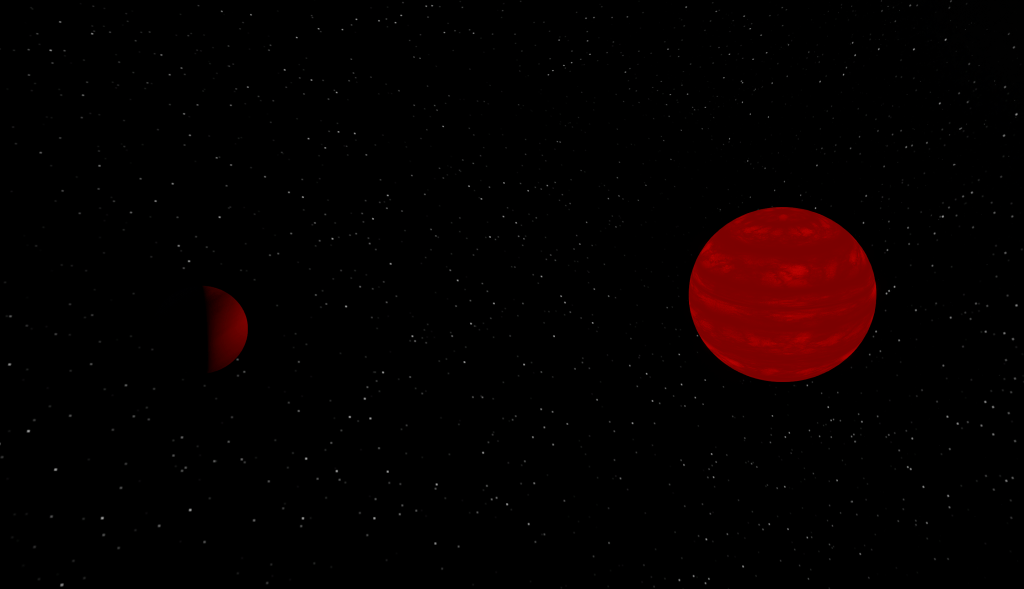
Illustration of a Gas Giant in orbit around a Brown Dwarf. The glow is from the burning of deuterium. There is no star in the system.
The physics is also less clean than the number suggests. Deuterium burning depends on composition and internal structure, so 13 Jupiter masses is not a sharp physical switch. There is no sudden change in radius, density or atmospheric behaviour that occurs at precisely that mass. A brown dwarf can be about the same size of a Jupiter, and puffball ‘Hot Jupiters’ that have drifted closer to host stars can actually be larger than more massive brown dwarfs.
The problem becomes even more obvious when formation enters the discussion. A planet formed inside a protoplanetary disc can, in some circumstances, reach masses above the conventional deuterium-burning threshold. Conversely, gravitational collapse in a molecular cloud can produce objects below it.
So what should determine the name: mass, formation mechanism, location or present-day dynamics?
There is no answer that works perfectly in every case. Astronomers cannot even agree on a definition of a planet, and although no binary exoplanets have been discovered, Pluto and Charon are close to such a system.
A moon without a planet
The terminology becomes even more difficult when the central body is itself substellar.
Consider a brown dwarf orbiting a star. If a smaller object orbits that brown dwarf, calling it a satellite is dynamically reasonable. But should it be called an exomoon?
The word ‘moon’ carries an implicit hierarchy. In the Solar System, the planets dominate the gravitational architecture of their systems and their moons orbit them. But a brown dwarf may be only slightly more massive than the object orbiting it. At that point the distinction between a planet with a moon, a binary planetary system and a planet orbiting a brown dwarf becomes increasingly dependent on the chosen definition.
The current IAU working definition does recognise planetary-mass bodies orbiting brown dwarfs as exoplanets when the relevant mass-ratio condition is satisfied. But this does not eliminate the broader terminology problem, particularly for free-floating systems and substellar binaries.
This is why the term ‘exosatellite’ is useful. They describe the dynamics without pretending that the classification problem has been completely solved.
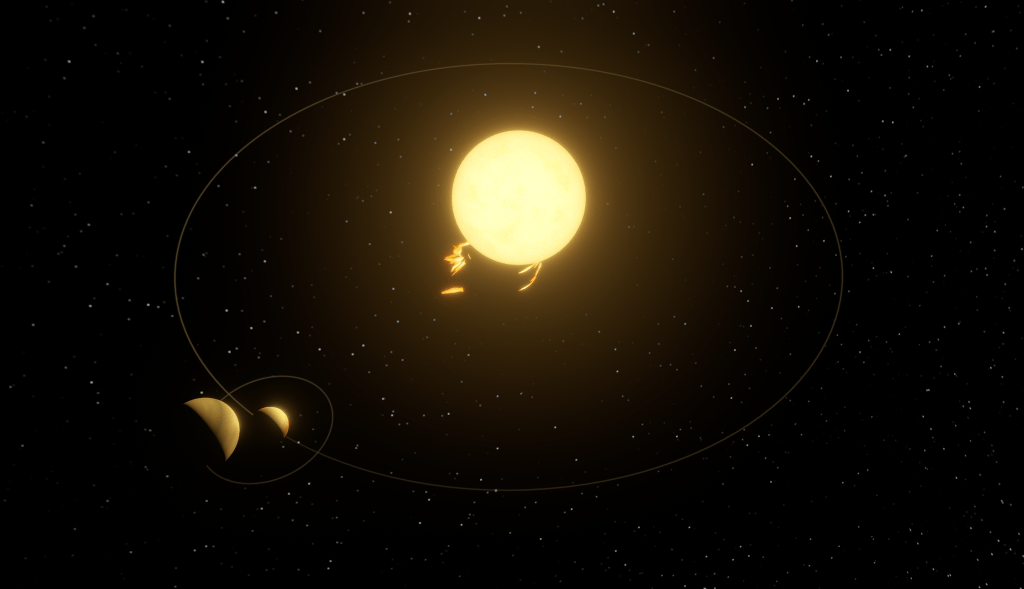
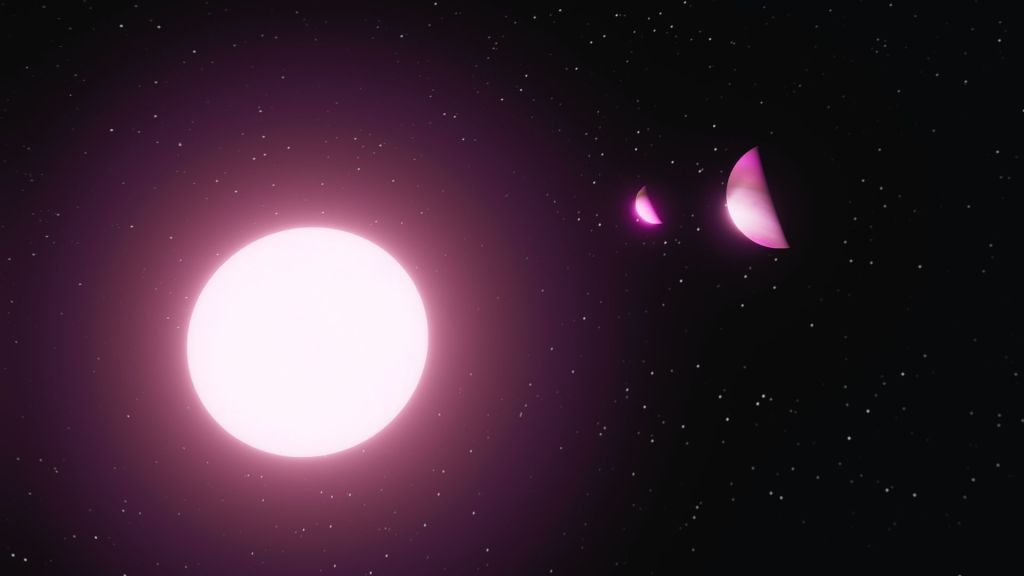
Illustration of CD-35 2722 B b. While the masses and sizes are accurate, the orbital distances have been reduced for illustration purposes. Note that the brown dwarf is more massive, but its companion is larger.
The recent case of CD-35 2722 B illustrates the point particularly well. The object is itself a brown dwarf companion to an M-dwarf star. In 2026, observations with the VLT’s CRIRES+ instrument produced evidence for a planetary-mass object orbiting the brown dwarf. The strongest signal corresponds to a minimum mass of about 0.9 Jupiter masses and an orbital period of roughly 170 days. A second, less certain signal corresponds to about 0.3 Jupiter masses and an 87-day period.
Those periods are close to a 2:1 mean-motion resonance. That is the same broad type of orbital relationship seen among several familiar satellite systems, including Jupiter’s moons.
But there is an important caveat: these are still candidates, not an established population of confirmed exomoons. Indeed, the authors themselves describe the object as an exosatellite and note that the definition of an exomoon remains unsettled.
That distinction is precisely the sort of detail that gets lost when an unusual astronomical result is reduced to a headline. Both Wired and Time have termed it as an exomoon, the first one at that, ignoring previously discovered hierarchical systems with similar configurations.
A starless nursery
JWST has made the lowest-mass end of this population particularly difficult to ignore.
In the young star-forming cluster IC 348, astronomers have found objects with estimated masses of only a few Jupiter masses. An earlier JWST study identified a free-floating object estimated at roughly 3–4 Jupiter masses, making it one of the lowest-mass directly imaged brown-dwarf-like objects known at the time.
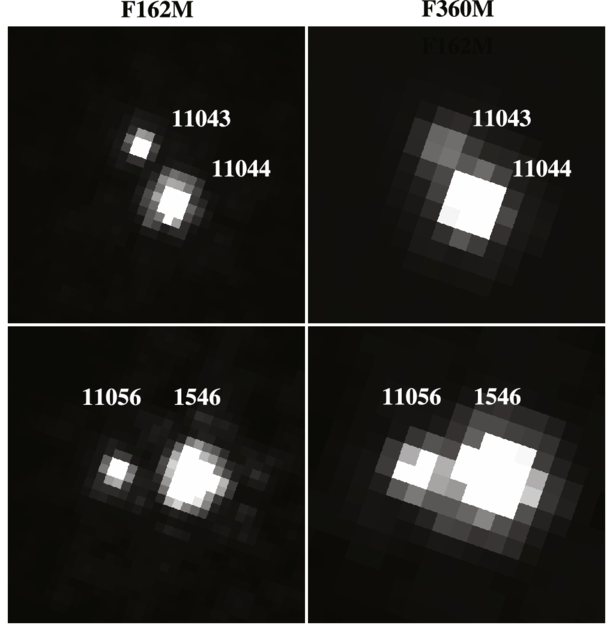
Two close pairs in IC 814.
A deeper JWST survey pushed the estimated masses even lower.
The survey identified 39 brown-dwarf candidates and obtained spectra for 15. Nine were classified as substellar members of the cluster, with the faintest having estimated masses of around 2 Jupiter masses. Two of these objects, with estimated masses of about 2 and 10 Jupiter masses, show substantial infrared excesses indicating circumstellar discs.
That is an important observation.
A disc around an isolated planetary-mass object means there is material surrounding the object that could potentially participate in the formation of smaller bodies.
In other words, a body that is not orbiting a star may itself possess something resembling a miniature planetary system in the making.
This does not prove that planets are forming around these objects. The infrared excess tells us that warm material is present in a disc; it does not by itself establish that moons or planets have already assembled. But it demonstrates that the raw ingredients and environment for planet formation can exist around objects that are barely more massive than Jupiter.
That complicates the usual picture in which planets are secondary products of star formation.
Some planetary systems may have no star at their centre at all.
A new atmospheric class
The IC 348 objects are interesting for another reason.
JWST’s Near-Infrared Spectrograph detected a broad absorption feature around 3.4 micrometres in many of the coolest objects. The feature has been associated with an unidentified aliphatic hydrocarbon and resembles chemistry observed in parts of the Solar System, including Saturn and Titan.
The feature becomes stronger in the fainter, presumably cooler objects.
That led researchers to propose a new spectral class, ‘H’, for these extremely cool young substellar objects. The proposed classification is based on the presence of the 3.4-micrometre hydrocarbon feature rather than simply their mass.
This is a useful reminder that classification in astronomy often follows what can actually be measured.
Spectral classes tell us about observable atmospheric physics. Mass classifications tell us about gravity and evolution. Formation classifications attempt to reconstruct history.
Those three systems do not necessarily produce the same answer.
The JuMBO problem
If the IC 348 objects challenge the lower boundary of the brown-dwarf population, the Jupiter Mass Binary Objects, or JuMBOs, challenge the architecture of planetary systems themselves.
In 2023, JWST observations of the Trapezium Cluster in the Orion Nebula identified roughly 540 planetary-mass candidates, with estimated masses extending down to about 0.6 Jupiter masses. The surprising result was that roughly 9 per cent appeared to exist in wide binary or multiple configurations. Around 90 objects were associated with these paired or multiple systems in the original sample.
These are not planets orbiting a star. The paired objects appear to orbit one another while the system as a whole moves freely through the cluster.
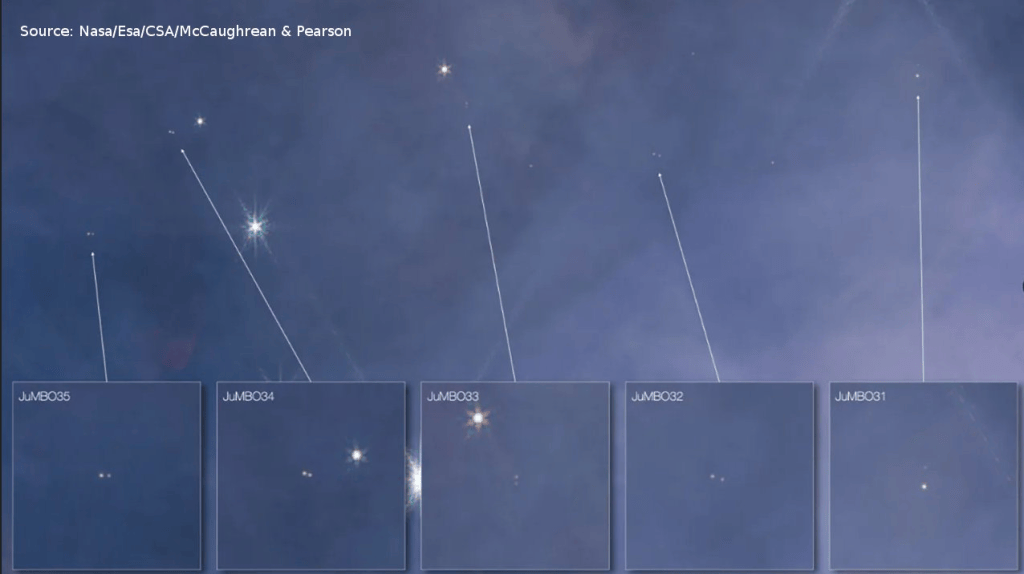
JuMBOs in the Trapezium Cluster.
Some of the pairs are separated by tens to hundreds of astronomical units. That is extraordinarily wide for two objects with such small masses. Their mutual gravitational binding is weak, leaving them vulnerable to disruption by passing stars and other objects.
This is the part that makes JuMBOs so interesting. A single free-floating planetary-mass object can be produced in several ways. It could have formed like a very small star through gravitational collapse. It could have formed in a planetary disc and later been ejected. It could also have been stripped from a planetary system during the chaotic early evolution of a star cluster.
Producing two such objects and leaving them gravitationally bound is harder. The pair has to lose enough energy to become bound without being separated by subsequent encounters. At wide separations, the binding energy is small. That creates a serious test for formation models.
How do two rogue planets stay together?
One possibility is that JuMBOs formed together. A sufficiently dense fragment of a collapsing molecular cloud could, in principle, split into two low-mass objects. Another possibility is fragmentation within a disc or some other starless substellar environment.
These mechanisms essentially treat JuMBOs as miniature binary stars.
The problem is that pushing conventional fragmentation physics down to masses of less than a few Jupiter masses and separations of hundreds of astronomical units is not straightforward.
Another possibility reverses the sequence. The two bodies may originally have been planets orbiting the same star.
A close encounter with another star can disturb a planetary system. Numerical simulations show that under favourable geometries, two giant planets can be ejected together while remaining gravitationally bound to each other. The resulting binary can emerge with a semi-major axis roughly three times the planets’ original separation and with unusually high, or ‘superthermal’, eccentricities.
This mechanism has an attractive feature: planetary systems already provide a natural way to make two objects of planetary mass.
The difficulty is survival.
The Orion Nebula is a crowded environment. A loosely bound pair travelling through such a cluster can be disrupted by subsequent stellar encounters. Any model that produces JuMBOs must therefore explain not only how the pairs form but how enough of them survive long enough to be observed.
That is why the 9 per cent figure is so important. It is not simply a count of strange objects. It places a quantitative constraint on models of star and planet formation.
A planetary system with no star
There are even more extreme examples. 2MASS J0249−0557 is a bound system consisting entirely of substellar objects. At its centre is a close brown-dwarf binary. The two components have estimated masses of roughly 48 and 44 Jupiter masses and are separated by only about 2.17 astronomical units.
Far away, at approximately 1,950 astronomical units, is an object with a mass of about 11.6 Jupiter masses. There is no conventional hydrogen-burning star at the centre.
The outer object is therefore a planetary-mass companion to a pair of brown dwarfs, in a system that can reasonably be described as starless in the sense relevant to stellar classification.
Its architecture is difficult to fit into everyday language.
The central pair behaves like a binary. The outer object behaves dynamically like a circumbinary planet. Yet the central objects are not stars. The entire system sits in the young Beta Pictoris moving group, allowing astronomers to study objects of similar age that may have formed through different pathways.
This is exactly the sort of system in which ‘planet’, ‘brown dwarf’ and ‘binary’ defy the tendency of scientists to lob everything into mutually exclusive buckets.
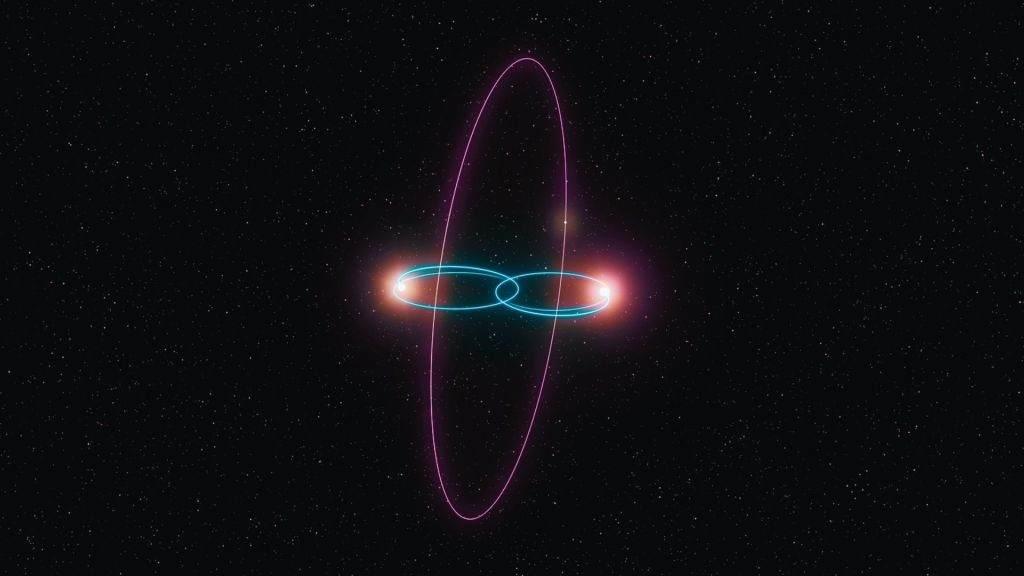
A circumbinary world in polar orbit
Another system pushes the architecture of a star system itself into unfamiliar territory. 2M1510 contains an eclipsing pair of brown dwarfs. Observations have provided evidence for a planetary-mass companion orbiting both objects. The remarkable feature is its orbital orientation.
Instead of following roughly the same plane as the brown-dwarf binary, the planet appears to move in a polar orbit, close to perpendicular to the binary’s orbital plane.
Circumbinary planets are already dynamically complicated because the gravitational field of the central pair changes as the two objects orbit one another. A polar configuration adds another layer of three-dimensional dynamics.
The system also contains a distant tertiary brown dwarf about 250 astronomical units away, making the overall architecture a hierarchy of substellar objects rather than a familiar star-and-planets system.
Hydrodynamical modelling suggests that misaligned material around the central brown-dwarf binary can evolve towards a polar orientation under the right conditions. That makes polar discs and polar planets more than mathematical curiosities: they can emerge naturally from the dynamics of a misaligned system.
The result is a planetary architecture in which even the orbital plane refuses to follow the conventional rules.
The Trojan boundary
There is another way to build an unusual planetary system without making one body a satellite of another. Two planetary-mass objects can share the same orbit around a much more massive central body.
This is a 1:1 mean-motion resonance. The most familiar Solar System examples are the Trojan asteroids that occupy regions around Jupiter’s L4 and L5 Lagrangian points. The important distinction is that the two objects do not orbit one another as a conventional binary. They share the same orbital period around the central body.
L4 and L5 are locations 60 degrees ahead of and behind the secondary body in its orbit. In a simplified three-body system, objects near these points can remain trapped in librating or ‘tadpole’ orbits rather than simply drifting away.
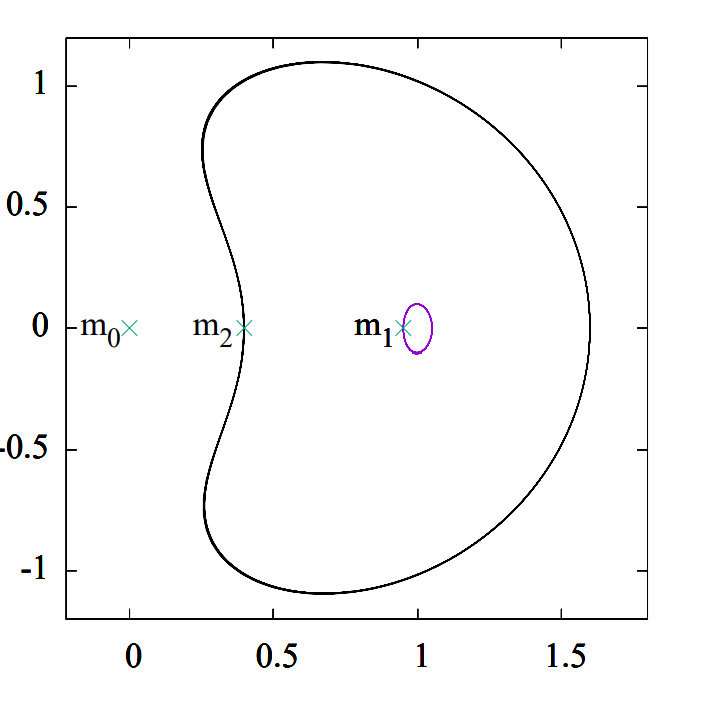
There is nothing preventing exoplanets from occupying the L4 and L5 Lagrange points around a brown dwarf, or each other.
For planetary-mass bodies, however, the masses matter. The classical Gascheau stability criterion shows that, for nearly circular configurations, the combined mass of the two co-orbiting bodies must remain below roughly 3.7 per cent of the mass of the dominant central body for the L4/L5 configuration to remain linearly stable.
Put simply, the star has to dominate the system strongly enough that the two planets do not destabilise the triangular configuration. This creates a fascinating boundary.
If two bodies are very unequal in mass, the smaller can look like a conventional Trojan. If their masses become more comparable, the system starts approaching something more like a binary planetary configuration. The distinction is then not just about what the objects are but about how their mutual gravity shapes the orbit.
Looking for exotrojans
Astronomers have begun searching for these configurations in real planetary systems.
The TROY project is one such effort. Rather than simply looking for another planet on a different orbit, it searches for objects sharing an orbit with a known planet.
One technique is the alpha test, which compares the timing of a planet’s transit measured through different observables. A sufficiently massive co-orbital companion can shift the system’s effective centre of mass and introduce measurable timing offsets. The technique is therefore sensitive to the mass imbalance between co-orbital bodies.
So far, the lack of an unambiguous exoplanetary Trojan remains a puzzle. Co-orbital systems occur naturally in planetary formation simulations and are common in our own Solar System in the form of smaller bodies. Yet a clear pair of planetary-mass co-orbitals has proved much harder to establish observationally.
That absence is scientifically useful.
If planetary-mass Trojans are genuinely rare, formation and migration models need to explain why. If they are common but difficult to detect, future observations could reveal an entirely new class of planetary architecture.
Nomenclature is not the real problem
The deeper lesson from these systems is that nature does not appear to care about the buckets humans invented for it.
‘Planet’ describes one combination of mass, location and dynamics. ‘Brown dwarf’ describes another, often with formation and nuclear-burning history mixed into the definition. ‘Moon’ describes a hierarchical relationship. ‘Binary’ describes mutual orbital dynamics. None of these words captures every relevant physical property at once.
A 2-Jupiter-mass object in a young cluster can resemble a miniature brown dwarf. A similarly massive object orbiting a star can be classified as a planet. A planetary-mass body orbiting a brown dwarf can be an exoplanet under the current working definition. Two planetary-mass objects can instead orbit each other. And two more can share the same orbit around a much larger body.
The objects do not become fundamentally different because we change their labels. What changes is the physical question we are asking.
If the question is how did it form?, the distinction between planet and brown dwarf may depend on whether the object emerged from a disc or collapsed directly from gas.
If the question is what does it orbit?, hierarchy becomes more important.
If the question is how does it move?, terms such as binary, circumbinary, co-orbital and satellite become more useful.
If the question is what is happening in its atmosphere?, mass may be less informative than temperature, chemistry and gravity.
That is why the newest observations are so valuable. JWST is finding objects at masses where conventional categories overlap. High-resolution spectroscopy is beginning to probe atmospheres that were previously inaccessible. Radial-velocity observations are reaching into the systems around brown dwarfs. Long-term astrometry can determine whether apparently isolated objects are actually bound companions.
The result will probably not be a new, perfectly ordered classification scheme.
It will be something more interesting: evidence that the transition from star to brown dwarf to planet is not a clean staircase but a complicated landscape.
The Universe contains worlds that can be born like stars, behave like planets, travel like rogue objects and orbit like moons.
Some have discs.
Some have companions.
Some may have moons of their own.
And some exist in systems where there is no star at all.
Astronomers are struggling because the universe is far richer than the buckets invented to understand it. Scientists have yet to embrace a Copernican view of the cosmos, and most of our science, institutions and science bodies remain Ptolemaic.
Image Credits:
2M1510 b: ESO/L Calçada
Close pairs in IC 814: KL Luhman and C Alves de Oliveira 2025 ApJL 986 L14
Trojan Exoplanets: arXiv:2402.15168v1 [astro-ph.EP]
Sources:
IAU working definition of exoplanet
Jupiter-mass companions of brown dwarfs
- https://arxiv.org/abs/astro-ph/0405628
- https://arxiv.org/abs/2303.16923
- https://arxiv.org/abs/2011.08986
Rogue planets with companions / binary planets
- https://iopscience.iop.org/article/10.3847/2041-8213/aa76df
- https://arxiv.org/abs/2310.01231
- https://arxiv.org/abs/2507.03679
JuMBOs and free-floating planetary-mass multiples
Circumbinary planets around brown-dwarf binaries
- https://www.science.org/doi/10.1126/sciadv.adu0627
- https://arxiv.org/abs/2001.07175
- https://arxiv.org/abs/2506.22747
- https://arxiv.org/abs/2510.14801

Leave a comment