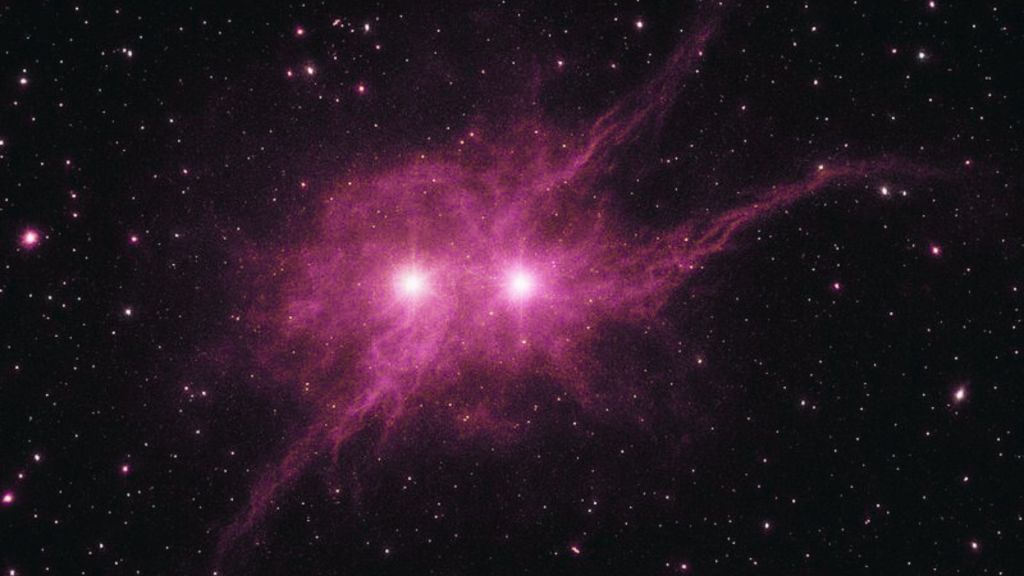
Two supermassive black holes can be active inside the same merging galaxy system. They are not yet a binary, but they may be on the long route towards becoming one. That makes dual active galactic nuclei, or dual AGNs, an unusually useful stage in the evolution of galaxies and black holes.
An active galactic nucleus is powered when gas loses angular momentum and falls towards a supermassive black hole, forming a hot accretion flow that can radiate across the electromagnetic spectrum. A dual AGN is a system in which two such black holes are accreting at the same time, generally within a merging pair of galaxies.
The distinction from a binary matters. Dual AGNs can be separated by anything from tens of kiloparsecs to less than a kiloparsec. A bound supermassive black-hole binary occupies a much smaller scale, typically tens of parsecs or below, where the two black holes are gravitationally bound to each other. The transition between these stages is one of the least directly observed parts of black-hole evolution.
Mergers feed both black holes
The basic mechanism begins with a galaxy merger. In the standard ΛCDM picture, galaxies grow hierarchically through mergers and accretion. Massive galaxies almost invariably contain central supermassive black holes, so when two galaxies merge, their black holes are brought into the same gravitational system.
The merger does not simply make the two black holes fall towards each other. The galaxies contain stars, dark matter and gas, all of which respond differently to the changing gravitational potential. Dynamical friction transfers orbital energy and angular momentum from each black hole to its surroundings, causing the black holes to lose orbital energy and spiral inward.
Gas behaves differently, and like a fluid in space. Gravitational torques generated during the interaction can remove angular momentum from gas and drive it towards the central regions. The result can be a compact, turbulent reservoir of molecular gas capable of feeding one or both black holes.
This is where the word simultaneous becomes important. A merger does not automatically switch on both AGNs at the same time.
Hydrodynamical simulations show that dual activity is intermittent. Gas distributions are asymmetric, one nucleus may lose its fuel more efficiently than the other, and individual accretion episodes are short compared with the overall merger. Simulations find that dual activity is particularly enhanced during late passages, with typical observable dual-AGN timescales of roughly 20–70 million years for minor mergers and 100–160 million years for major mergers under particular luminosity criteria.
That helps explain why confirmed dual AGNs remain uncommon. The two black holes have to be close enough to be interacting, both have to be accreting above the observational threshold, and astronomers have to catch them during the relatively brief period when both are visible.
The resolution problem
At cosmological distances, two nuclei separated by hundreds of parsecs can appear as a single unresolved source. Dust makes the problem worse. Galaxy mergers produce precisely the environments most likely to obscure the nuclei: dense molecular clouds, compact star-forming regions and large columns of gas.
That is why dual AGN searches increasingly rely on several wavelengths rather than a single diagnostic.
Radio interferometry is valuable because radio emission is largely unaffected by dust. Very high-resolution observations can isolate compact radio cores associated with AGN jets and distinguish them from more diffuse radio emission produced by star formation. Arrays such as the VLA and, at different scales and frequencies, VLBA, LOFAR and future SKA facilities can therefore provide an important test of whether two compact engines exist.
X-rays provide another powerful route. Accretion close to a black hole produces energetic X-rays, while hard X-rays are less susceptible to absorption than optical light. Chandra’s angular resolution is particularly useful for separating close sources. Spectroscopy adds another diagnostic: fluorescent Fe Kα emission around 6.4 keV can reveal heavily obscured accreting nuclei.
Even then, overlapping point-spread functions can make two sources look like one. Statistical methods such as BAYMAX can test whether the observed X-ray photons are better explained by one point source or two unresolved sources.
Infrared observations attack the problem from another direction. Near-infrared wavelengths penetrate dust more effectively than optical light, while adaptive optics on large ground-based telescopes can resolve nuclear structures on scales of tens to hundreds of parsecs in nearby systems. JWST adds both high-resolution infrared imaging and spectroscopy, allowing astronomers to examine obscured nuclei at much larger cosmological distances.
Optical spectroscopy remains useful, but one famous shortcut has caused considerable confusion.
The double-peak trap
A spectrum showing two peaks in the [O III] λ5007 emission line can look like an obvious signature of two black holes. It is not.
Two active nuclei can produce two narrow-line regions moving at different velocities. But a single AGN can also generate two peaks when its jets accelerate surrounding gas, when a biconical outflow is viewed from an appropriate angle, or when ionised gas is rotating in a disc.
In one detailed study of 42 double-peaked [O III] AGNs, only two systems had line splitting driven by the orbital motion of merging nuclei. Roughly 98 per cent of the sample’s double peaks were instead attributed to gas kinematics.
The lesson is straightforward: a double-peaked spectrum is a candidate selection method, not a confirmation of a dual AGN. Spatially resolved spectroscopy and independent evidence from radio, infrared or X-ray observations are needed.
Modern surveys add still more tools. Gaia astrometry can detect tiny shifts in an unresolved source’s photocentre caused by independently varying components. Time-domain models can test whether observed variability is better explained by one accretion flow or two. Machine-learning systems can help search enormous imaging surveys for unusual nuclear structures and eliminate foreground stars and chance alignments.
The strongest cases therefore tend to be multi-wavelength cases.
Inside the merger
The surroundings of a dual AGN are often as interesting as the black holes themselves.
A merging host can show tidal tails, shells, distorted discs, stellar bridges and clumpy regions of intense star formation. These structures are not merely visual evidence of a merger. They record the gravitational processes redistributing matter and angular momentum through the system.
The nuclei can also be deeply obscured. X-ray studies of optically selected dual-AGN samples have found about 80 per cent of confirmed AGNs to be Compton-thin, with hydrogen column densities above cm, while about 16 per cent are Compton-thick, with cm. Obscuration tends to increase as the nuclear separation decreases.
This is physically significant. The same merger-driven inflows that feed the black holes can pile enormous quantities of gas around them.
That gas can also form stars. The merger therefore links three processes that are often studied separately: black-hole accretion, star formation and galactic feedback.
Two active nuclei can inject energy into their environment through radiation, winds and jets. These processes can heat or expel gas, alter star formation and influence the circumgalactic medium. At high redshift, the effect can extend well beyond the host galaxy.
A striking example comes from a dual AGN at , observed with JWST and VLT/MUSE. The two nuclei are separated by about 10.4 proper kiloparsecs and are embedded in a Lyα nebula extending more than 22 kpc. The system lies in an overdense region that may represent a protocluster or filamentary node.
This is important because it pushes dual-AGN activity into an era when the Universe was less than a billion years old.
The road to gravitational waves
The ultimate reason dual AGNs matter is what happens after the visible merger.
As the galaxies combine, the two black holes should continue losing orbital energy. Dynamical friction dominates at relatively large separations. At smaller scales, interactions with stars and gas become increasingly important. Eventually, the black holes can form a gravitationally bound binary.
But getting from a bound binary separated by parsecs to a merger is not trivial.
This is the final parsec problem. Once the binary becomes hard, the mechanisms that remove its remaining orbital energy can become inefficient in an idealised, spherical stellar system. Stars can interact with the binary and carry away energy, while gas in a circumbinary disc can exert torques. Whether these processes always drive the black holes efficiently to coalescence remains an active research problem.
Dual AGNs provide an observational starting point for measuring that evolutionary sequence.
The final merger of two supermassive black holes should produce low-frequency gravitational waves. The nanohertz part of that spectrum is already being investigated with pulsar timing arrays, while future space-based observatories such as LISA will target higher frequencies from massive black-hole systems.
Dual AGNs are not themselves gravitational-wave sources in the same sense as the final coalescence. They are electromagnetic signposts of an earlier stage. Their abundance, separation distribution and lifetimes can therefore help estimate how many black-hole pairs ultimately reach the gravitational-wave regime.
Five systems worth watching
UGC 4211 is one of the clearest demonstrations of how far this evolution can be followed observationally. At , its two nuclei are separated by only about 230 pc. HST, VLT/MUSE, Keck and ALMA observations independently support the interpretation that both nuclei contain accreting SMBHs.
NGC 6240 is another classic late-stage merger. Its two heavily obscured active nuclei are separated by roughly 750 pc, making it an important laboratory for studying black-hole growth inside a gas-rich merger.
MCG-03-34-64 may probe an even more compact regime. Chandra observations reveal two spatially resolved Fe Kα peaks separated by about 125 pc, while VLA observations show corresponding radio peaks. The authors describe the system as a candidate dual AGN, rather than treating the interpretation as settled fact.
ESO 509-IG066 demonstrates another important feature of dual systems: they do not remain steadily active. Its two nuclei are separated by about 11 kpc. One nucleus declined in X-ray flux by a factor of ten between 2004 and 2011, with the evidence favouring a genuine decline in accretion rather than simple obscuration.
And the JWST system demonstrates that dual AGNs are not exclusively a phenomenon of the nearby Universe. Its large Lyα nebula and dense environment offer a glimpse of how black-hole pairs may have participated in early galaxy assembly.
The Census
The central problem in dual-AGN astronomy is no longer simply finding interesting examples. It is establishing a reliable population.
That requires large surveys with enough angular resolution to separate nuclei, enough sensitivity to detect obscured accretion and enough spectroscopy to distinguish black-hole activity from ordinary gas dynamics.
Euclid and the Vera C. Rubin Observatory will provide enormous imaging and time-domain datasets. JWST is already opening the high-redshift regime. The Extremely Large Telescope and advanced adaptive-optics systems will eventually resolve increasingly small nuclear structures. The SKA will add unprecedented radio sensitivity and resolution across large populations.
The result should be a much better map of the transition from galaxy merger to dual AGN to bound black-hole binary system to gravitational-wave source.
That sequence is theoretically plausible but observationally incomplete. Dual AGNs occupy the crucial middle ground: close enough for the merger to affect both black holes, yet separated enough that astronomers can sometimes still resolve them individually.
They are therefore more than two bright nuclei in a disturbed galaxy. They are snapshots of supermassive black holes caught in the process of becoming a single gravitational system.


Leave a comment