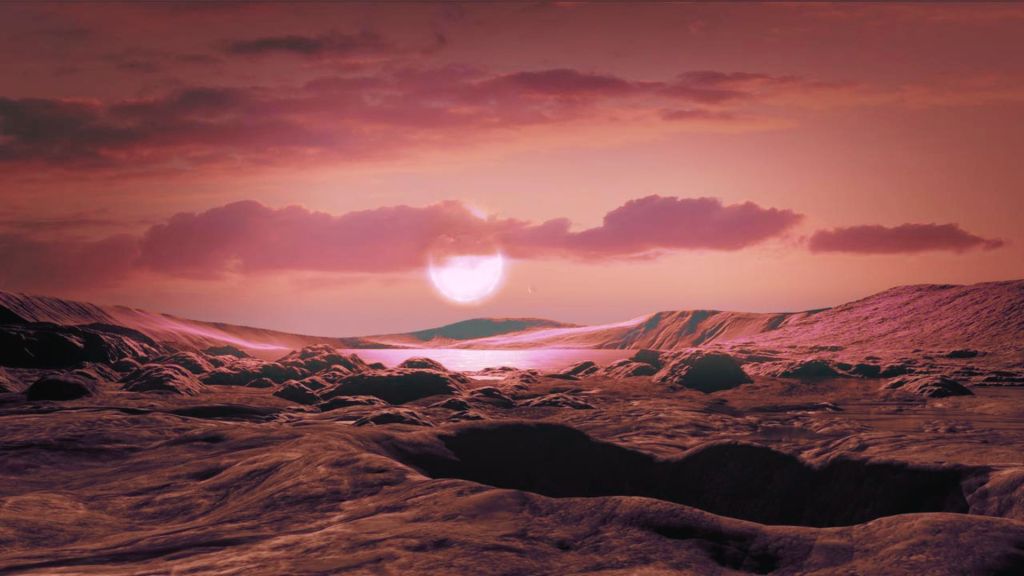
Our Sun is a yellow dwarf star, and is small as far as stars go. The larger stars are blue and white giants, that live fast and burn up all their nuclear fuel in a few million years. The smaller stars, yellow, orange and red dwarfs can burn for much longer. The Sun and the Earth have been around for 4.6 and 4.5 billion years. Simple life emerged within the first billion years after the Earth was assembled in the gas and dust leftover from the birth of the Sun. The unicellular life transitioned to complex, multicellular life only 500 million years ago. The clock is ticking for these carbon-based lifeforms, as the Sun is expected to grow warmer over the next billion years, drying out the Earth and potentially stripping its atmosphere. The Doom of Earthlings is closer on the horizon than the eventual explosive death of the Sun in about five billion years, when it will swell up to a red giant, swallowing all the inner worlds, before going supernova. While a red giant is hostile to life on nearby terrestrial worlds, a red dwarf on the other hand, may just give life its best possible chance. Red dwarf or M dwarf stars are the smallest and most common stars in the universe, and can burn persistently for billions of years.
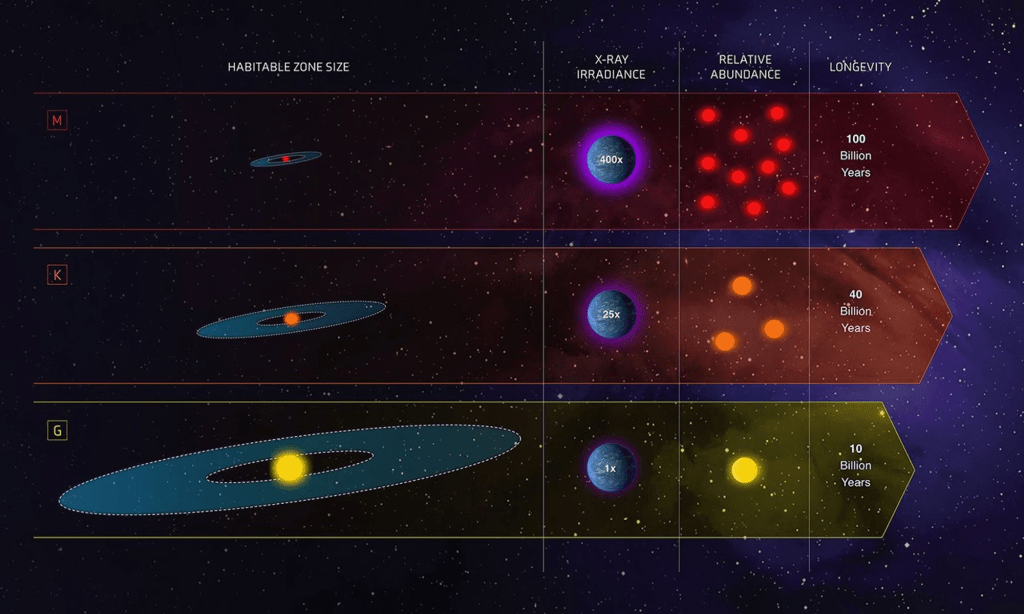
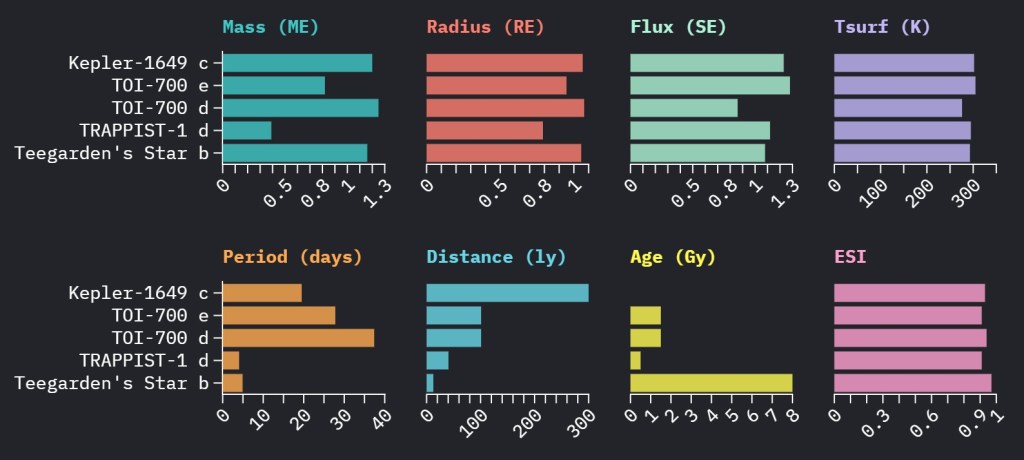
Life is known on only one Earth-sized planet in orbit around a yellow dwarf star within the habitable zone. It stands to reason that life may potentially be discovered on Earth-sized planets in orbits around other stars. We do not know of a single terrestrial world, around the same size as Earth with habitable surface conditions around a G dwarf or yellow star. We do know of a couple of Super Earths that are on the edge of habitability around a yellow star, that offer a larger surface area for life to thrive, along with a stronger gravity and an atmosphere that is likely to be thicker. We also know of a two Earth-sized habitable worlds in orbits around K dwarf or orange stars. Earth-sized worlds with habitable conditions are common around the smaller red dwarf stars though, which host the planets most like the Earth on multiple parameters. These are the worlds with an Earth Similarity Index (ESI) between 0.90 and 1, which would be a carbon copy of Earth.
The Terminator Line
These are the most habitable exoplanets known. As the red dwarf stars are smaller and cooler, the habitable zone is in a tight orbit. The years on these worlds are between four and 38 Earth days long. The exoplanets are in such tight orbits, that they tend to be tidally locked, the same way the Moon is to the Earth. These means that these worlds have permanent day and night sides, divided by a band of perpetual twilight that has been provided the very cool name of ‘The Terminator Line’.

These red dwarf stars are tempestuous, and frequently erupt in flares. The younger red dwarfs are more impulsive, with frequent stellar outbursts, but the older stars are calmer. Any complex life would have to find a way to shield itself from the extreme radiation. TRAPPIST-1 d has a low density, where the gravity could be a sixth, about the same as the Moon. The strength of the gravity would influence the geology and biology of the planet, and would be one of the significant factors influencing the thickness of the atmospheres.
Teegarden’s Star b
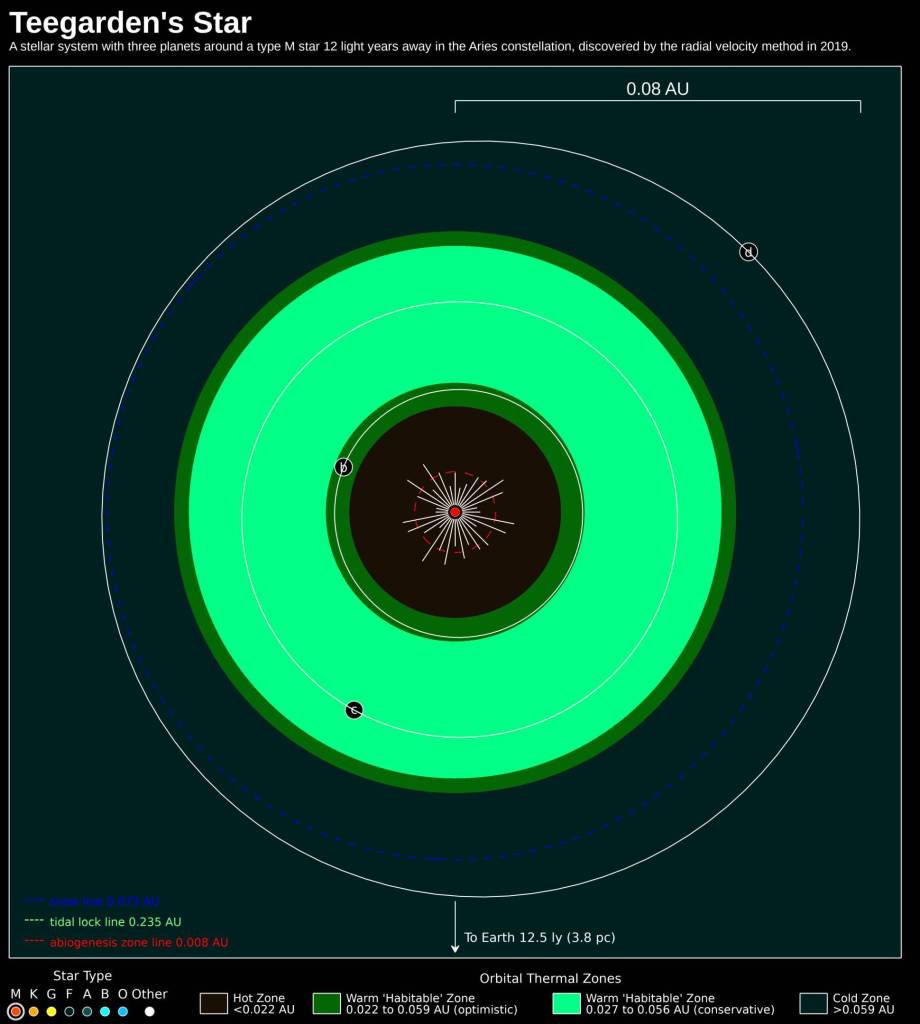
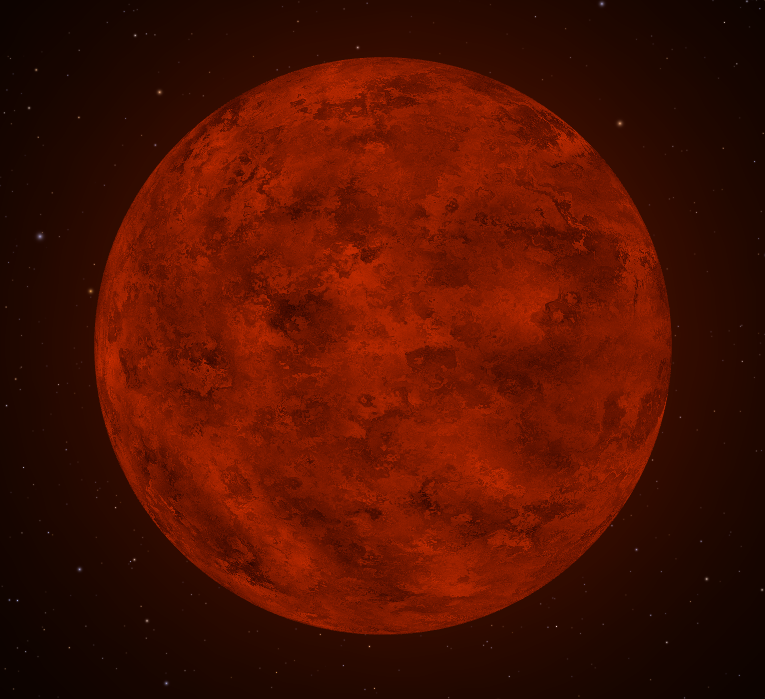
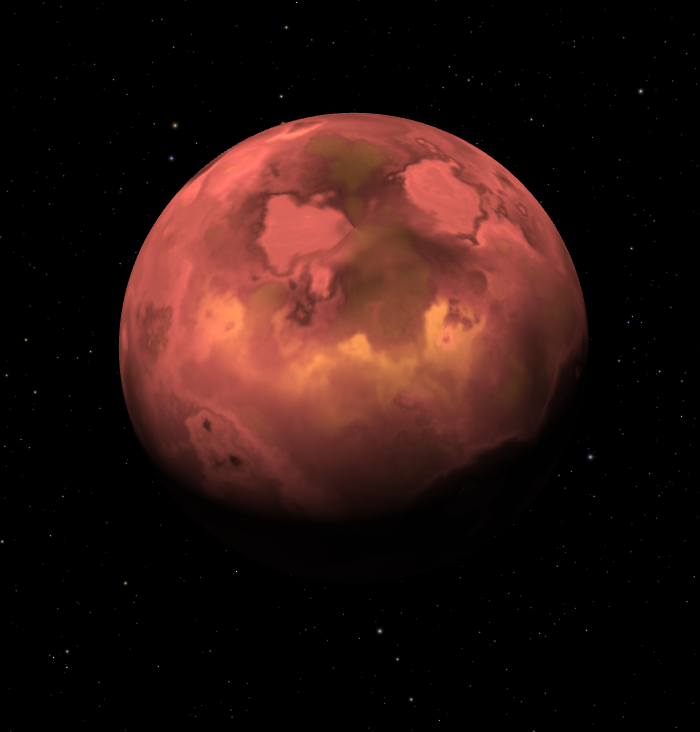
Teegarden’s Star b is the exoplanet most like the Earth. It is tidally locked to the host star, with a sharp temperature difference between the day and night sides. A thick atmosphere would moderate the extreme temperature gradients, and the terminator line would have a stable climate with moderate temperatures. Temperatures on the day side may be in the 20–50°C range, while it could reach -100°C on the night side, in the absence of atmospheric convection. It might be possible that such tidally-locked worlds host life in a belt along the terminator line, with the day sides being too hot and the night sides being too cold.
Teegarden’s Star
Teegarden’s Star b
Teegarden’s star is eight billion years old, and has a low luminosity as well as flare activity. If the planetary core is a sphere of molten metal, then a geomagnetic field would offer some protection to the planet from the flare activity and bombardment by X-rays and ultraviolet radiation. Life on the surface would have to be hardy to withstand the frequent flares from the host stars. The lifeforms would have to depend on chemosynthesis or infrared photosynthesis. Any vegetation on the surface would have black or purple pigments.
TOI-700 d, e
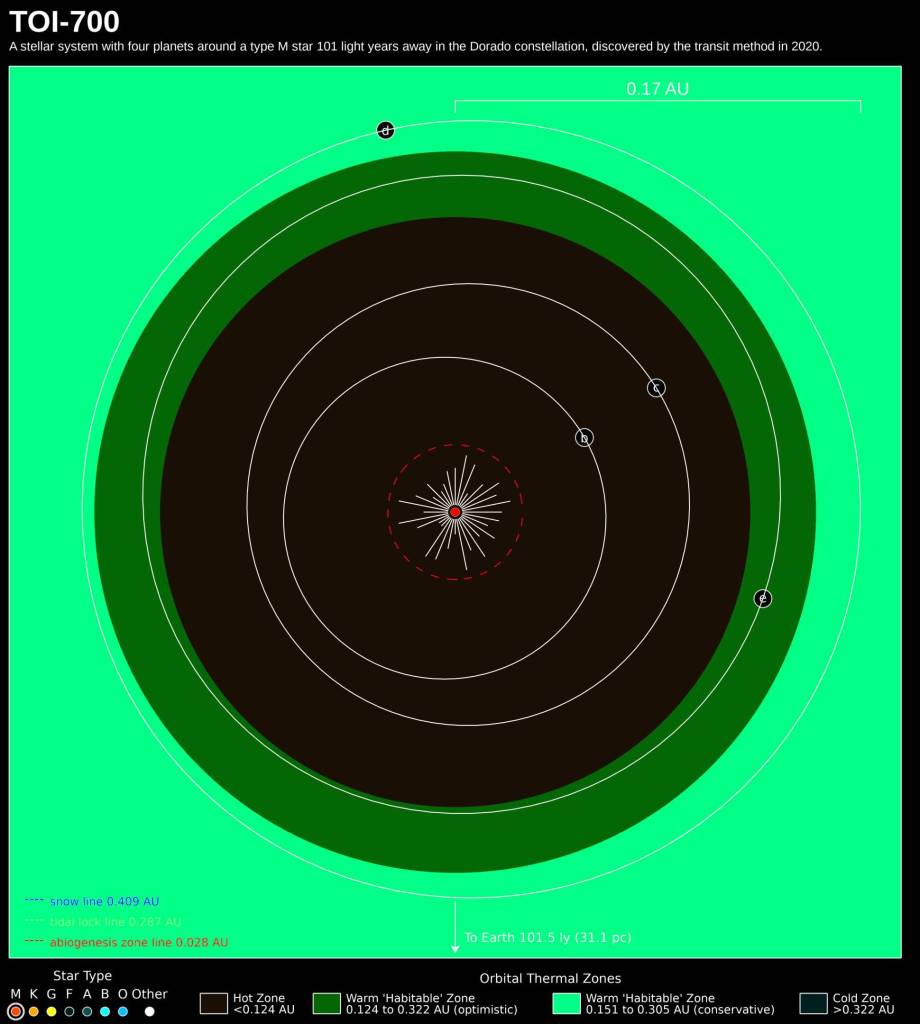
TOI-700 is a relatively quiet M dwarf star, with a pair of potentially habitable exoplanets in orbit around it. These worlds may not be tidally locked. The outer planet is in a wider orbit and is less likely to be tidally locked, potentially having a 20-30 hour day if rotating freely. A buildup of greenhouse gases such as carbon dioxide or methane could help these worlds maintain liquid water on the surface. On TOI-700 d, climate models predict a hotspot at the neverending noon, with winds creating habitable rings by transporting heat to the cooler regions.
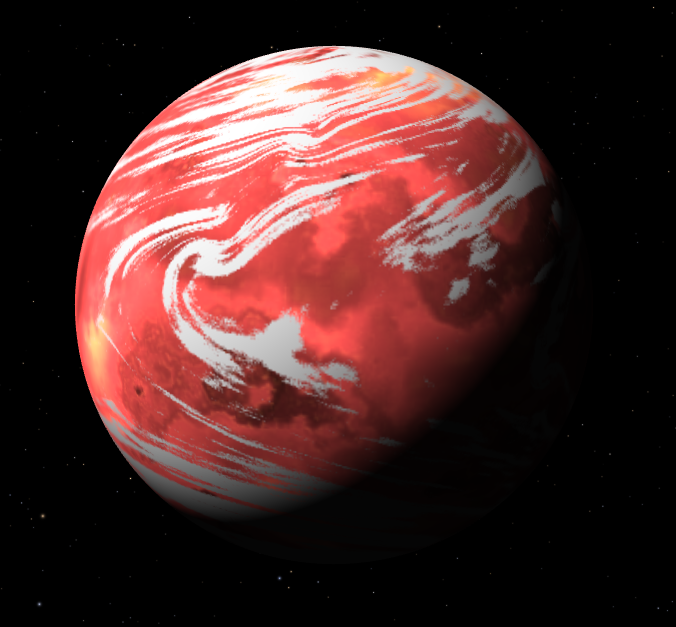
TOI 700 d or e
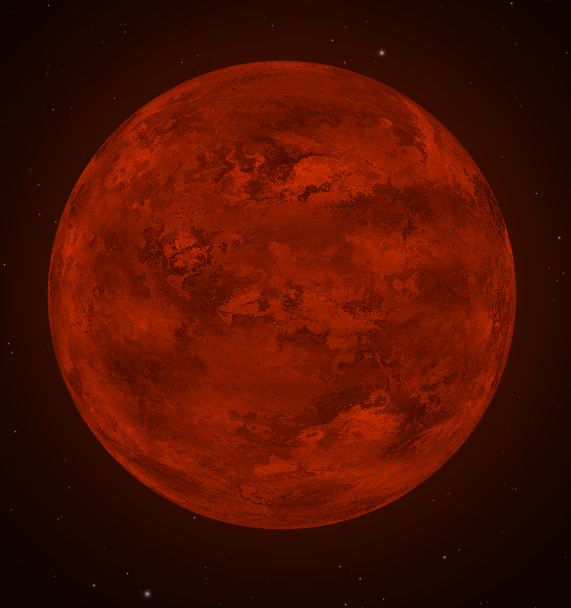
TOI 700
The red light from the host star would favour infrared photosynthesis. The vegetation could be dense and dark. TOI-700 e may host extremophiles in aquifers or oceans covered by ice, relying on geothermal energy, similar to the hypothesized ecosystems on the ice moons of the Solar System, Europa and Enceladus. The surface temperatures range between -10 and 30°C. TOI-700 d may also host marine ecosystems, at least in the temperate regions. This world is slightly warmer, with surface temperatures ranging between 0 and 40°C.
Kepler-1649 c
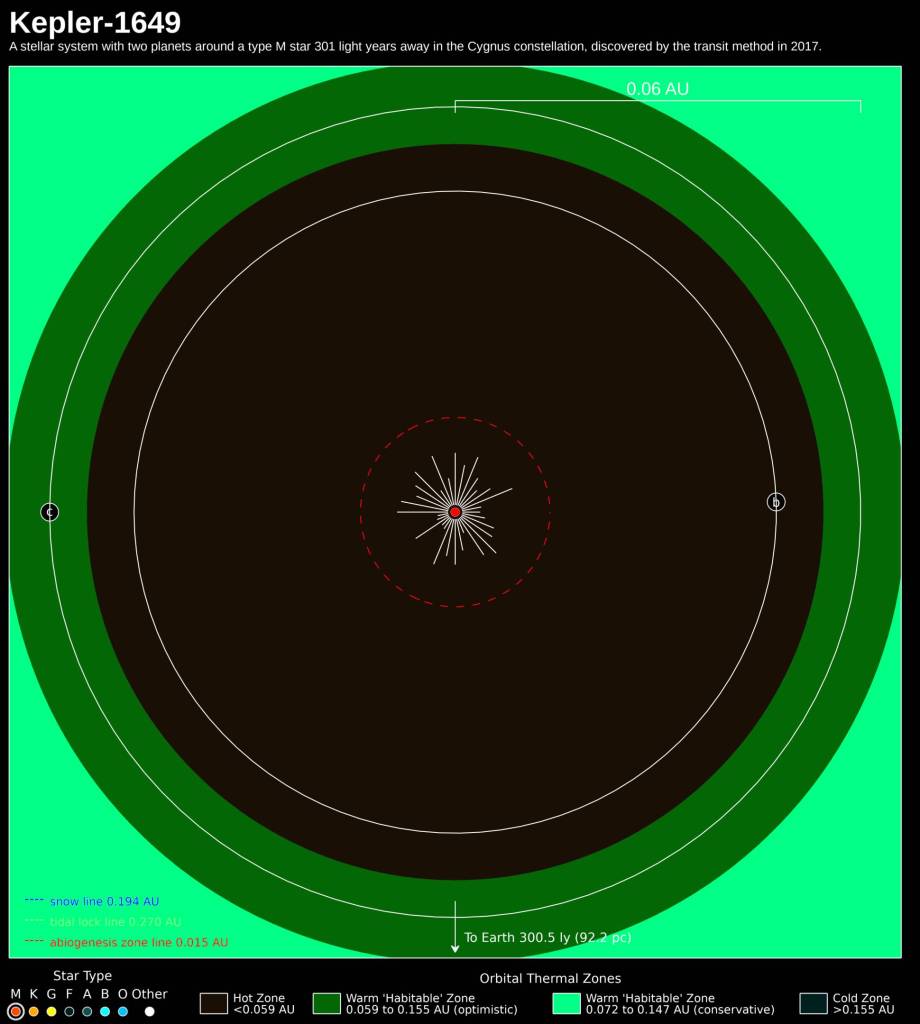
Kepler‑1649 c is a compelling candidate for habitability because it receives a similar amount of energy from its host star as Earth, a property known as insolation. The planet orbits close to the host star, completing a circuit within 20 days, which makes it a strong candidate for tidal locking. The dayside temperatures would reach 50°C while the nightside temperatures can drop to -150°C. The temperatures at the terminator line would be between 0 and 20°C, perfect for water, and life.
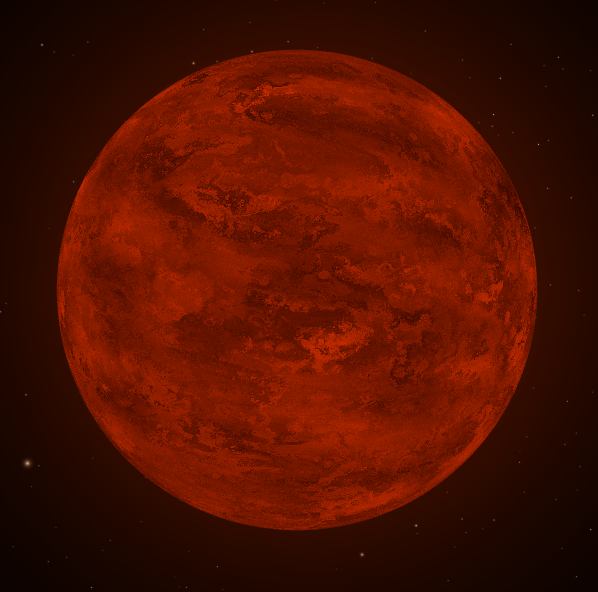
Kepler 1649
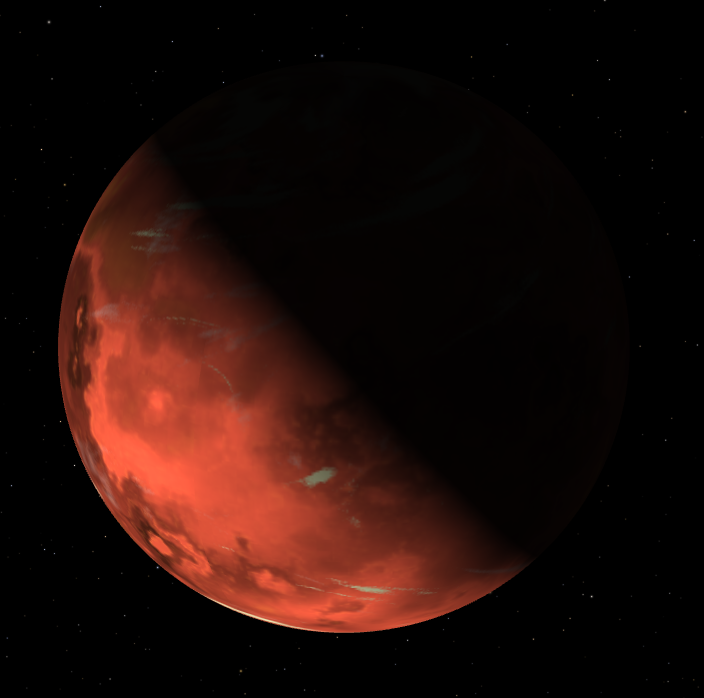
Kepler 1649 c
Hardy lichen could eke out a living on the surface. The planet has to help life survive the stellar activity. The ultraviolet threat is somewhat reduced compared to active red dwarfs. Still, the star is volatile enough to frequently sterilize the surface, unless an ozone layer offers protection. Subsurface or underwater life sustained by geothermal activity could be protected from flare damage. Biofluids or biofilm may be able to offer additional ultraviolet protection. A weak gravity eases movement, but also allows the atmosphere to escape more easily.
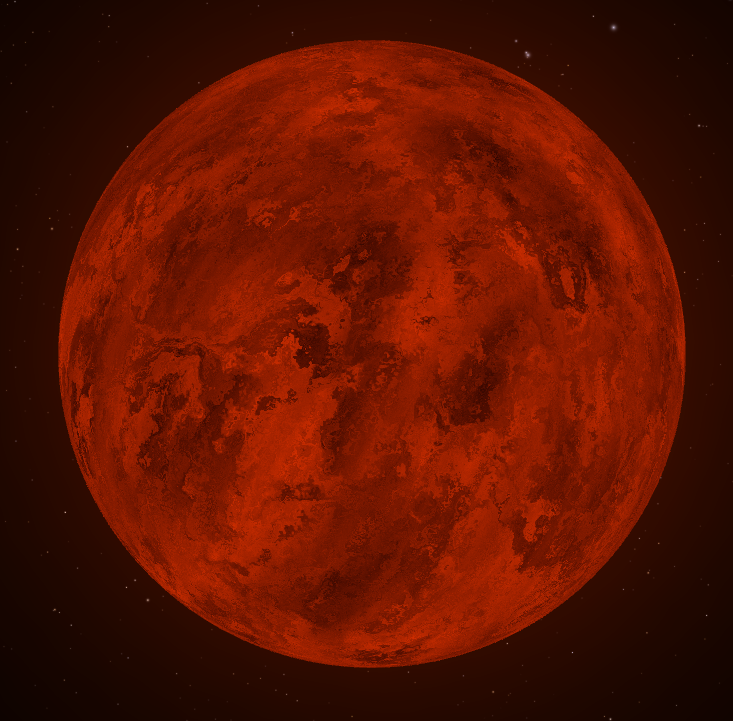
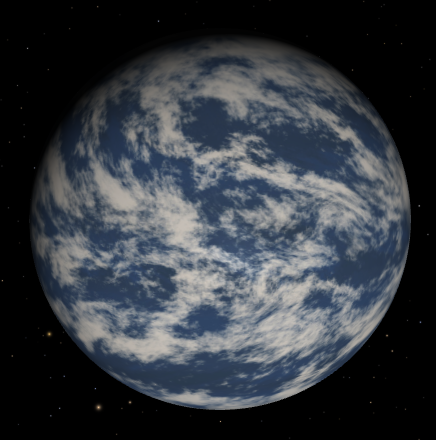
TRAPPIST-1 d
One of seven worlds all orbiting in lockstep around the ultracool red dwarf star, TRAPPIST-1 d has a year that lasts a little over four Earth days. The world is cooked and exposed to intense flares, and there is no chance of any life living on the day side. If the world has a thin atmosphere, which is more likely, the surface would be desiccated, deprived of water. A thick atmosphere or an global liquid water ocean could stabilize the temperatures. The dayside temperatures can reach as high as 40–70°C, while the nightside temperatures can plunge even below -200°C.
TRAPPIST-1
TRAPPIST-1 d
Climate models indicate that a dense atmosphere could facilitate a temperate zone along the terminator line, where microbial life could thrive. The nightside is a hemisphere of frigid wastes. A subsurface ecosystem in deep caves might depend on chemosynthesis instead of photosynthesis. The intense radiation would favour microbial over complex life. The earliest, most primitive life forms on Earth could go dormant for extended periods of time when conditions were unfavourable. Such a strategy of cryptobiotic life in refugia might be necessary on TRAPPIST-1 d, to survive the bombardment by the host star.
The Red Edge
Across the universe, life has to struggle. These are harsh and alien environments, and despite the similarity to the Earth, sapiens cannot walk on these extraterrestrial environments. The residents on these worlds are rich in the most important resource the universe has to offer – time. These dim red suns can live for a 100 billion years, or longer, providing plenty of time for life to evolve and thrive. Despite their dramatic temperature gradients and intense stellar flares, the conditions for life are naturally favourable along the transition zones. Considering how incredibly common these red dwarf stars are, most life in the universe may be along the terminator lines.
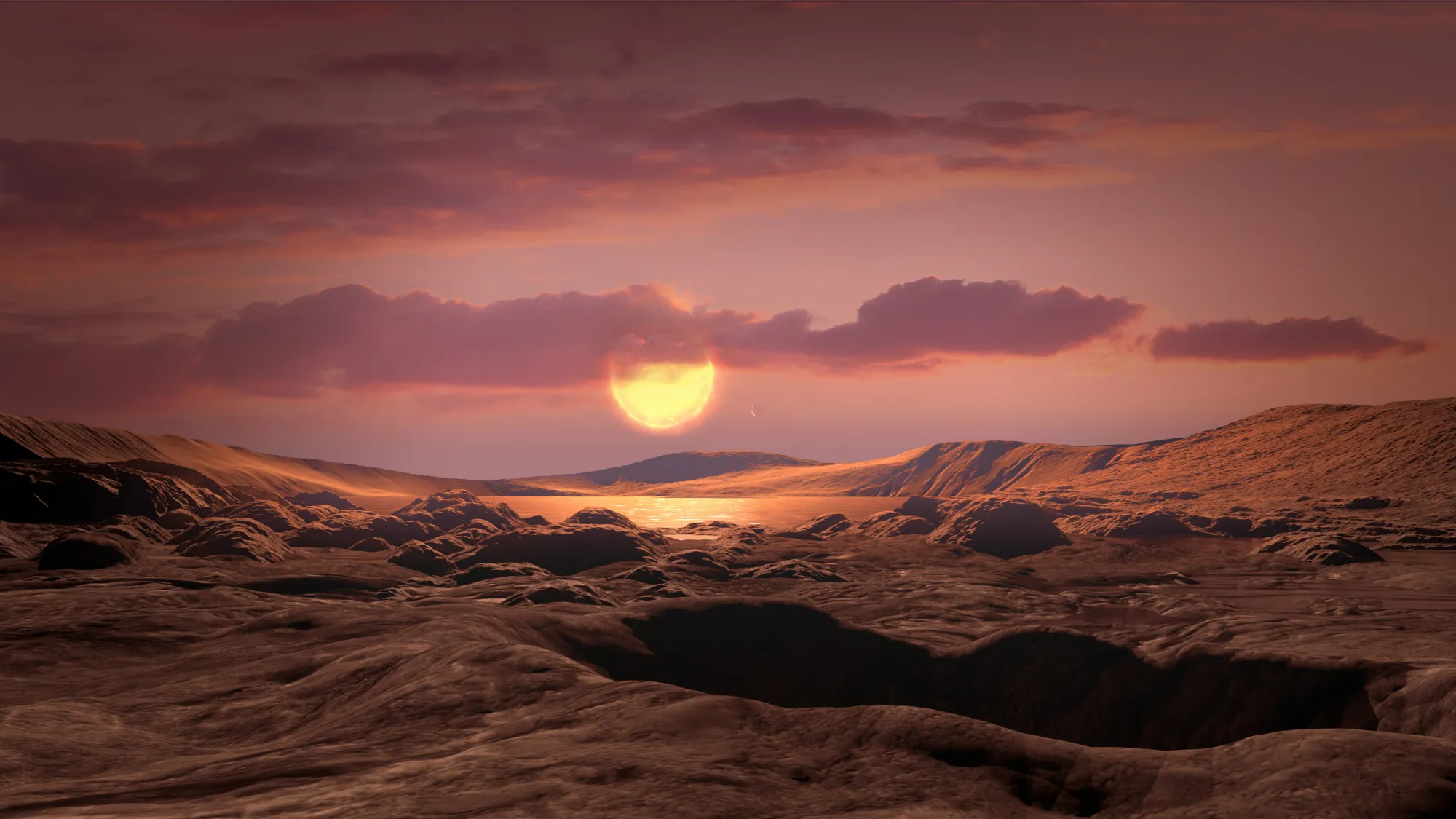
Image Credits:
Types of StarS: NASA, ESA and Z. Levy (STScI)
Orbital Plots: PHL @ UPR Arecibo.
Kepler 1649 c: NASA/Ames Research Center/Daniel Rutter
Exoplanets: NASA Eyes on Exoplanets

Leave a comment