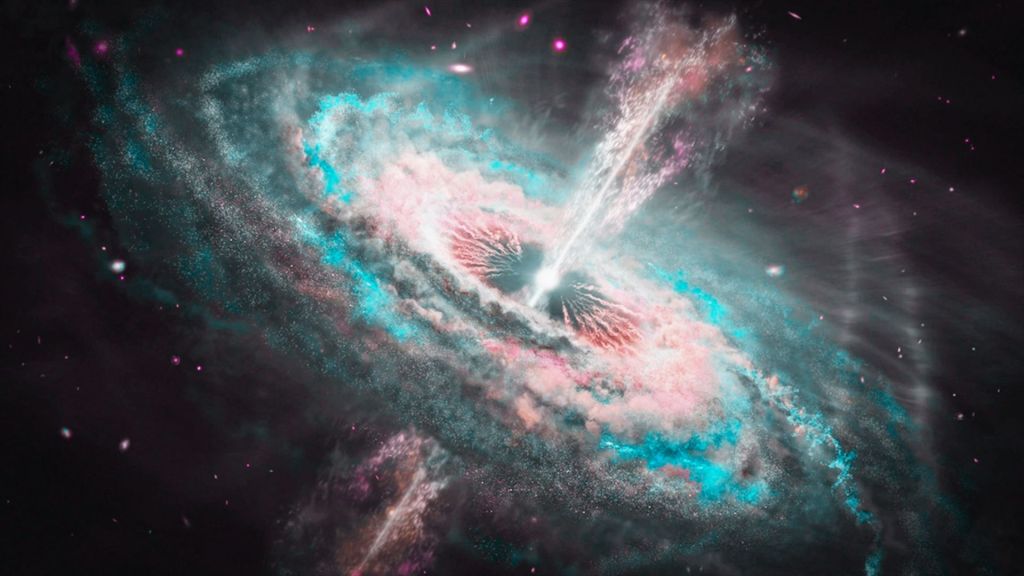
Supermassive black holes occupy the cores of massive, evolved galaxies such as the Milky Way. These supermassive black holes evolve in tandem with the surrounding galaxies. Actively feeding supermassive black holes are surrounded by accretion disks of infalling gas and dust. The tortured material glows in wavelengths across the electromagnetic spectrum, which along with magnetic fields drive hot, ionised gas outwards in the form of black hole winds. These winds can be powerful enough to blast away the gas and dust across the entire galaxy, the raw material from which new stars are born.
Researchers have discovered an unprecedented number of exceptionally fast and powerful galactic winds streaming from quasars a mere one billion years after the Big Bang, when the universe was less than five per cent of its present age. Quasars are actively feeding black holes at incredible distances, from the infancy of the universe, that appear as point sources, or quasi-stellar objects. Quasars are driven by supermassive black holes, and may explain a long-standing cosmological mystery.
The early universe is full of galaxies that formed within two billion years of the Big Bang. A large number of young galaxies stopped forming stars early on. Scientists did not expect such massive galaxies that formed so soon after the Big Bang to stop forming stars so rapidly as well. The new research suggests that these galaxies stopped forming stars as they were quenched by the blowtorch action of the quasars, that stripped the galaxies of their gas reservoirs, shutting down the process of star formation.
Quenching Star Formation
Astronomers used the James Webb Space Telescope to observe 27 quasars that formed within a billion years of the Big Bang. Six of them had exceptionally fast galaxy-scale winds, even for quasars. The survey revealed that quasars with extremely fast outflows were at least four times more common at higher redshifts than at lower redshifts. The average outflow rate of kinetic energy in these early quasars were about a 100 times higher than quasars with a lower redshift.
The researchers believe that such ‘super quasars’ can explain the abundance of galaxies that stopped forming stars in the early universe. The team has estimated that the extreme outflows from quasars are very short lived, and they go dormant in about 100 million years, leaving behind a quiescent galaxy. The strength and speed of the outflows has led scientists to believe that the outflows reach the intergalactic medium, the space between galaxies, indicating that the quasars influence the environment surrounding the galaxy as well.
Image Credit: NASA, ESA and J Olmsted (STScI).
Paper Source: Extreme galaxy-scale outflows are frequent among luminous early quasars

Leave a comment