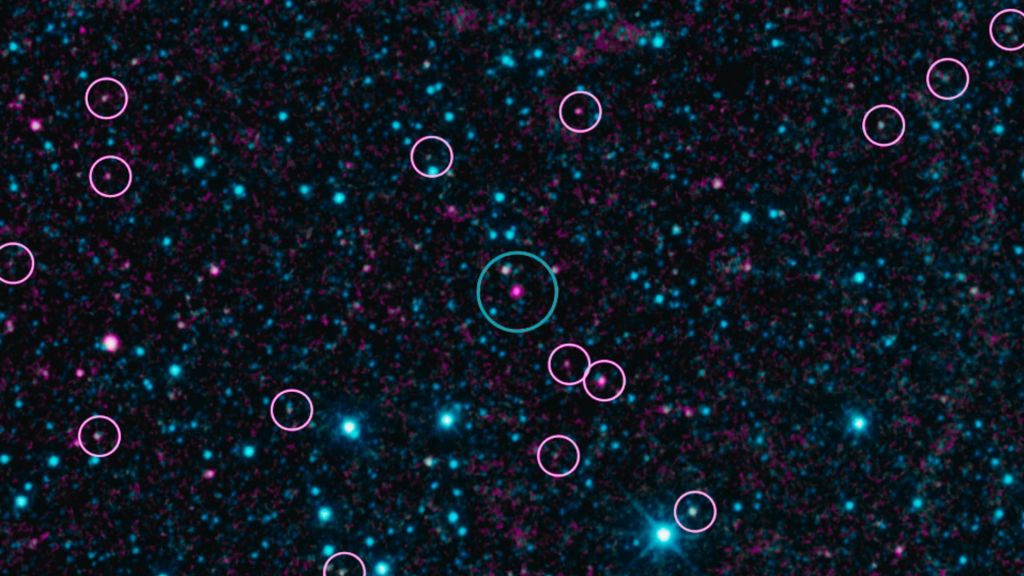
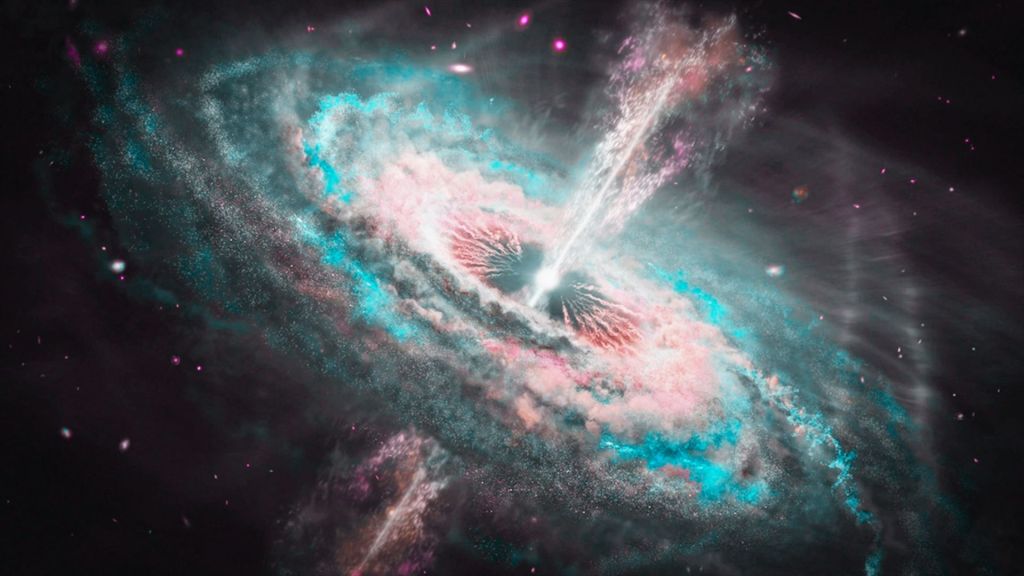
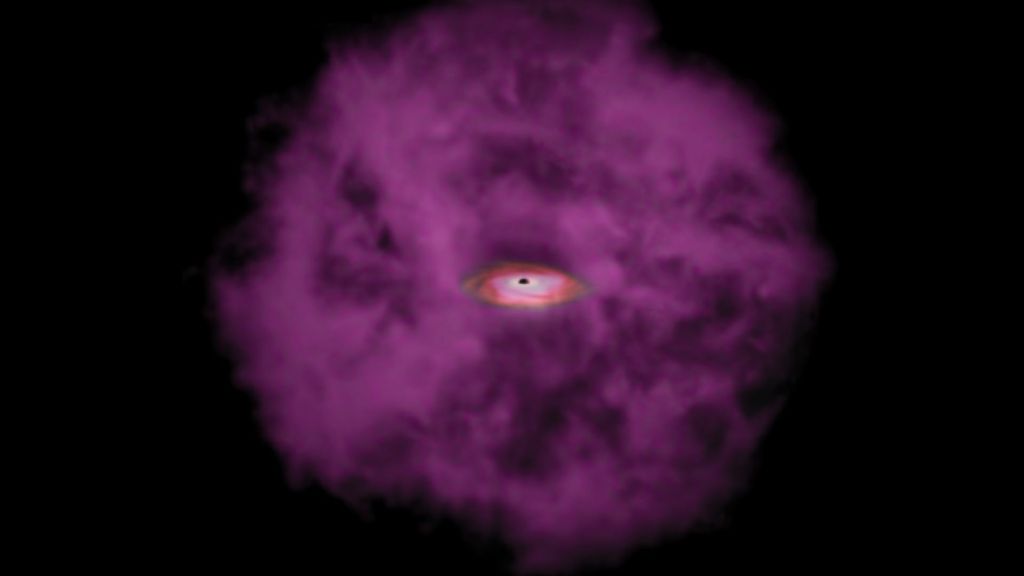
Hot, Dust-Obscured Galaxies or Hot DOGs are among the most luminous and enigmatic objects in the universe. These are distant galaxies shrouded in interstellar dust, and were discovered just over a decade ago. They contain within them bright black holes that are actively feeding, but are cloaked by an envelope of dust. Hot DOGs challenge the conventional understanding of galaxy formation, the growth of supermassive black holes occupying the cores of most massive galaxies, as well as how they influence star formation. The extreme friction in the material falling into the black holes glow in frequencies across the electromagnetic spectrum, with the radiation of trillions of suns, yet most of the light is obscured by the surrounding clouds of gas and dust. As a result, most of the brilliance from Hot DOGs are revealed only in infrared frequencies, that pass readily through the cosmic fog.
Hot DOGs were first spotted by NASA’s Wide-field Infrared Survey Explorer (WISE) instrument launched in 2009 to reveal the infrared sky. Within three years, WISE had uncovered a new, rare class of objects that were bright in mid-infrared frequencies, but undetectable in shorter wavelengths. Due to their spectral energy distributions (SEDs) peaking at shorter or hotter infrared wavelengths compared to typical luminous infrared galaxies (LIRGs), they were dubbed Hot DOGs. Unlike the cooler, dust-obscured galaxies, the Hot DOGs are surrounded by dust heated by the active galactic nuclei (AGN). About one in a million galaxies are Hot DOGs, and every one of them contain voraciously feeding SMBHs.
Exceeding the Eddington Limit
The radiation from the material falling into a supermassive black hole drives some of the material away. At a point, this light becomes so bright that no more matter can fall in, which is known as the Eddington Limit. Hot DOGs are so heavily obscured, that even the most energetic X-ray light cannot penetrate them, which are instead absorbed by the dust and reemitted in infrared light, which is essentially heat. The modelling of the SEDs of Hot DOGs requires a combination of an obscured AGN template with a stellar component in UV and optical frequencies. The host galaxies appear to be normal star-forming systems, but the luminosities of the AGNs indicate SMBHs containing 10 to 100 times more mass than possible considering the amount of mass estimated to be contained within the host galaxies.

WISE has identified about 1,000 Hot DOGs.
Precise measurements of redshift indicate that the Hot DOGs are mostly from the cosmic noon, between two and three billion years after the Big Bang, a period of the universe when the assembly and growth of black holes peaked, along with the formation of new stars. The rarity of Hot DOGs in comparison to the most luminous unobscured quasars, or distant actively feeding SMBHs indicate that the Hot DOGs may represent a transitional phase in quasar evolution. Hot DOGs may be obscured counterparts of the bright quasars, where the dust shrouds the nucleus during a brief period of intense feedback before being blown away, revealing a quasar bright in ultraviolet light. Some Hot DOGs do show signs of powerful outflows, supporting the interpretation of a transition phase. These outflows quench star formation across the host galaxy, by blowing away gas and dust, the raw material from which stars are born.
Blue-Excess Hot DOGs
Not all Hot DOGs fit into this picture though, a subpopulation dubbed Blue-Excess Hot DOGs (BHDs) that have a spectral blue bump, inconsistent UV and optical emissions. While some BHDs display disturbed features indicating an ongoing merger, most are compact and appear undisturbed. The X-ray spectra confirm single, highly obscured AGNs, with low dust-to-gas rations, hinting at unique environments. While scientists do not know the reason for this blue bump, they have some ideas. The system might be made up of interacting galaxies with a pair of AGNs, where only one is unobscured. Another possibility is despite the extreme winds from the active black hole exceeding the Eddington Limit, the galaxies might be forming massive young stars at a furious rate. Another possibility is that the polar jets from the SMBHs are clearing the dust in the direction of the Earth and its astronomical instruments. The data from Hubble favours this last explanation because the UV emissions are concentrated in the central regions, and there is a lack of merger signatures in most cases, although extreme star formation cannot be ruled out without additional observations. This diversity of potential theories highlights Hot DOGs as laboratories for studying how AGNs interact with their host galaxies, where feedback mechanisms such as radiation-driven outflows or mechanical heating shape the formation of galaxies.
Now coming to the environments in which Hot DOGs reside, these regions are often overdense, potentially protoclusters that are on the way to become massive galaxy clusters. The Hot DOGs are surrounded by companion galaxies that are 14 times denser than field expectations. The velocity offsets also indicate gravitational interactions, with high star formation rates in the brighter companions. This overdensity hints at merger-driven galaxy evolution, where interactions fuel the accretion of SMBHs and obscuration by dust. This overdensity has been revealed through observations by the Very Large Telescope in the Atacama desert of Northern Chile. Observations from the nearby ALMA of a particularly luminous Hot DOG designated as W2246-0526 revealed dust streamers and bridges extending to 35 kiloparsecs, linking to nearby galaxies and hinting at ongoing mergers. The ALMA observations also reveal highly turbulent interstellar media. Some Hot DOGs show ordered rotation, while others contain chaotic disruptions from mergers.
What future observations of Hot DOGs can reveal
Future observations by Webb can provide more refined stellar mass estimates, and determine how much of the light is from the central AGNs and how much is from the stars in the surrounding galaxies. Higher-resolution mappings by ALMA could resolve nuclear dynamics. Future observations can also be used to determine if the BHDs are forming stars at a furious rate or not. Hot DOGs allows astronomers to study the engines driving galaxy evolution. Active SMBHs in dusty environments at great distances are very similar in their spectral signature to one of the most exciting theoretical objects that humans have dreamed of, Dyson Spheres that extract the energy from a star and radiate waste energy as heat or infrared light. Hot DOGs can confuse the search for Dyson Spheres, but that is a story for another day.
Image Credits:
WISE Hot DOGs: By NASA/JPL-Caltech/UCLA
Hot DOG: NASA/JPL-Caltech/UCLA
Sources:
Hot Dust-obscured Galaxies with Excess Blue Light
Detection of companion galaxies around hot dust-obscured hyper-luminous galaxy W0410-0913
Kinematics and star formation of high-redshift hot dust-obscured quasars as seen by ALMA



Leave a comment