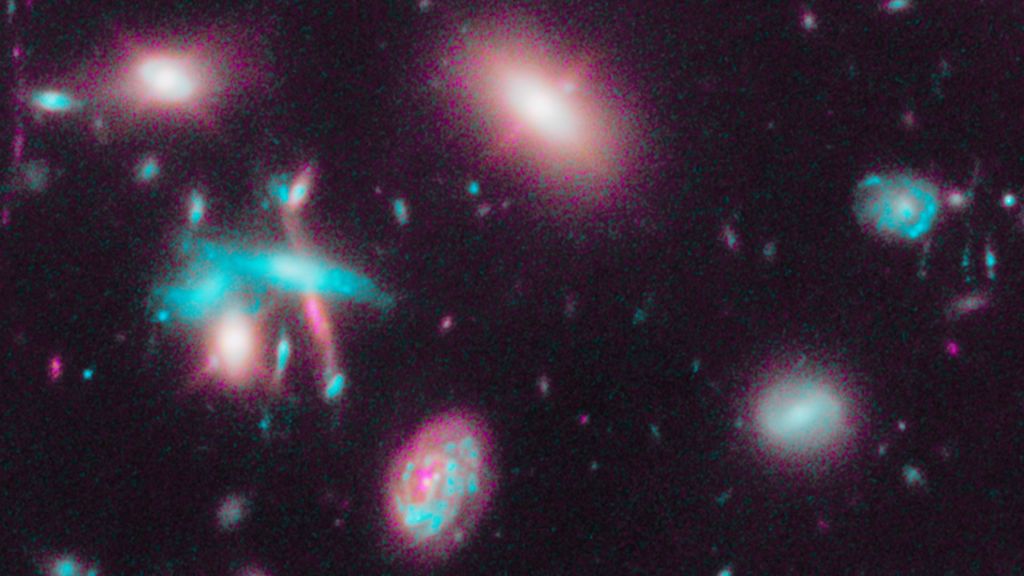
To weigh a galaxy, count all its stars and add up the masses. The mass of all the stars in any galaxy is not sufficient to hold it together, especially considering the motions of the stars on the fringes, and perpendicular to the plane of the galaxy. The motions of stars on the edges of galaxies provide a clue on the distribution of the invisible mass, and it extends far beyond the visible boundaries of the galaxies. The mystery repeats itself at higher scales, with galaxies on the edges of galaxy clusters moving too rapidly to be gravitationally bound to the visible mass densities.
This phantom substance interacts gravitationally with regular baryonic matter made up of familiar particles such as protons and neutrons. It does not interact with light, hence it is called dark matter. Despite decades of search, the nature of dark matter remains elusive. We have no confirmation yet that it is matter at all, and while we figure out what it is, making as few assumptions as possible is a great way to improve our chances of finding it. All we know about dark matter is that its gravitational influence works as the glue for the large scale structures in the cosmos. It is more accurate to call it dark gravity.
In the 1930s, the Dutch astronomer Jan Oort determined that the mass of the stars and gas in the disk of the Milky Way was insufficient to explain the motion of stars above the galactic plane. Also in the 1930s, the Swiss astronomer Fritz Zwicky working at Caltech discovered that the galaxies in the Coma Cluster were moving so fast that they would have flown apart if only the visible matter was holding the cluster together. He postulated the existence of Dark Matter as we understand it today, calling it ‘dunkle materie’.
In the 1970s, American astronomer Vera Rubin and her collaborator Kent Ford investigated the rotational curves of spiral galaxies. According to both Newtonian Mechanics and General Relativity, the stars farther from the core of the galaxy should orbit it more slowly, similar to planets at greater distances from the Sun. They instead discovered that the orbits of the stars around the galaxy core remained constant, or even increased with distance. The implication of dark matter was crystallized, galaxies contained far more mass than was visible, and this mass extended well beyond the visible disks of gas and dust. The pioneering work of Rubin cemented the idea that galaxies are embedded within large halos of dark gravity.
Gravitational Lensing
These dark gravity halos are necessary to explain galaxy rotation curves, gravitational lensing and the motions of galaxies within galaxy clusters, all of which are astrophysical observations that can be repeated by any intelligent agent in the universe with sufficiently advanced technologies. Despite the dominant role in shaping the cosmos, dark matter refuses to reveal itself in experiments aimed at direct detection. Even the most powerful atom smashers in the world have failed to produce any particles that could form dark matter. Specialized underground detectors aimed at capturing rare interactions between hypothetical dark matter particles and baryonic matter have failed to yield any definite results.

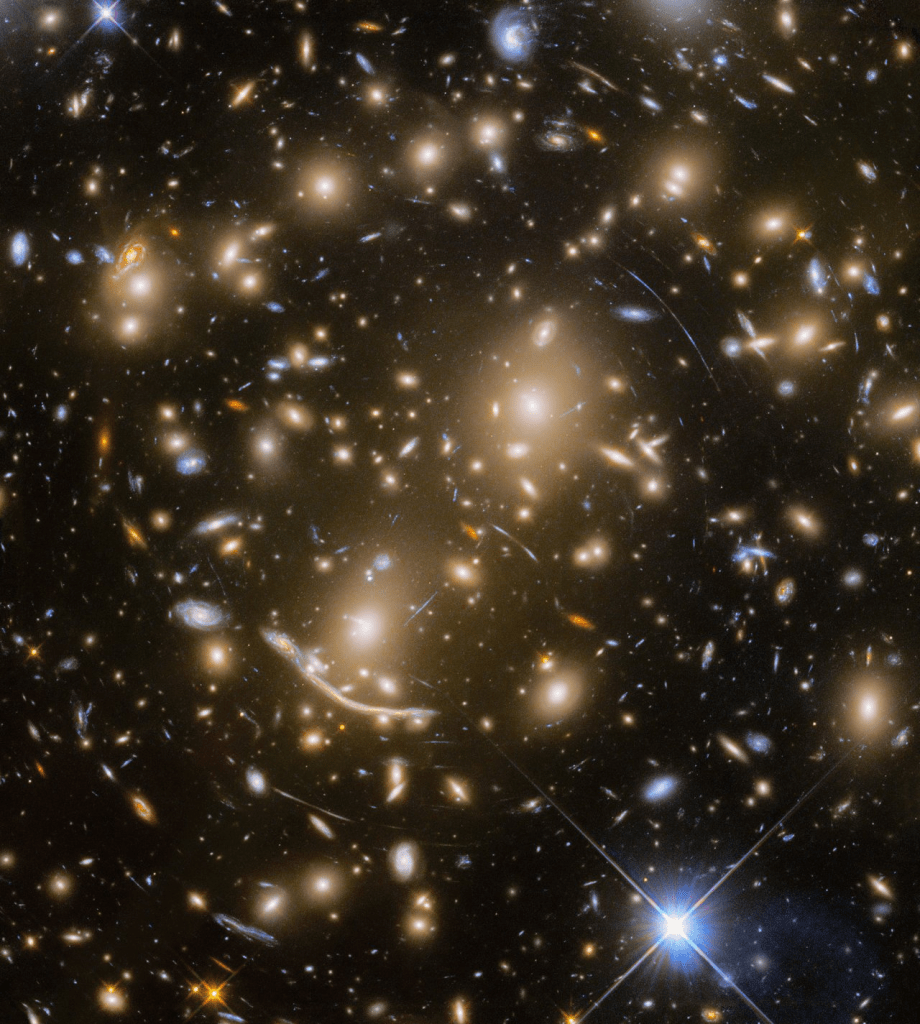
The nature of the elusive dark gravity has become one of the biggest mysteries of the universe. Computer simulations of the large scale structures of the universe, filaments of galaxy clusters interspersed by voids, forming the cosmic web, require the presence of dark gravity. Without dark gravity, galaxies and galaxy clusters would lack the cohesion necessary to form and persist across billions of years. Dark gravity is most apparent in gravitational lensing, where extreme mass densities distort and amplify light from distant background objects. After studying the extent of the amplification and distortion, astronomers can estimate the amount of dark gravity contained within a galaxy cluster, by subtracting the influence of all the visible mass.
Strange theories
One of the proposed avenues for detecting dark matter is to look for interactions between dark matter particles. If dark matter is made up of weakly interacting massive particles (WIMPs), they would collide and annihilate at times, just like matter interacting with antimatter, and produce detectable gamma-ray signals. Gamma-ray telescopes have scanned the skies for such signals, and have only found tantalizing hints, with no concrete evidence. According to the MOND (Modified Newtonian Dynamics) hypothesis, dark matter is literally dark gravity in the sense that our understanding of gravity at cosmic scales is incomplete. Modifying our understanding of gravity itself might eliminate the need for dark matter.
Another theory is that dark matter is not made up of a single type of particle, but a mixture of different components. Some physicists have also proposed that dark matter are primordial black holes, objects of incredible densities formed in the infancy of the universe. Observations of merging black holes suggest that such theories fall short of accounting for all dark matter. Scientists have proposed dark matter is cannibalistic, holographic or fuzzy. There are also some theories that are attempting to link dark matter with the accelerating expansion of the universe. For now, dark matter, or more precisely, dark gravity, remains an enigma.
Image Credits:
Coma Cluster: NASA, ESA, J. Mack (STScI) and J. Madrid (Australian Telescope National Facility
Abell 370: NASA, ESA/Hubble, HST Frontier Fields



Leave a comment