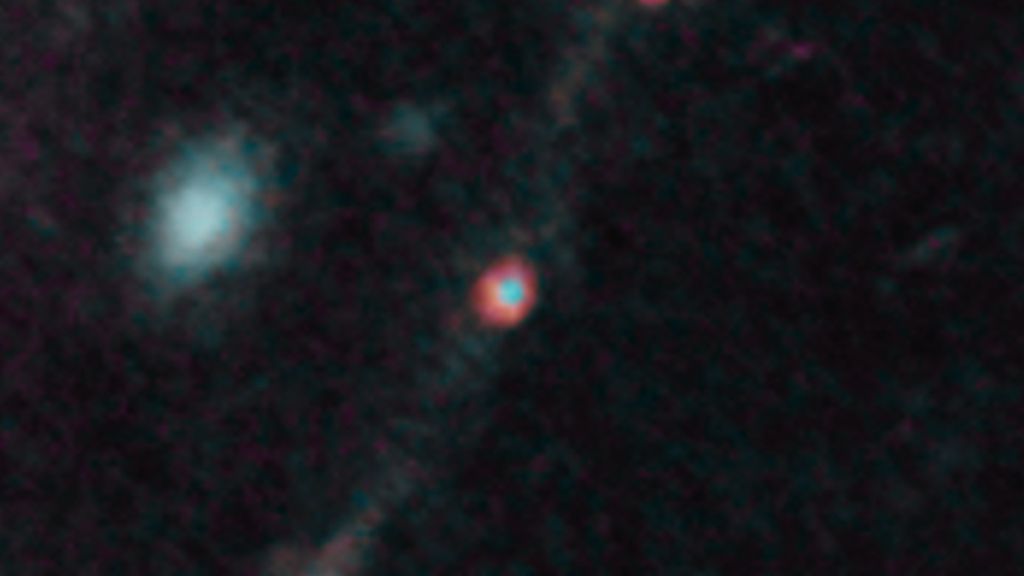
A massive cluster of galaxies designated as WHL0137-08 distorts and amplifies the light from a distant galaxy, dubbed the Sunrise Arc. This distant galaxy is at a distance of 13 billion lightyears, with the Sunrise Arc forming within the first six hundred million years after the Big Bang. At such enormous distances, even galaxies are not visible, but a wrinkle in spacetime has captured and amplified a thousand times over, the light from a single, lone star, dubbed Earendel.
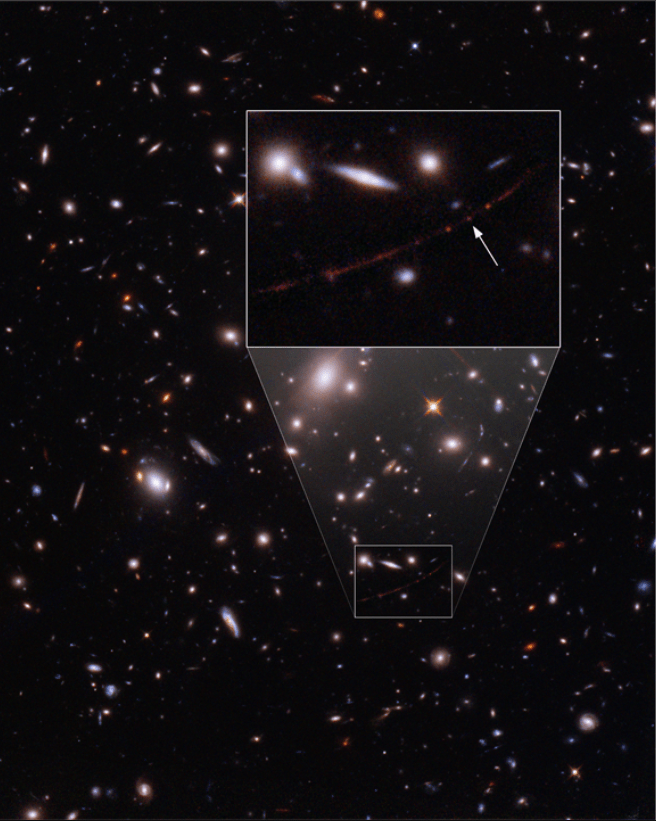
The star has the official designation of WHL0137-LS, and is either a lone star or part of a tight binary pair. The nickname means ‘morning star’. The red dot on either side of it is the same gravitational cluster, distorted by the extreme density of mass in the foreground cluster of galaxies. The star is positioned right on the edge of the ‘critical curve’ of the gravitational lensing, where the magnification peaks. Estimates of the degree of magnification varies between 4,000 and 35,000 times, depending on how the lensing is modeled.
This is a young, hot giant from the dawn of time, the likes of which are not seen in an older universe. The star is about 4 million times brighter than the Sun and glows blueish-white. Earendel may contain between 20 to 200 times the mass of the Sun. Earendel may just be an elusive Population III star, the first stars in the universe to be born out of pristine clouds of hydrogen and helium, long before the heavier elements polluted the universe. Despite decades of searching, scientists have never discovered Population III stars, but Earendel is a compelling candidate.
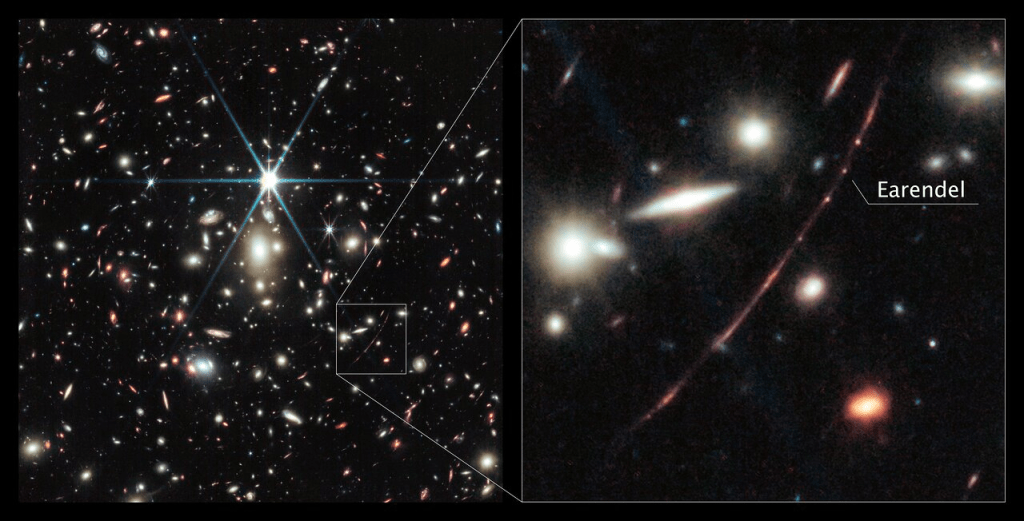
A way to test the hypothesis is to carefully examine the light from the distant star to understand its elemental composition. If the star only contains hydrogen and helium, then it is born out of the pristine star forming material in the infancy of the universe. If heavier elements or metals are discovered on the star, it means that it is not a Pop III star. Confirming its mass can also provide clues, at 20 solar masses the odds increase that it is not a relic from the dawn of time, at 200 solar masses or beyond, it almost certainly is a massive early star.
Earendel sits in a galaxy that is already enriched with heavier elements, suggesting the early universe was a patchwork of pristine and polluted zones. Discovering confirmed Pop III stars would allow us to probe theories of star formation, including that the earliest stars were ginormous. If it is a metal-rich Pop II star, than Earendel might be the most massive of its kind ever spotted.
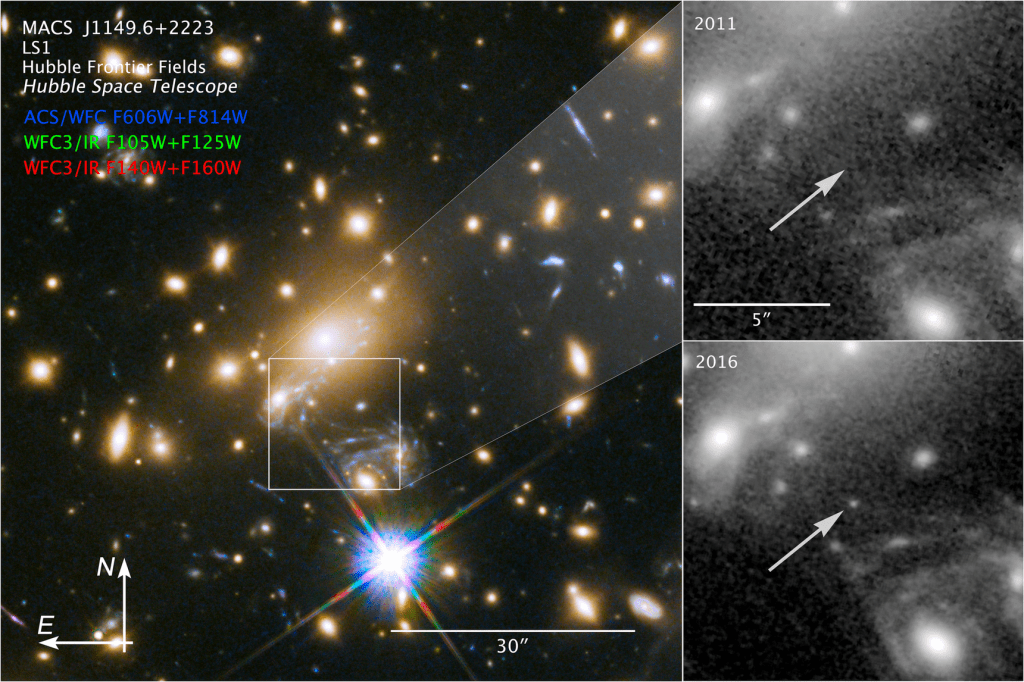
There is another magnified star at a similar distance, called Icarus. This object is lensed by the foreground cluster designated as MACS J1149+2223. The foreground cluster itself is located five billion lightyears from the Earth. The distant lone star is a blue giant, and is a close fit to what the first stars in the universe are expected to look like. Future observations will be able to confirm if these distant candidates are indeed the elusive Pop III stars.
Sources:
Analytic model for the statistics of ultrahigh magnification events
Effects of Subhalos on Interpreting Highly Magnified Sources Near Lensing Caustics
Two Lensed Star Candidates at z ≃ 4.8 behind the Galaxy Cluster MACS J0647.7+7015
JWST Imaging of Earendel, the Extremely Magnified Star at Redshift z = 6.2
On the Probability of the Extremely Lensed z = 6.2 Earendel Source Being a Population III Star
Image Credits:
Hubble image: NASA, ESA, Alyssa Pagan (STScI)
Webb image: NASA, ESA, CSA, D. Coe (AURA/STScI for ESA), Z. Levay


Leave a comment