
Laboratory astrochemistry fuses the raw data of astronomical observation with the intricate mechanisms of chemical evolution. By replicating the frigid, radiant, vacuum conditions of deep space, this discipline unveils the identities, origins, and behaviors of molecules scattered across the cosmos, forging a bridge between the observable and the theoretical.
In the shadowed depths of dense molecular clouds, the nurseries of protostars, interstellar ices cloak microscopic dust grains, forming frozen reservoirs of molecular complexity. These icy grains harbor water, elemental molecules, and an array of complex organic molecules (COMs), in an environment where cold prebiotic chemistry occurs long before the assembly of planets in the waste material surrounding newborn stars.
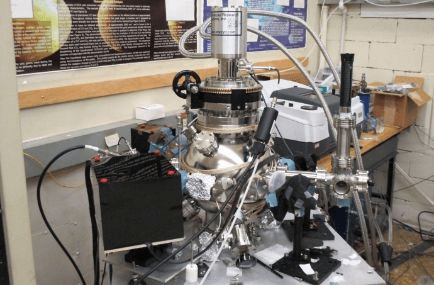
Vacuum Chambers: Replicate the ultra-low pressures of interstellar space, mimicking the sparse conditions of the cosmos.

Cold Fingers/Cryostats: Chill surfaces to 10-20 K, mirroring the frigid dust grains in molecular clouds.

Ice Films: Gases flood the chamber, condensing into ice films on the cold surface, simulating interstellar ices.
Interpreting astronomical observations and identifying molecules with precision requires understanding how these molecules, such as the solid forms of gases would appear in the distant whispers of starlight captured by astronomical instruments. Based on signatures of molecules examined in labs, COMs such as acetaldehyde, ethanol, and methyl formate have been spotted around baby stars. Simpler species such as methane and sulfur dioxide also emerge, their spectral fingerprints aligning with lab-generated analogs, offering a clear window into the composition of these cosmic frosts.
The icy surfaces of dust grains serve as crucibles for chemical transformation, driven by ultraviolet radiation and energetic particle bombardment. Laboratory simulations replicate these conditions, illuminating the pathways that forge progressive complexity. When UV light or cosmic-ray analogs strike simple ice mixtures, molecules such as ethanolamine—a precursor to biologically significant compounds—emerge. These experiments trace the stepping stones of prebiotic chemistry, revealing how the seeds of complexity germinate in the cold expanse of energy and matter.
Interstellar Ices
Beyond identification, laboratory astrochemistry quantifies the physical essence of these molecules. Infrared band strengths, a measure of how strongly a molecule absorbs light, are meticulously calculated, enabling precise estimates of molecular abundance in space. For unstable or polymerizing species, innovative techniques ensure accuracy, anchoring the interpretation of telescopic data in empirical rigor.
The dynamic interplay between solid ice and gaseous vapor shapes the chemical narrative of star-forming regions. Molecules can go through several periods in either the ice or gas states within a stellar nursery, with multiple opportunities for interactions during transitions.

Various energy sources, such as UV lamps, electron beams, or thermal heating, are used to simulate the energetic processing of ices

Infrared Spectroscopy: Tracks ice composition changes during processing, revealing molecular transformations.

Data Comparison: Lab spectra are matched with telescope data to pinpoint molecules in interstellar space.
As protostellar heat intensifies, and the embryonic stars increase in mass, the complex ices sublimate. Laboratory studies of thermal desorption pinpoint the sublimation temperatures of various species, mapping the chemical evolution of the hot cores of protostars. These experiments reveal the sequential release of molecules, from volatile methane to more tenacious COMs, painting a thermal portrait of stellar birth.
The ratios of COMs in gas versus ice offer clues to their cosmic journey. Methyl formate and dimethyl ether exhibit a near-direct inheritance from ice to gas, suggesting stability across phases. Yet, acetaldehyde and ethanol display divergent ratios, hinting at gas-phase reprocessing or observational biases—a puzzle laboratory data continues to unravel.
The Role of Ions
Charged particles—ions—linger within interstellar ices, their presence long hypothesized and now substantiated.
In the frigid lattice of cosmic ices, acid-base interactions spark the formation of ions such as formate and cyanate. Lab simulations at cryogenic temperatures replicate these reactions, their products mirroring detections in protostellar envelopes. Such findings underscore the ionic contribution to interstellar chemistry.
Bombardment by energetic particles further enriches these ionic populations. Lab-based irradiation of ice mantles yields a cascade of charged species, which then catalyze additional reactions. This energetic alchemy amplifies the molecular diversity of the cosmos, a process meticulously charted through controlled experiments.
Exocomets around a newborn star

Image Credit: ESO/L. Calçada
As telescopes pierce the veil of star-forming regions with unprecedented precision, the much more humble laboratory astrochemistry serves as their indispensable counterpart. High-resolution spectra demand a robust foundation of experimental data to decode their secrets.
Astrochemical models rely on laboratory inputs to refine their predictions. Reaction rates, formation pathways, and molecular behaviors—each parameter is honed by empirical data, ensuring these simulations mirror the universe’s chemical reality. These insights steer the gaze of astronomers, highlighting key spectral features and forecasting the molecular makeup of uncharted regions. This predictive power transforms raw data into coherent narratives of cosmic chemistry.
In the sterile confines of laboratories, the conditions of the infinite are distilled and dissected. This relentless pursuit of knowledge unravels the universe’s chemical underpinnings, illuminating the processes that weave simplicity into complexity, long before the appearance of warm little ponds.
Image Credits:
Warm Little Pond: Andy Wang/Unsplash
UV Lamp, UHV system: NASA GSFC
Cryostat, Ice Crystals: NASA
Spectrometer: Binghamton University
Sources:
JOYS+: The link between the ice and gas of complex organic molecules
Infrared spectra of solid-state ethanolamine: Laboratory data in support of JWST observations
The deuterium fractionation of water on solar-system scales in deeply-embedded low-mass protostars⋆
JWST Observations of Young protoStars (JOYS+): Detecting icy complex organic molecules and ions


Leave a reply to Hot Corinos – StarBullet.in Cancel reply