Welcome to my corner of the cosmos — a digital observatory where experimental technologies are used to explore deep mysteries and cool theories. This is scratchpad, a passion project, a creative outlet, and an ongoing journey through the strangest frontiers of astrophysics and astrobiology. In this page, I will try to explain what I am trying to do here. The tl;dr version is that this an attempting at countering SEO and AI slop.
Despite what Reddit claims, Google is the frontpage of the Internet, and journalists have to depend on The Big G’s algorithms to keep food on the table. This means that the blogs indexed on Google News are constantly catering to what people are searching for, and there is no one actively looking for agnostic biosignatures or glitching neutron stars, at least not yet, which is the stuff that interests me the most and what I want to write about.
I want to write for humans, not machines. So I am doing that here, totally free of the burden of SEO, which is in a constant state of flux anyway. Google keeps updating the algorithms, and has to necessarily keep the details opaque to prevent exploitation. These ephemeral and obscure SEO demands have superseded any editorial instincts that publications might have. Here, the news, the audience, and Google are all in the process of figuring themselves and their roles out, and I do not want to blame anyone for the mess, I just want to no part in it, using my time to write for my perfect, imaginary universe.

Apophis is a really long serpent or a cosmic dragon in Egyptian mythology, with one depiction hilariously walking on human legs.
The language and style I am attempting to use is inspired from the Reader’s Digest ‘New Reading’ course books and broadsheet newspapers of the 20th century. A geomagnetic storm can just as well be described as a sun storm, and I like concise headlines as against a call to action stuffed with keywords, say something along the lines of ‘Watch Live Now: Sunita Williams Rescue Mission to the ISS’. The idea is to use as few words as necessary, maintaining a high signal-to-noise ratio. I follow the Oxford Style Guide.
I like to make science more accessible, but I absolutely hate treating my audience as idiots. I am imagining a global, or actually even an eternal and cosmic audience that is intelligent, but just may not use English as their first language. I want to tackle Jargon Monoxide by introducing complex terms naturally, in a manner that makes sense to any intelligent reader.
When media it treats its audience as dumb, and constantly tries to simplify content, it can obscure what actually happened. Translunar injection manoeuvres are great examples, which are often described as as a spacecraft taking a crucial step in the mission, hopping to the Moon, or leaving the Earth forever. When ISRO’s Aditya observatory successfully executed a Trans-Lagrangian Point 1 Insertion manoeuvre, the irrelevant detail of what actually happened was lost in the overenthusiastic coverage. When people say they do not trust or consume the mainstream media, I can totally understand why. There is just so much garbage, especially with major media houses running wild with ChatGPT, while not even bothering to use Grammarly.
Here is an example from Times of India, about the James Webb Space Telescope photographing a supernova. There is no photograph, no supernova, and no galaxy at that distance from the Earth. Times of India, News18 and Money Control all did stories on a close approach by Asteroid Apophis on November 13, 2024, when the asteroid was actually on the other side of the Sun, as far away from Earth that it can possibly get during its orbit. Such senseless, hallucinogenic offerings at the altar of Google are neither planned disinformation, nor clumsy misinformation, it is a novel form of noise. These are the leaders in my industry and I just cannot compete with an approach so ridonkulously callous. Here, I am attempting to use these same tools in a way that makes sense.

The asteroid Apophis was on the other side of the Sun during the imaginary encounter in 2024, covered widely by the mainstream media. The close encounter is actually on April 13, 2029. You can track it in realtime here.
This is me trying to figure out how best to integrate AI tools into my writing process. The use of AI for writing is still frowned upon, while the tools available are getting increasingly diverse. AI slop is used in blog updates by companies, press releases and official statements, making covering news difficult. NotebookLM, ChatRTX, ChatGPT, Qwen, Hailou, DeepSeek, Grok, Meta, Hyperwrite and Google’s AI Kitchen can all be used in various permutations and combinations to write stories that cannot be written by humans. I am discovering that being conscious and attentive at prompt engineering, filtering out hallucinations and straightforward, old-fashioned editing can significantly improve AI content. I also like building AI pipelines by processing content through multiple tools. AI is also great at prompting you to write more.
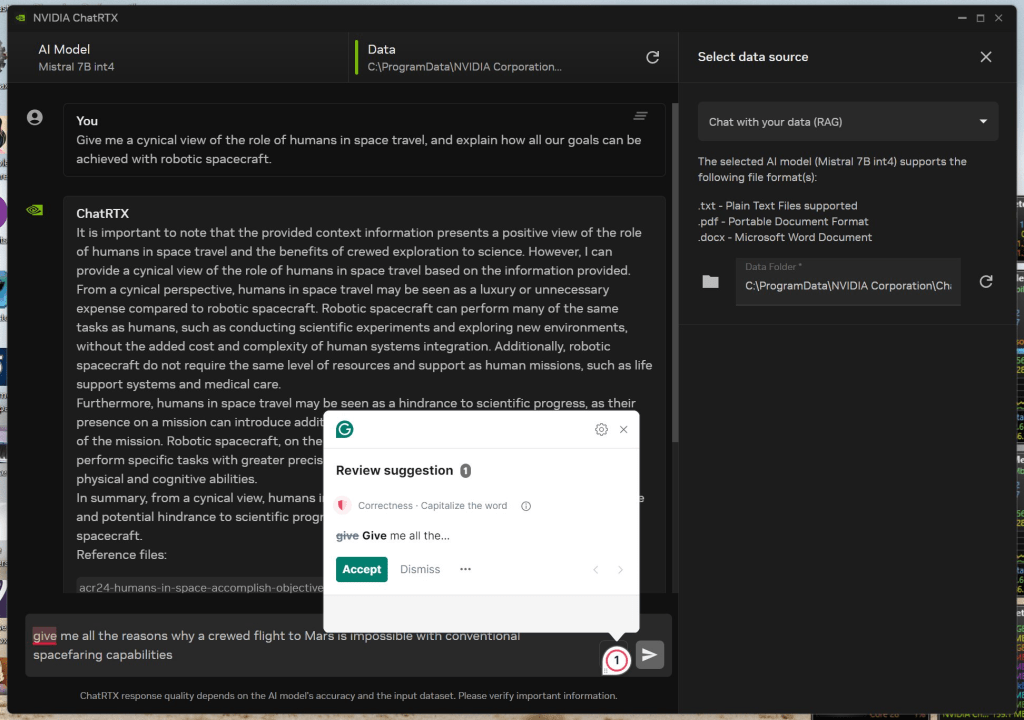
I prefer Grammarly at the ends of the pipelines, not the starts! But thanks anyway, ChatRTX.
This is an experiment, a playground, and a record of science that sparks my curiosity: Alien biochemistry, recycled pulsars, rogue exoplanets, the exotic physics of dead stars and the idea that information itself might be the essence of life in every form, across the universe.✨🚀

