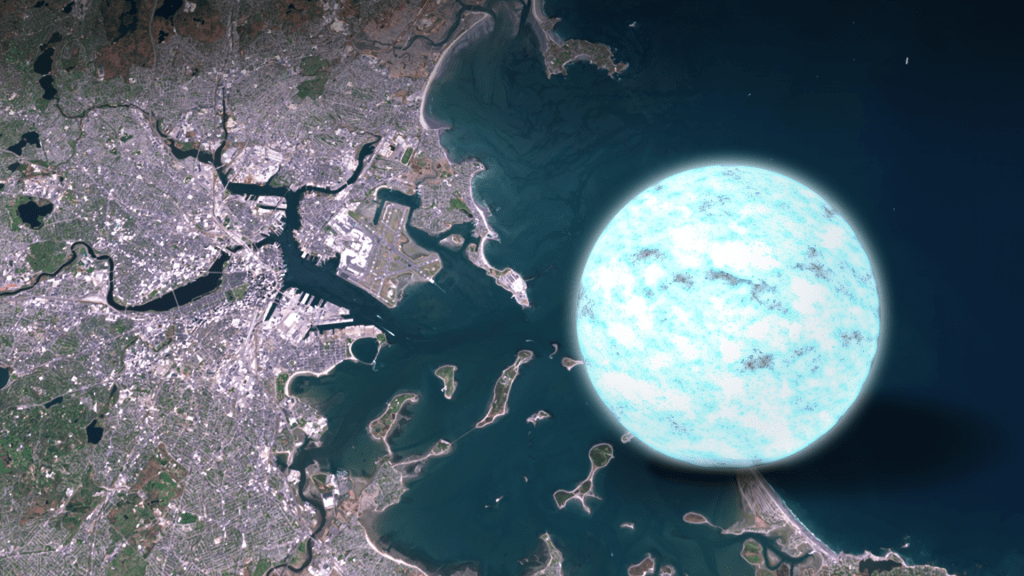
When a star more massive than the Sun dies, it produces a stellar remnant, a compact, city-sized core made almost entirely of neutrons packed at incredible density. Stars die when they run out of nuclear fuel. The outer layers are violently shed, the rest collapses. When a star containing as much mass as the Sun or less dies, it leaves behind a white dwarf. More massive stars leave behind neutron stars, and the most massive ones collapse into stellar mass black holes. Rapidly spinning neutron stars are called pulsars and highly magnetised ones are called magnetars. The characteristics of the dead star results in the formation of a free neutron star, a pulsar or a magnetar.
Neutron stars are dark and compact, and astronomers have to wait for them to interact with something in their environment to detect them. Jets from the magnetic poles of spinning pulsars can sweep across the Earth like the light from a cosmic lighthouse. A neutron star can accrete the atmosphere of a binary stellar companion. The tortured material in the accretion disk can shine brightly in X-rays. The lightcurves of superluminous supernovae can contain telltale ‘chirps’, indicating the formation of magnetars. When two neutron stars collide, they can create ripples in spacetime that generate gravitational waves, which can be detected at astronomical distances. These events are accompanied by a kilonova, an intense, ‘golden’ flash of light.
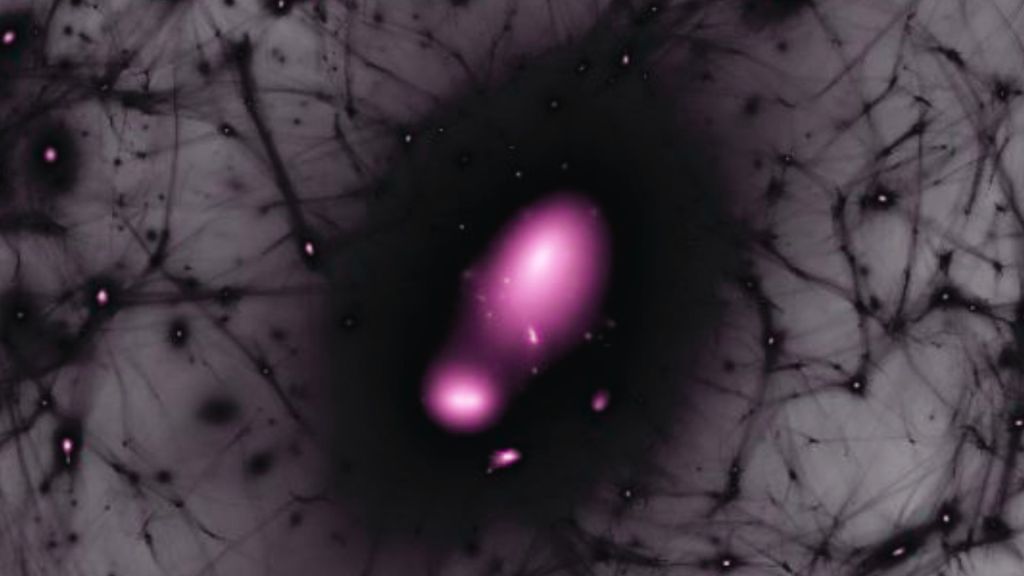
When two neutron stars collide, some of the material gets ejected at high velocities, spreading far beyond the 100 light years typical of ejecta from supernovas, or dying stars. The neutron dense material quickly decays radioactively, and transforms into heavy metals including iridium, neodymium, tellurium, platinum and gold. The launched material snakes through the galaxy along tangled magnetic fields. Neutron star mergers are efficient ways to enrich entire galaxies with these heavy elements. The first confirmed gravitational wave detection of a merger between neutron stars occurred in August 2017. The event has been designated as GW170817. Researchers from Northwestern University have developed a simulation to explore the different possible scenarios that would have resulted in the same observed signals.
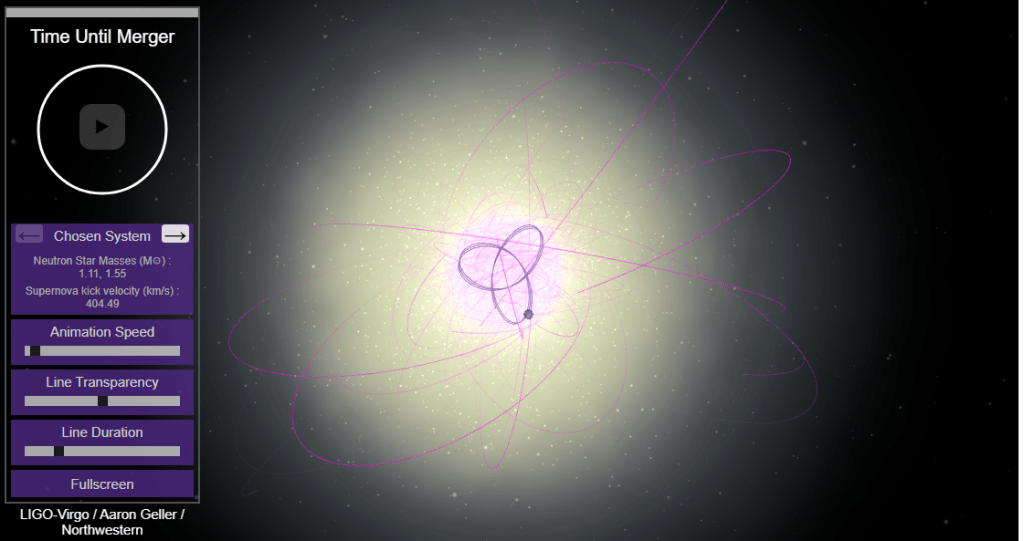
All the observed gravitational wave events can be explored at the Gravitational-wave Transient Catalog (GWTC).
Stellarcollapse.org maintains a nice, updated chart on the masses of observed neutron stars.
To stay up-to-date on the latest research on neutron stars, you can look up the papers on arxiv, sort by newest.
There are only about 5,000 neutron stars known, including pulsars and magnetars. The Australia Telescope National Facility maintains a handy catalogue for pulsars.
You can help astronomers find neutron stars on your desktop computer or even spare droid actually. You need to create an account for Einstein@Home, install the BOINC software, then choose Einstein@Home from the list and enter https://einsteinathome.org.
There is likely to be a short observation run in the Summer of 2026, during which the Gravity Spy citizen science project will be active on Zooniverse. There is a tutorial, and it involves classifying signals. This helps scientists find glitches, when neutron stars spin up rapidly or may even be the signatures of surface features.
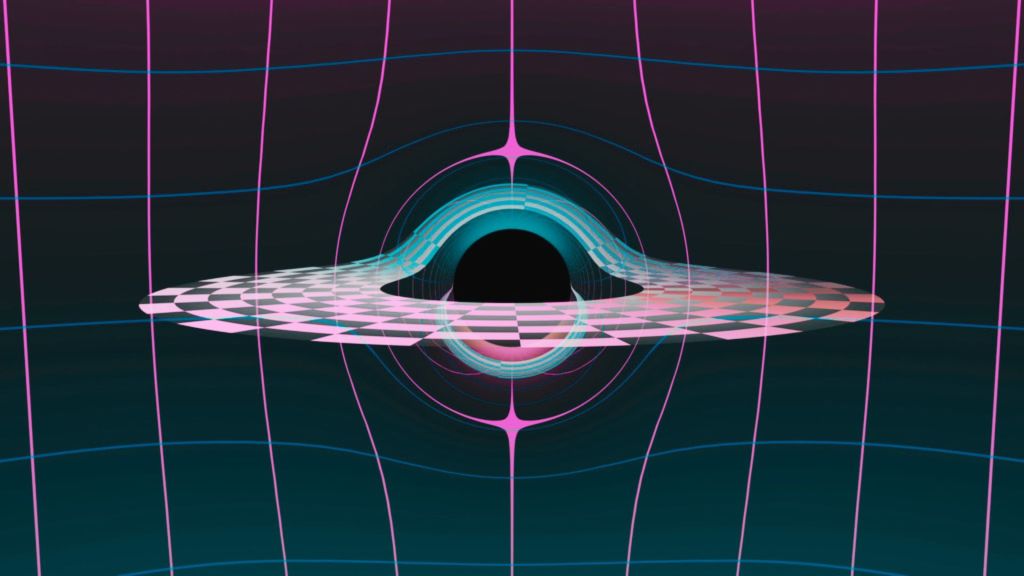
Neutron stars have a solid crust, about 1-2 km in thickness. There can be mountain ranges on the surface, 2 cm in height. The interior is liquid. The interiors of neutron stars is just about how extreme matter can get in the universe, other than black holes. The interiors of black holes are just a little harder to probe, considering even light does not escape. We may as well discover dark matter before we can peek into singularities, at least those dressed in black holes. The interiors of neutron stars though, is something that we can probe. The Neutron Star Interior Composition Explorer (NICER) is a purpose-built X-ray telescope mounted on the International Space Station, and one of its primary goals is to study the ultradense matter that is on the verge of collapsing into black holes. The latest science results from the NICER instrument can be accessed here.
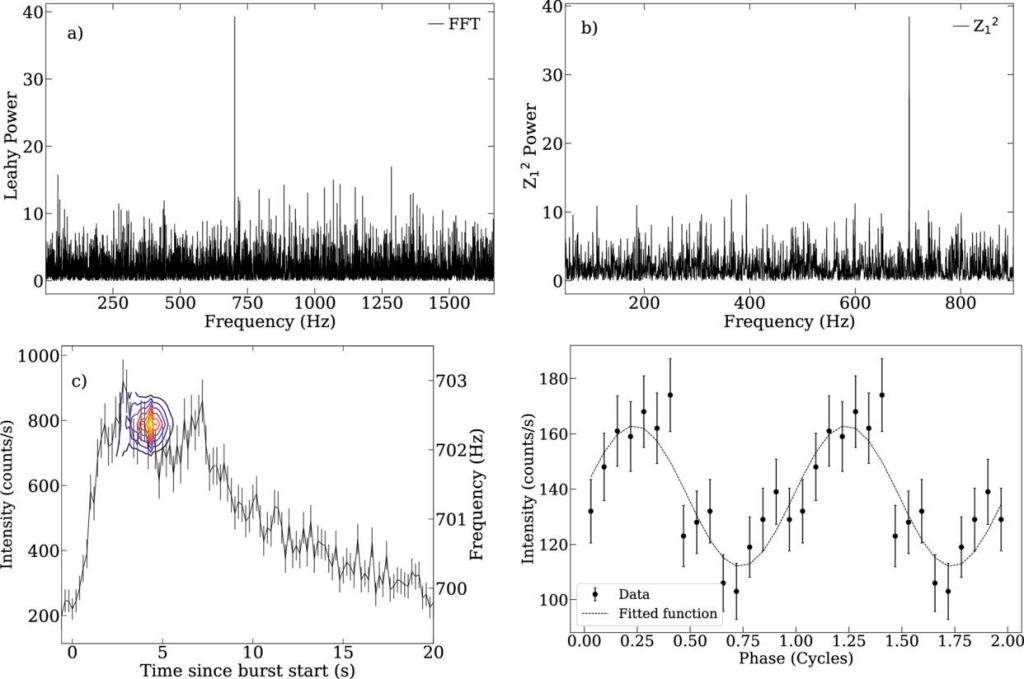
The above image shows the peak in X-ray luminosity associated with the peak of a thermonuclear burst oscillation from a binary system at a distance of about 26,000 lightyears from the Earth in the constellation of Sagittarius, designated as 4U 1820-30. A star about as massive as the Sun, and a heavier companion, both died, leaving behind a white dwarf and a neutron star. The two are spiralling inwards, orbiting each other every 11 minutes. The neutron star is pulling away material from the white dwarf, which is repeatedly accumulating and reaching a critical limit, resulting in spectacular thermonuclear explosions. Astronomers have tracked 15 such bursts between 2017 and 2021.
The unexpected utility of mysterious objects
Astronomers have found binary systems with neutron stars and white dwarfs, neutron stars and black holes, but so far a confirmed system with a pulsar orbiting a black hole is not known. Such a system is something that astrophysicists are very interested in finding. The pulsar acts as a very precise clock in this situation, and having one in the extreme environment around a black hole allows scientists to test all kinds of theories about black holes. A newly discovered pulsar designated as PSR J0514-4002E may just be in such a binary system. The binary companion is either the heaviest neutron star known, or the lightest black hole. The heaviest neutron stars can theoretically contain three times the mass of the Sun. The lightest stellar mass black holes contain about five times the mass of the Sun. The mystery companion of the pulsar sits neatly in the mass gap, and scientists don’t quite know what it is, but it may be the result of a merger between two neutron stars in the densely populated central region of an old globular cluster.
The gravitational wave event designated as GW230529 is a merger between a neutron star and an unknown compact object. This object also falls in the mass gap between the heaviest neutron stars and the lightest black hole. The discovery has implications for understanding the evolution of binary systems. The GAIA mission has uncovered a population of about 20 neutron stars in binary systems with Sun-like stars. This means that the system survived the cataclysmic supernova of one of its stars, which has been predicted in theory. Scientists suspect that there are many more similar systems. These neutron stars were the first to be discovered purely based on the gravitational influence on their binary companions.
Another mystery object, designated as ASKAP J193505.1+214841.0, is either the slowest spinning neutron star known, or a white dwarf with an extraordinarily strong magnetic field. Follow-up observations are necessary to confirm the nature of the object, but either scenario is likely to yield valuable insights into extreme physics.
One of the great things about pulsars is that we can monitor multiple pulsars at once, and by precisely timing them, it is possible to track gravitational waves washing over the universe. This is known as a pulsar timing array, and with multiple continent scale collaborations pooling resources towards one massive, global collaboration resulting in the International Pulsar Timing Array.
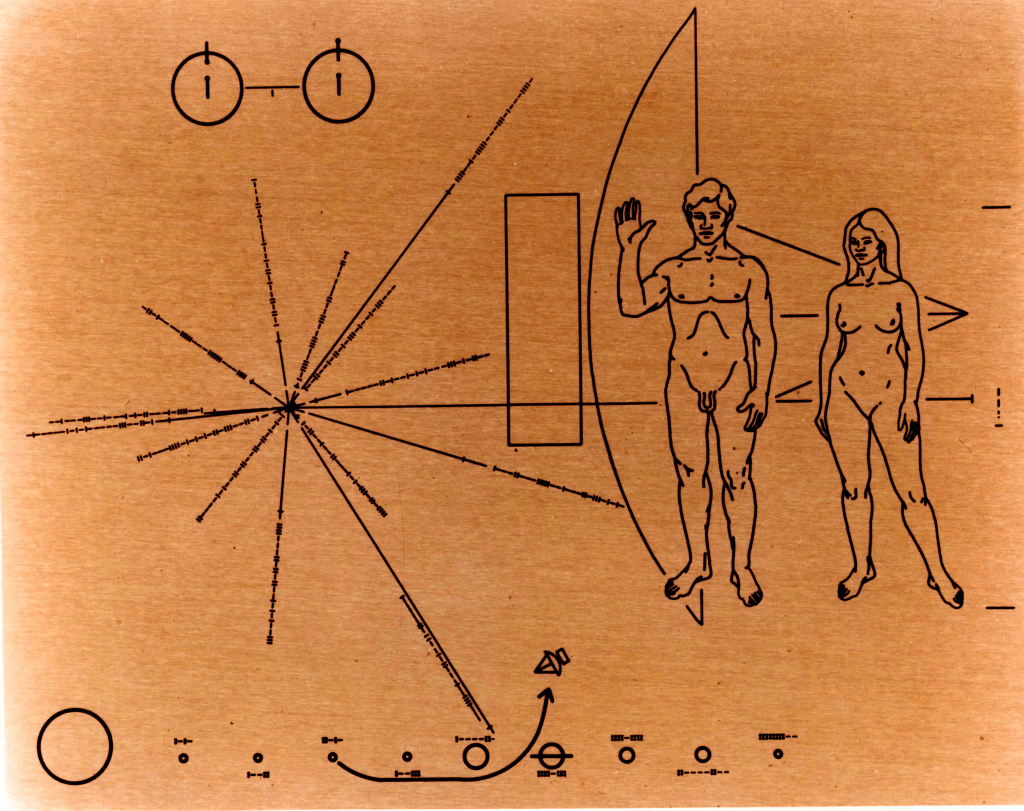
They also essentially function as a natural GPS for the Galaxy. The pioneer plaque shows the location of the Sun with respect to nearby pulsars, and the centre of the galaxy. Carl Sagan determined that this was the best way to communicate to any alien civilisation that would find the Pioneer probes, on who we are and how to find us. Pioneer 10 will reach the star of Aldebaran in about two million years. Pioneer 11 will reach one of the stars in the constellation of Aquila in about four million years.

Leave a comment