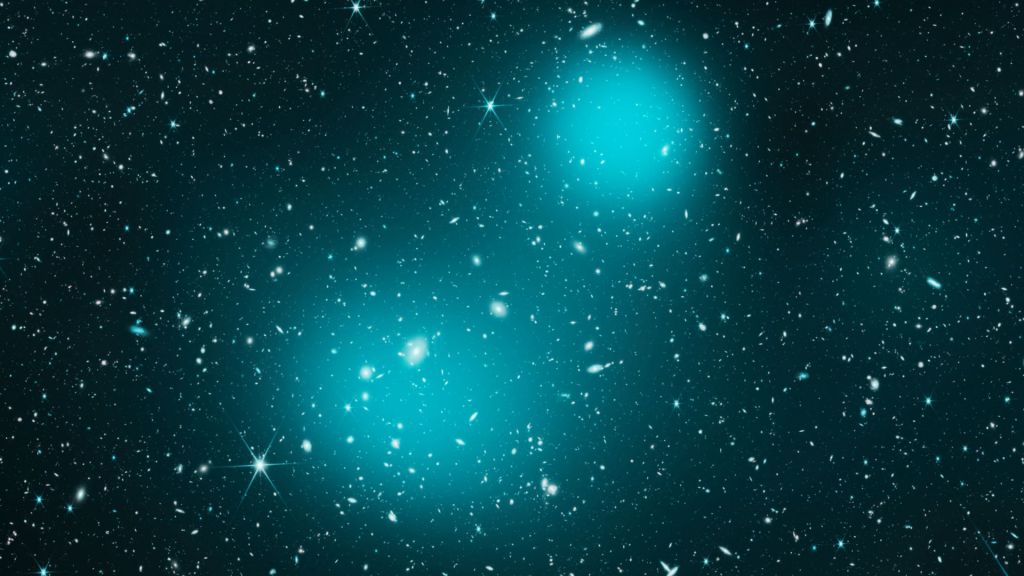
Dark Matter makes up about 85 per cent of the matter in the universe. It does not emit, absorb or reflect light, so it is invisible. Scientists are sure it exists because it is the gravitational influence of dark matter that allows galaxies to maintain their shapes. The stars within galaxies such as the Milky Way, would scatter across space were it not for the gravitational influence of dark matter. Galaxies are embedded within vast and massive haloes of dark matter. In the standard model of cosmology, called the Lambda-CDM or ΛCDM model, dark matter is cold, meaning the particles move slowly, and interacts only weakly with ordinary or baryonic matter such as atoms and the particles in stars and planets. This weak interaction means that dark matter forms clumps under gravity, which are the haloes around galaxies holding them together.
Despite decades of exhaustive search, scientists have not discovered dark matter yet, and it’s nature remains a mystery. Dark matter is actually more accurately described as Dark Gravity.
Neutrinos are tiny particles produced in nuclear reactions, such as the nuclear furnace at the core of the Sun. They are part of the standard model of particle physics. Neutrinos interact weakly with ordinary matter through the weak nuclear force. They pass through most materials easily. In fact, about a trillion neutrinos flow right through your body every second without effect. For this reason, they are known as ‘ghost’ particles. There are three types of neutrinos, electron, muon and tau neutrinos. In the early universe, neutrinos were abundant and hot, behaving like radiation. As the universe cooled, they became non-relativistic, if they have mass. For simplicity, many models treat them as massless. Together, dark matter and neutrinos are two of the most mysterious components of the universe.
Neither dark matter nor neutrinos interact much with ordinary matter. The gravity of dark matter affects stars and gas, but it does not collide or exchange energy easily with baryonic matter. Neutrinos scatter off nuclei very rarely, with tiny cross-sections. Particle physics experiments such as those conducted at the Large Hadron Collider have looked for rare and elusive interactions between dark matter and regular matter, but none have confirmed the nature of dark matter yet. A dramatic new study suggests that matter and neutrinos might in fact, interact with each other. The theory originates from the field of cosmology. In the early universe, neutrinos filled space with increased density. If dark matter would scatter off the neutrinos, it would impact the formation of large-scale structures in the universe. Such interactions cause damping in the matter power spectrum, which describes how matter clumps up at different scales.
Scientists found evidence of this possible interaction by analysing cosmic data. The Cosmic Microwave Background (CMB), or the residual glow from radiation 380,000 years after the Big Bang, when the rapidly expanding universe cooled sufficiently for the first neutral hydrogen atoms to form, through a process called recombination. Data from the Planck satellite and the Atacama Cosmology Telescope (ACT) show small deviations at high multipoles, indicating non-zero coupling. This was also suggested by Lyman-alpha forest data, which probes gas clouds at redshifts between two and five. To test their interpretation, the scientists added weak lensing data from the dark Energy Survey (DES) Year 3. Weak lensing measures how gravity bends light from distant galaxies, allowing scientists to map matter distribution at redshifts below 3.5. The researchers modified the matter power spectrum for neutrino-dark matter (vDM) interactions, using N-body simulations for nonlinear affects at small scales.
The scientists were examining how gravity bends light from distant galaxies, called cosmic shear, and found a slight hint that dark matter and neutrinos interact. This interaction is measured by a number called u_vDM, which is around 11^-4. This has no units, and the value compares the chance of dark matter scattering off neutrinos to a known scattering process, adjusted for the mass of the dark matter. According to data on the cosmic microwave background by the Planck satellite and the Atacama Cosmology Telescope, as well as baryon acoustic oscillations (BAO), which map large-scale structures, the hint became stronger. The research reveals that dark matter may not be isolated as previously believed, and questions the validity of the ΛCDM model.
The S8 Tension
The research provides an elegant solution to what is known as the S8 tension, a discrepancy in the structure growth parameter, where the early universe data captured by Planck has predicted higher values than those derived by weak lensing surveys of the late universe. Combining the datasets allows for S8 to be consistent across epochs. In models where neutrinos and dark matter interact, the interactions damp down clumping on small scales. If dark matter couples to neutrinos, it might also couple to other particles such as baryons or photons. Neutrino interactions are less constrained by CMD.
There are some indirect affects for feedback models on active galactic nuclei (AGNs), or voraciously feeding bright black holes that can at times outshine all the other stars in the surrounding galaxy. Supermassive black holes regulate star formation in a galaxy by ejecting gas. In simulations, the feedback smooths out small-scale structures. vDM interactions add another suppression mechanism, so models cannot distinguish them. The uncertainties in the feedback results in small-scale tensions, such as in galaxy luminosity functions. If dark matter interacts with neutrinos, the strength needed by the feedback is reduced considerably.
Future surveys such as the Vera C Rubin Observatory and the China Space Station Telescope will be able to test and verify if dark matter interacts with neutrinos. The discovery hints at physics beyond the standard model. Terrestrial searches for vDM, such as neutrino detectors could also confirm the scientists. If verified the discovery provides a rare window to studying dark matter.
Source: A solution to the S8 tension through neutrino–dark matter interactions
Image Credit: NASA/STScI/J. DePasquale/A. Pagan

Leave a comment