The first Luminous Fast blue Optical Transient (LFBOT) was discovered on 16 June 2018 by the Asteroid Terrestrial-Impact Last Alert System (ATLAS), specifically the ATLAS-HKO telescope at the Haleakala Observatory in Hawaii. This is a robotic survey that scans wide swaths of the sky repeatedly looking for transients, or objects that appear to change luminosity or position. The event designated as AT2018cow was quickly nicknamed ‘the Cow’ and appeared as a sudden, brilliant flash, triggering rapid observations from space and ground-based instruments. Within days, the spectra revealed an exceptionally hot, blue continuum with few absorption lines. Photometry indicated that the object peaked in luminosity just a couple of days before decaying faster than typical supernovae, that can linger for weeks or months. Multi-wavelength data showed luminous X-ray and radio emission, indicating ongoing energy injection, likely from a central engine interacting with dense surrounding material.
Early observations indicated a luminous, hot, rapidly evolving transient unlike supernovae, or gamma-ray bursts. Follow-up campaigns confirmed its uniqueness, establishing the LFBOT category for events with rapid timescales, blue colours, high luminosity, and broad spectral coverage from UV to X-rays to radio frequencies. Though fainter, short-lived FBOT-like candidates have appeared in earlier surveys, some going back to 2014. LFBOTs rise to brilliance in mere days, peak with a startling blue hue, and fade almost as swiftly. The discovery of AT2023fhn or ‘the Finch’ stood apart because of its large offset from the nearest galaxies. LFBOTs typically were formed in galaxies still undergoing star formation. The isolation of this event indicated that LFBOTs can occur in diverse environments, from the dense cores of galaxies to the sparse outskirts.
The most luminous LFBOT
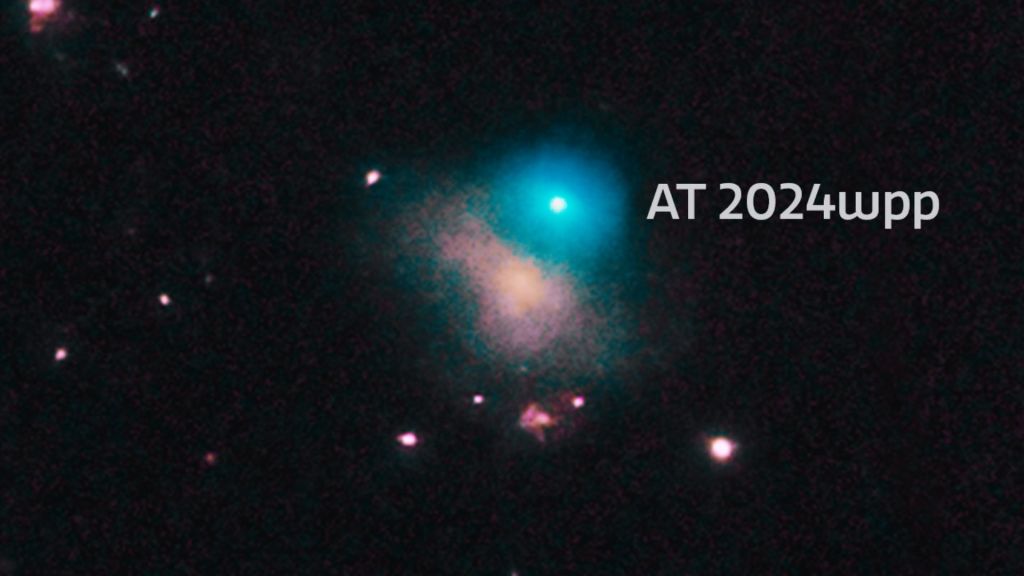
The most luminous such event is designated as AT2024wpp, or ‘the Whippet’, with an output that was ten times that of the Cow. Such extreme energies simply cannot be produced by conventional supernovae. The spectrum indicated a lack of cooling, implying a continuous injection of energy. A near-infrared excess emerged 20 days into the event, possibly from dust reprocessing or emissions from the extended ejecta. Faint hydrogen and helium lines appeared after 35 days, followed by a Compton hump in the X-ray data around day 50, with radio emissions peaking, indicating a blast wave accelerating through a dense shell, then into a steep density gradient.
Scientists have proposed a number of theoretical scenarios that can produce LFBOTs, including a failed supernova from a very massive star where the core collapse forms a black hole without a successful explosion, with the nascent black hole powering the transient through super-Eddington accretion, a stellar-mass black hole merging with a massive, hydrogen-poor star such as a Wolf-Rayet type (an extremely hot star that has lost much of its hydrogen), or exotic massive binary systems with strong winds. One explanation however, leads, and that is that LFBOTs are produced by tidal disruption events, or black holes tearing down stars.
TDEs cause LFBOTs
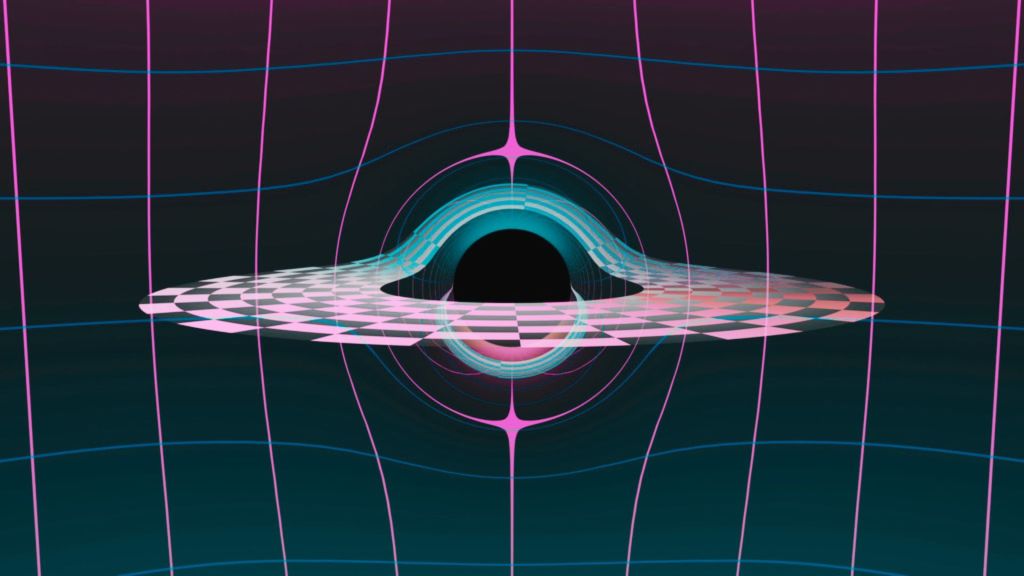
Scientists believe that the high-energy emissions from the Whippet was the result of a long-lived black hole binary system, where the black hole was siphoning material from its massive companion for an extended period. The process surrounded the black hole in a halo of gas too distant to be immediately consumed. When the companion star ventured too close, it was torn apart by tidal forces.
The disrupted material became entrained in the rotating accretion disk of the black hole, slamming into existing gas and producing powerful bursts of X-ray, ultraviolet and blue light. Some of the material was funneled towards the poles of the black holes by the magnetic fields of the accretion disk, ejected as polar jets traveling at about 40 per cent of the speed of light. These polar jets generated radio waves when they collided with the surrounding gas. Scientists estimate that the companion star contained more than ten times the mass of the Sun, and may have been a Wolf-Rayet star. This scenarios explains the weak hydrogen emission from the Whippet.
The next generation of observatories such as the Rubin Observatory and the Roman Space Telescope are expected to dramatically increase the number of discoverable LFBOTs.
Image Credit:
International Gemini Observatory/ CTIO/ NOIRLab/ DOE/ NSF/ AURA/ NASA/ ESA/ Hubble/ Swift/ CXC/ ALMA (ESO/NAOJ/NRAO) Image Processing: J. Miller & M. Rodriguez (International Gemini Observatory/NSF NOIRLab), T.A. Rector (University of Alaska Anchorage/NSF NOIRLab), D. de Martin & M. Zamani (NSF NOIRLab).
Sources:
Luminous Fast Blue Optical Transients and Type Ibn/Icn SNe from Wolf-Rayet/Black Hole Mergers
AT2023fhn (the Finch): a Luminous Fast Blue Optical Transient at a large offset from its host galaxy
Multi-wavelength observations of the luminous fast blue optical transient AT 2023fhn

Leave a comment