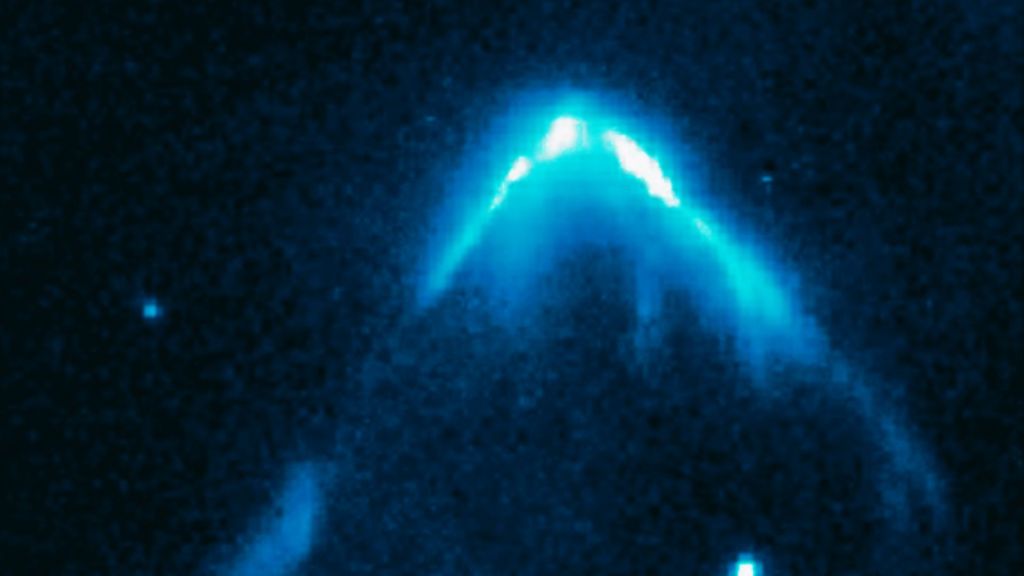
The mysterious and unexpected bow shock around RXJ0528+2838 is what you would expect to see from a stellar engine, fictional propulsion systems that can rapidly move stars through interstellar space. There are some interstellar interlopers, rapidly moving stars that naturally zip through space, without the use of such fantastic contraptions. As these ballistic stars plough through the interstellar medium, the thin, wispy gas that permeates the vast distances between stars, they create brilliant arrowhead structures and trailing tails of glowing gas. These bow shocks resemble the wake of a boat moving through the sea.
Stars form in vast clouds of gas known as stellar nurseries. The densest knots of cold gas collapse under the influence of gravity, drawing in the surrounding gas and dust till the pressure and temperatures can sustain the fusion of hydrogen into helium. The stars born in clusters are bound by the mutual influence of gravity. The interactions between stars in star clusters can result in some stars being ejected at tremendous velocities. These runaway stars easily move in speeds in excess of 30 kmps relative to the surrounding gas. Close encounters between two binary systems, or a binary system and a single star can result in such ejections. A supernova explosion in a binary system can also give a kick to the surviving star.
Runaway Stars
The speed of sound depends on the temperature and density of the gas. Both the temperature and the density of gas varies wildly in extreme, very-low density environments such as the interstellar medium, which has a density of about one atom per cubic centimetre. Runaway stars moving faster than the local speed of sound in the gas create bow shocks. This is the rate at which small pressure disturbances such as sound waves propagate through gas. The bow shocks are formed as streams of charged particles ejected from the surface of the star, known as stellar winds, collide with the ambient gas, compressing the hot gas into an arc-shaped structure ahead of the star. The tails, that resemble those of comets, are made of heated gas.
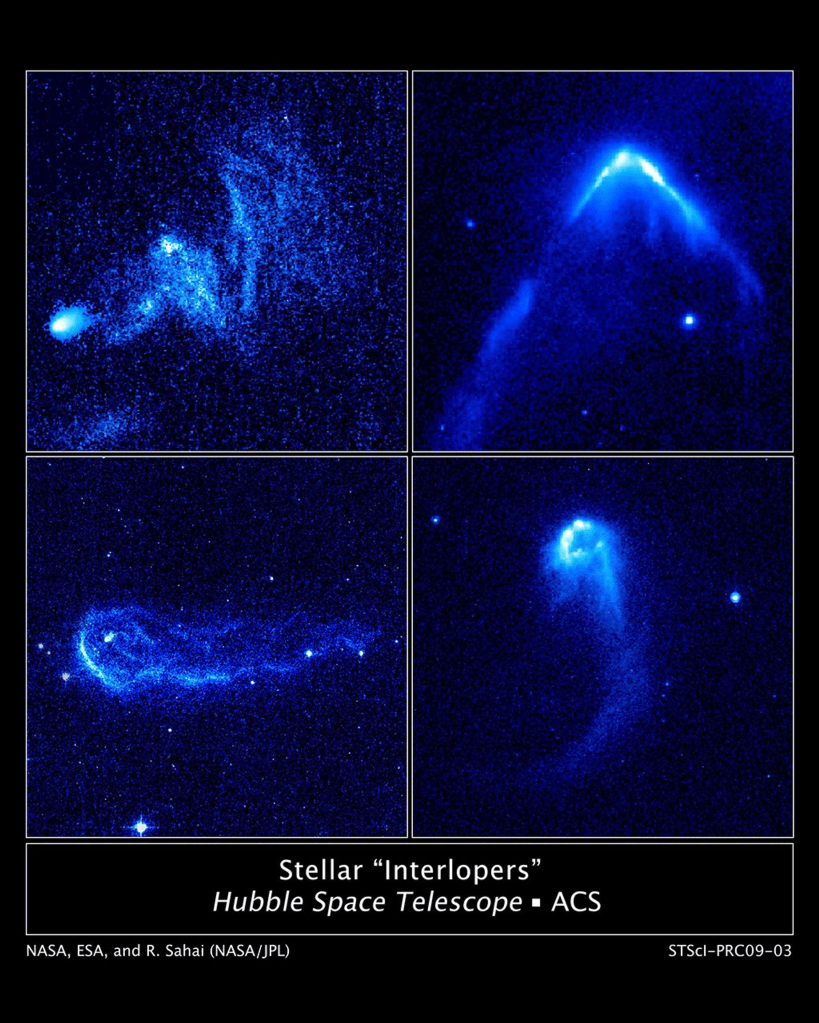
In 2009, the Hubble Space Telescope captured 14 such bow shocks for a survey. These stars were identified based on an earlier infrared surveys. The shocks were between 17 and 170 times the distance between the Sun and Neptune, or the size of the Solar System. All of the stars are young, only a few million years old. Astronomers can determine the age of the stars by carefully examining the strength of the stellar winds. Younger stars are more energetic. The masses of the stars range from a few to eight solar masses. They lack the ionised gas halos that shroud more massive stars. These runaway stars are moving in excess of 180,000 kmph relative to the dense gas, five times faster than average young stars in star clusters. Astronomers were able to trace the stars back to their origin clusters.
Way back in 1983, the Infrared Astronomical Satellite had detected similar but larger bow shocks around more massive runaway stars with stronger winds. The Hubble discoveries are of lower mass, lower-speed counterparts, which are likely to be more common as stellar interactions tend to kick out lighter stars. The positions of these stars are unpredictable, so astronomers can only spot them by luck. The bow shocks can accelerate particles to high enough energies to produce non-thermal radio and gamma-ray emissions. Astronomers are hunting runaway stars based on this theoretical grounding.
Sources:
Systematic search for very-high-energy gamma-ray emission from bow shocks of runaway stars
Hubble Finds Stars That ‘Go Ballistic’
Image Credit:

Leave a comment