
Dyson Spheres are hypothetical megastructures that advanced extraterrestrial civilisations could build around stars to harvest their radiation energy. Project Hephaistos, named after the Greek god of artisans and craftsmen, Hephaestus was a dedicated search for these structures. The theory behind the search was that any swarms of energy collectors around a star would radiate some of the collected energy in the form of waste head, resulting in a specific infrared signature that could be picked up over astronomical distances. The effort was significantly complicated by astrophysical sources that mimic these signatures, a challenge that the astronomers have termed as ‘contamination’.
Note that a rigid sphere would be too challenging to construct, it is unclear if star systems can even have sufficient material for such a structure even if all the moons and planets around a star are disassembled, and such a construction would be mechanically unstable, fragmenting rapidly. Instead, Dyson Spheres would have to be Dyson Swarms made up of independently orbiting collecting platforms. The foundational concept of a Dyson Sphere involves a civilisation constructing a swarm of artificial, light-absorbing components around its host star. Such a Dyson Sphere would have several observational effects: waste head emission, optical dimming of the host star or temporal variations in its luminosity.

Project Hephaistos focused on ‘incomplete’ Dyson Spheres, where the structure only partially obscures the host star, allowing the light to remain detectable. This is in contrast to some earlier searches that focused on only complete Dyson Spheres, which would completely obscure the host star and emit only thermal blackbody radiation. The researchers did not eliminate a variety of host objects, including the cores of dead stars such as white dwarfs, pulsars or black holes. The researchers also considered multi-layered Dyson Spheres, with nested shells operating at different temperatures. The observational limits derived for single-layer spheres could still apply even if only one layer or shell’s emissions completely dominated the others. Such a construction could be a Matryoshka Brain.
The observational effects of Dyson Spheres
Based on thermodynamic principles, some of the energy harvested by the sphere must be radiated away as waste heat. This is expected to be detectable as strong mid-infrared thermal radiation. Project Hephaistos primarily focused on detecting this waste heat, especially for Dyson Spheres operating at temperatures between 100K and 1000K or -173°C to 726°C, which would produce a significant excess in mid-infrared wavelengths, which would be covered by NASA’s Wide-field Infrared Survey Explorer (WISE) mission launched in 2009.
The Dyson Sphere would also block or obscure some of the direct starlight, making the host star appear less luminous than it should. The amount of dimming depends on something called the ‘covering factor’, which represents the fraction of starlight being intercepted, or the level of ‘completion’ of the sphere. A partial Dyson Sphere, would cause fluctuations in the luminosity of the star as different numbers of panels pass in front of it from the vantage point of Earth instruments. However, the detectability of such a signal depends on the size of components, a swarm of many small objects may appear as a translucent screen without causing significant variability.
The Hunt for Dyson Spheres
The search for any of these signatures, waste heat, the optical dimming or the luminosity variation are all considered forms of Dysonian Technosignature Hunting, which has the advantage of not relying on the civilisation’s desire to communicate with us. Project Hephaistos was an initiative designed to conduct the largest search to date of partial Dyson Spheres by leveraging massive astronomical catalogues from missions such as Gaia, 2MASS and WISE. The project was conducted in three distinct phases.
In Phase 1, the project focused on setting conservative limits on the prevalence of partial Dyson Spheres in the Milky Way. 290 million stars were analysed to determine what fraction could potentially host a Dyson Sphere. In a sample of 270,000 stars within 100 parsecs or 326 lightyears of the Earth, less than one in 50,000 could host a 300K or 27°C Dyson Sphere at 90 percent completion. These limits were derived by identifying the number of stars that fell into regions of colour-magnitude diagrams consistent with Dyson Sphere models, without attempting to identify specific conditions.
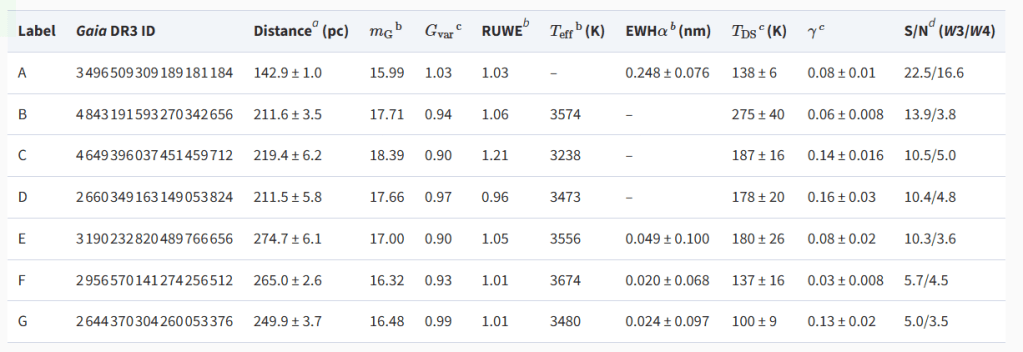
The second phase of the project shifted to focus on building a catalogue of potential Dyson Sphere candidates from a sample of five million stars within 300 parsecs or 978 lightyears of the Earth. A sophisticated pipeline was developed to identify sources with an infrared excess consistent with Dyson Sphere models while filtering out natural sources. This process involved a grid search of Dyson Sphere models, a convolutional neural network (CNN) to reject sources in nebular regions, cuts based on stellar variability and astrometric quality. Ultimately, the extensive filtering process yielded seven candidates (designated as A-G), all of which are M-dwarf stars exhibiting an excess of Mid-Infrared radiation of uncertain origin.
The Challenge of Contamination
The primary interlopers are objects surrounded by dust, either very young stars still accreting gas and dust, or very old stars that are shedding their outer layers. Young Stellar Objects (YSOs) or evolved stars ejecting dust shells can both mimic Dyson Spheres. These dusty environments absorb starlight and re-radiate it in mid-infrared wavelengths, creating an excess that can populate the same regions of colour-magnitude diagrams of Dyson Sphere models. The Hephaistos II pipeline was specifically designed to weed out many of these. This is the reason the CNN was used to identify and reject sources in dusty nebular regions.
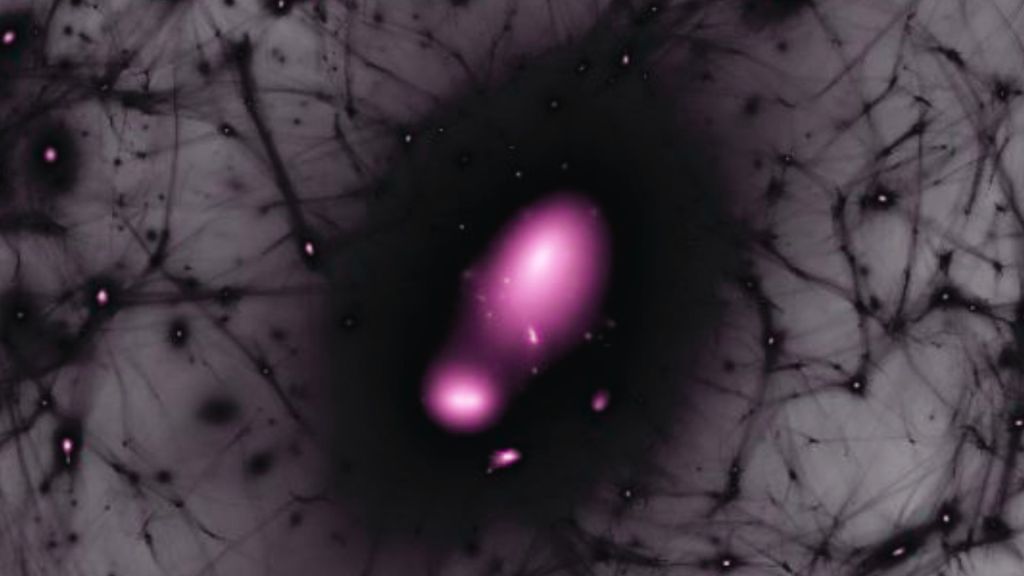
Unresolved binary systems can generate warm dust from planetary collisions, leading to an excess in mid-infrared frequencies. Debris disks around M-dwarf stars are very rare, but they are possible in theory, providing a natural explanation for the seven candidates identified by Project Hephaistos. A critical issue, especially for the seven identified candidates is contamination from unrelated background sources that are along the same line of sight. Several sources suggest that the mid-infrared excess of some candidates is not from the star itself, but from a background Active Galactic Nuclei, or the tortured material falling into a supermassive black hole occupying the core of a galaxy glowing from the extreme friction. Hot, Dust-Obscured Galaxies or Hot DOGs are a specific class of AGN that are faint in optical and near-infrared wavelengths, but bright in mid-infrared bands. Their estimated sky density is high enough to potentially account for all seven Hephaistos candidates being misidentified.
Hephaistos Candidate G
High-resolution radio observations of Hephaistos Candidate G provided strong evidence for the contamination scenario by a background Hot DOG. The observations revealed a radio source identified as a radio-loud AGN, offset from the position of the M-dwarf. Analysis of WISE observations indicated that while the near-infrared emissions centered on the star, the mid-infrared emissions were centered around the AGN, confirming that the background AGN was contaminating the mid-infrared observations, creating an illusion of a Dyson Sphere around a normal M-dwarf star.

Project Hephaistos has significantly advanced the search for Dyson Spheres by moving from statistical limits to identifying specific, although preliminary candidates. The findings of the project underscores the immense difficulty of this search. The case of Hephaistos Candidate G demonstrates that what may appear to be an extraordinary technosignature can be explained by a chance alignment with a distant astrophysical object, highlighting the critical need for high-resolution, multi-wavelength follow-up observations to disentangle true ‘anomalies’ from contamination.
Image Credits:
Cover Image: Star Engine/Gemini/Aditya Madanapalle
Dyson Sphere: NASA
Obscured AGN: NASA
Sources:
Project Hephaistos – I. Upper limits on partial Dyson spheres in the Milky Way
Project Hephaistos – II. Dyson sphere candidates from Gaia DR3, 2MASS, and WISE
Background Contamination of the Project Hephaistos Dyson Spheres Candidates


Leave a comment