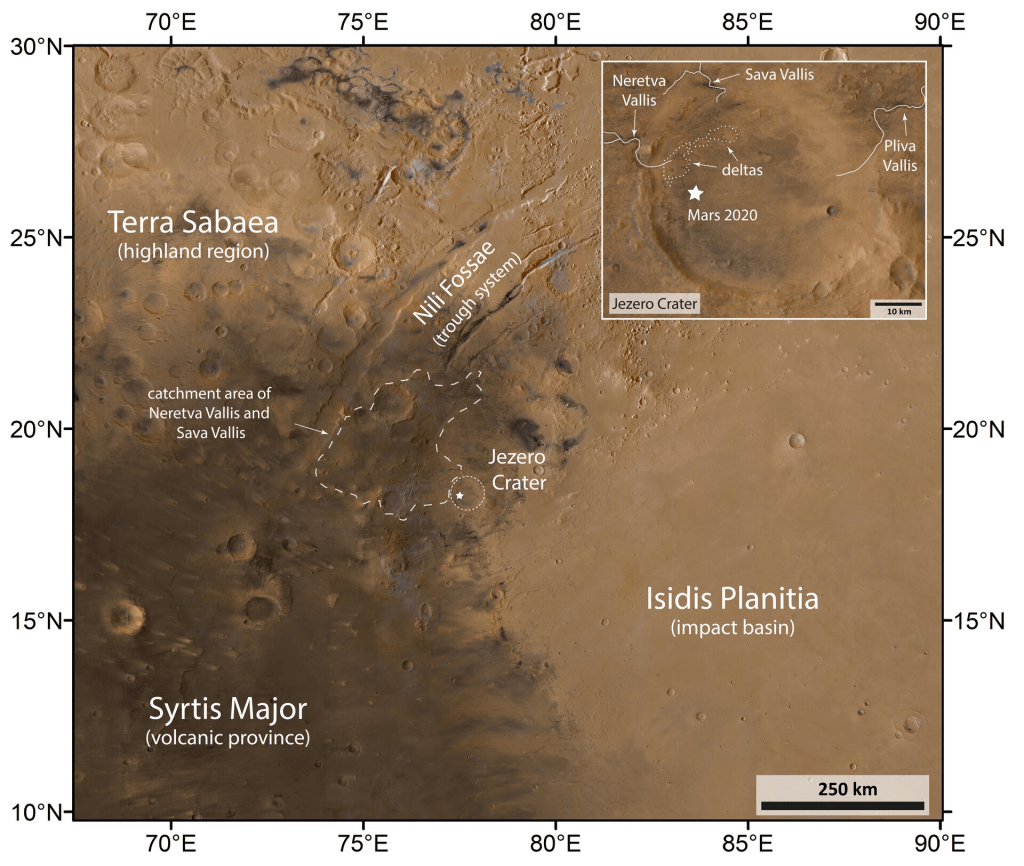
The Jezero Crater on Mars is an incredible location to investigate the past of Mars. It lies on the edges of Isidis Planitia, the third largest impact feature on Mars, formed about 3.9 billion years ago during the chaotic infancy of the Solar System, from an impactor measuring 200 km wide. Jezero crater is located on the fringes of an ancient Martian ocean, sandwiched between highlands, a river delta and a volcanic province. The dark regions have rolling dunes of dark volcanic dust.
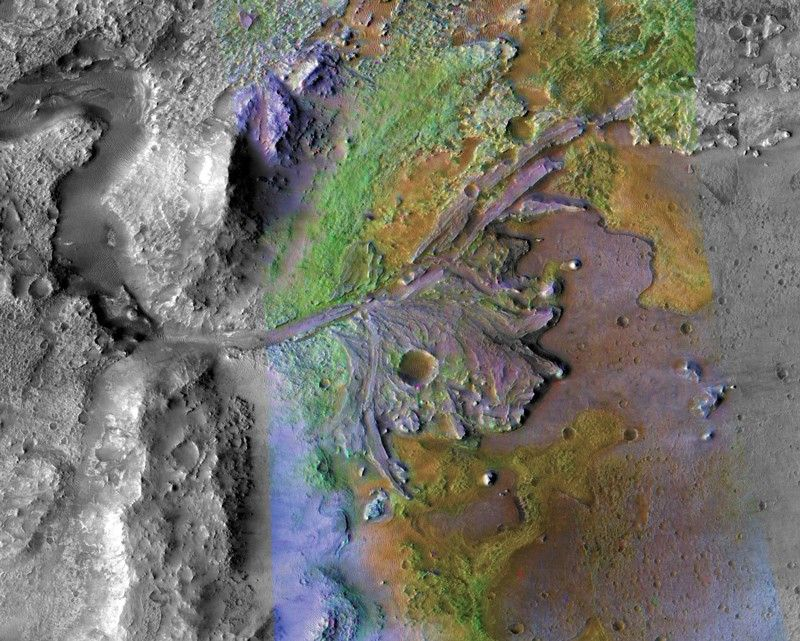
The rover is exploring a region close to the crater rim called the Jezero Fan, a delta that emptied into a lake that once occupied the crater floor. This region was sculpted by flowing water that carved channels and deposited sediments to form fans and deltas. The rocks close to where the channel exits from the crater rim are of uncertain origin, they may be fragments of volcanic rocks, or formed from underwater sedimentary deposits. This was a nutrient rich region, with conditions conducive to life as we know it.
The river channel flowing into the crater is called Neretva Vallis. Just where the channel cuts through the crater rim, is a bright patch visible from orbit known as ‘Bright Angel’. This formation may be sedimentary deposits at the bottom of a river that flowed billions of years ago, or even more ancient rock eroded away by the flowing water. The rocks here bear clear signs of weathering and fracturing.
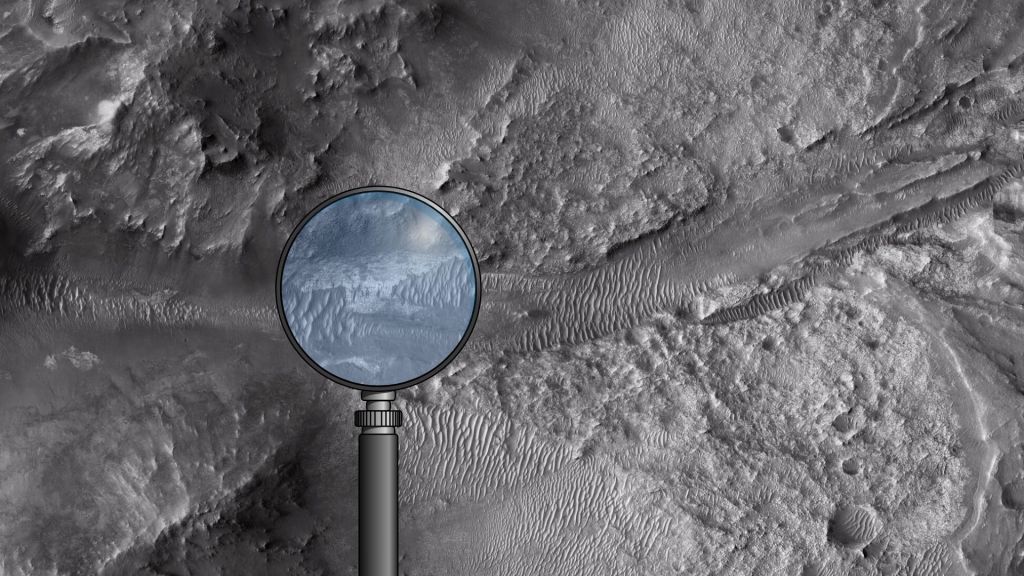
When Perseverance reached here, scientists were surprised to discover rocks unlike any previously encountered on Mars. The rocks contained an abundance of veins and nodules. There were also rocks packed with tightly packed spherical features that the scientists dubbed ‘popcorn’. The microscopic features were diverse and complex.
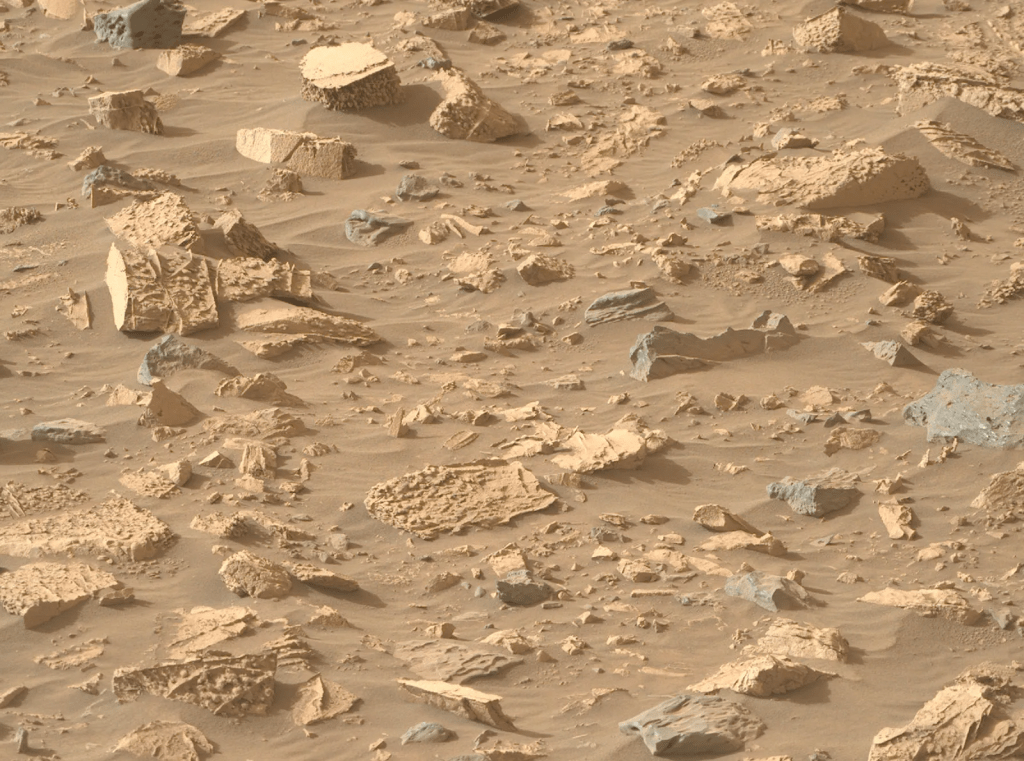
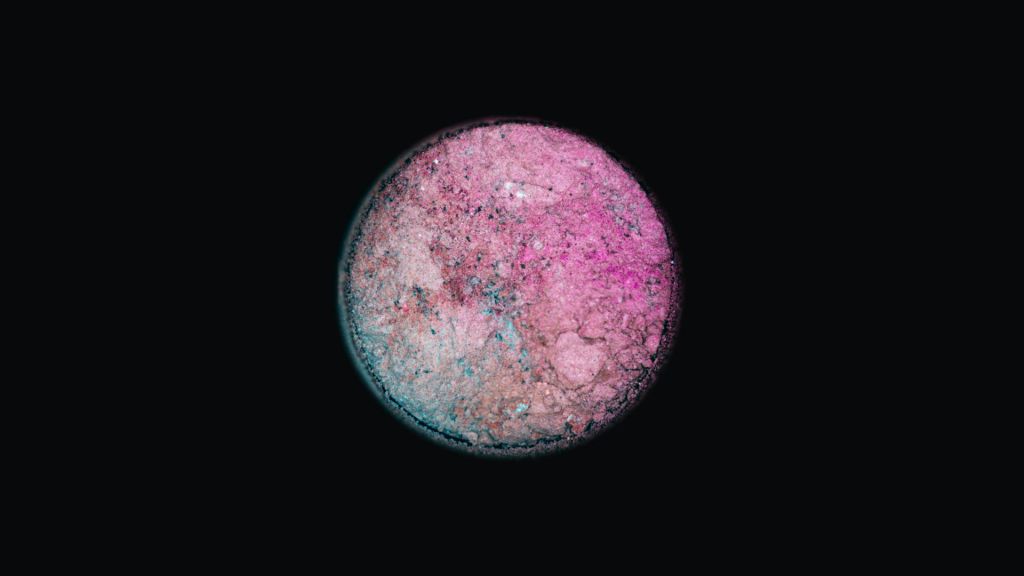
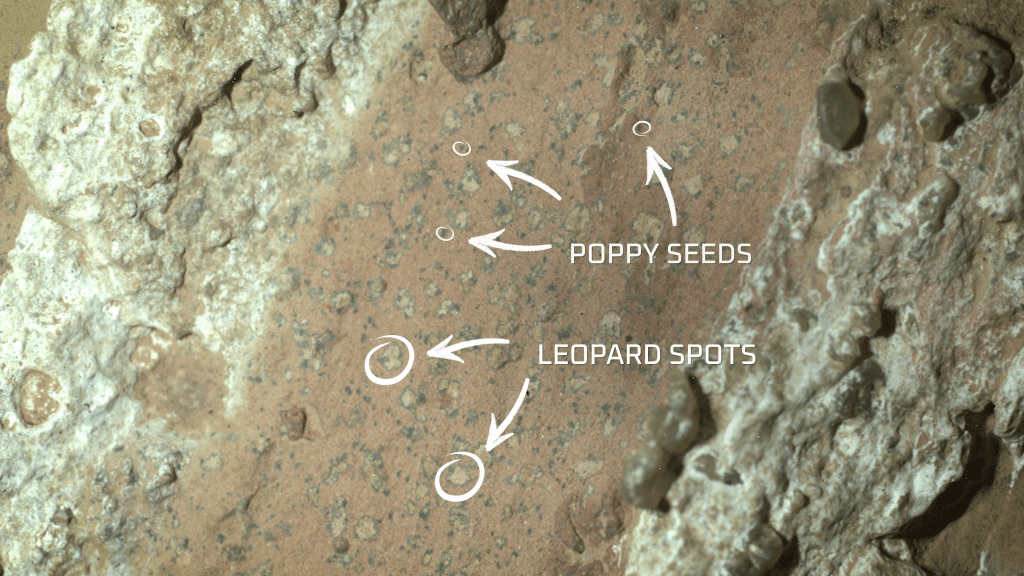
Within the Bright Angel formation, Perseverance stumbled across an arrowhead-shaped rock called Cheyava Falls. This rock featured small dark spots as well as larger bright spots with dark boundaries, dubbed ‘Leopard Spots’. The SHERLOC (Scanning Habitable Environments with Raman & Luminescence for Organics & Chemicals) instrument on board the rover discovered organic molecules on the rock. The bulk of these rocks are made up of fine-grained material that could not be resolved by the cameras on the rover, allowing to constrain their size, which is comparable to coarse silt or fine sand. The red colouration is because of the high iron content. In simple words, this is dried, eroded mud, a mixture of silt and clay.
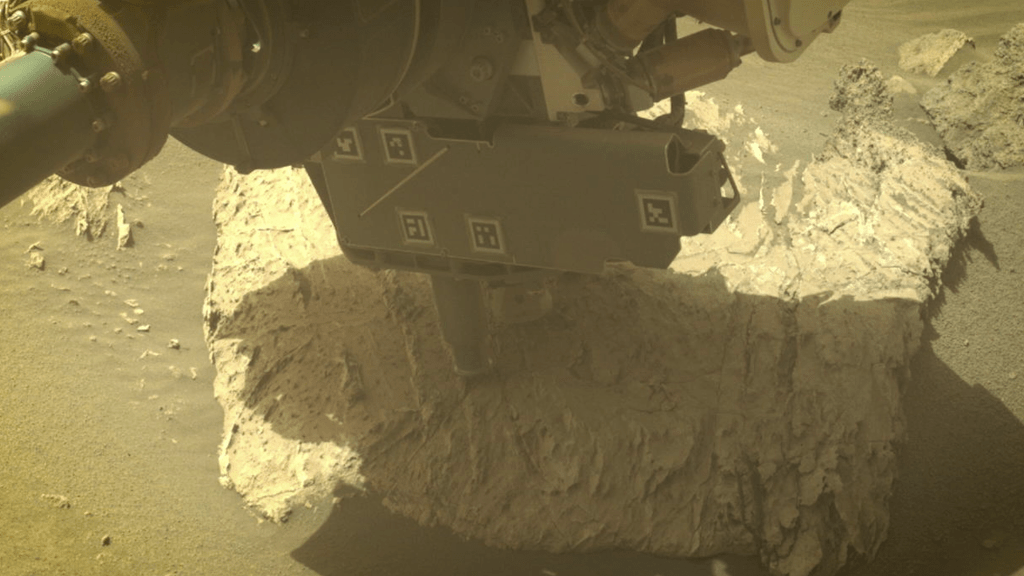
Perseverance collected a sample from the rock, dubbed ‘Sapphire Canyon’, which is the only sample collected on Mars where chemical reactions associated with life could have been taking place in the context of confirmed organic molecules. Sapphire Canyon is one of the most astrobiologically relevant samples collected, and waits to be analysed by labs on Earth. SHERLOC picked up organic material in a number of rocks in the region. The ‘poppy seeds’ on the Cheyava Falls rock is dark blue-green, and are enriched in iron, phosphorus and zinc. The ‘leopard spots’ appear to be reaction fronts, and are between one mm and 200 nm wide.
The combination of minerals found in the rocks, and the context that they were discovered in, are consistent with biological processes. Researchers have identified the minerals as ferrous iron phosphate or vivianite and iron silphide or greigite that are typically formed on Earth by reactions inovled in organic matter in low-temperature aqueous environments. We might be looking at Martian poop here, and we will no for sure if we bring the samples home and analyse them under a microscope. These are among the strongest potential biosignatures discovered so far. Now I absolutely abhor politics, and hardly post about anything closer than Proxima Centauri, with a deliberate aversion to human spaceships and rockets… but this needs to be said. The Trump Administration’s proposed ‘Skinny Budget’ for NASA cancels the Mars Sample Return mission, favouring a return of the samples by a future crewed mission, that might be decades into the future. Lockheed Martin has proposed a fixed-price mission at less than half the current budget, for only $3 billion, we can bring home these samples, and potentially confirm the presence of extraterrestrial life.
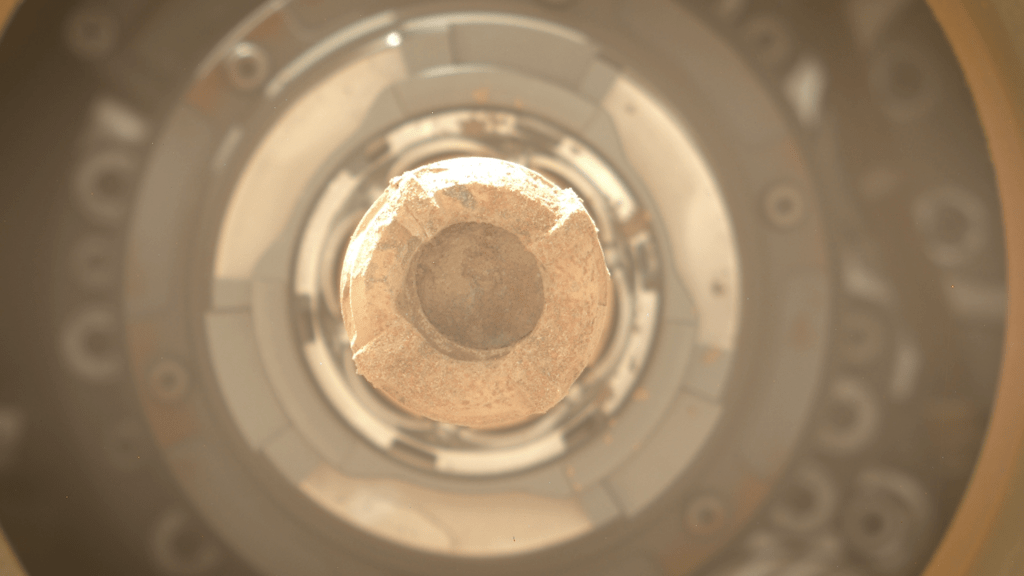
Image Credits:
Jezero Crater and surroundings: ESA/DLR/FU Berlin
Jezero Crater: NASA/JPL-Caltech/MSSS/JHU-APL
NASA
Popcorn: NASA/JPL-Caltech/ASU
Source:
Redox-driven mineral and organic associations in Jezero Crater, Mars




Leave a comment