
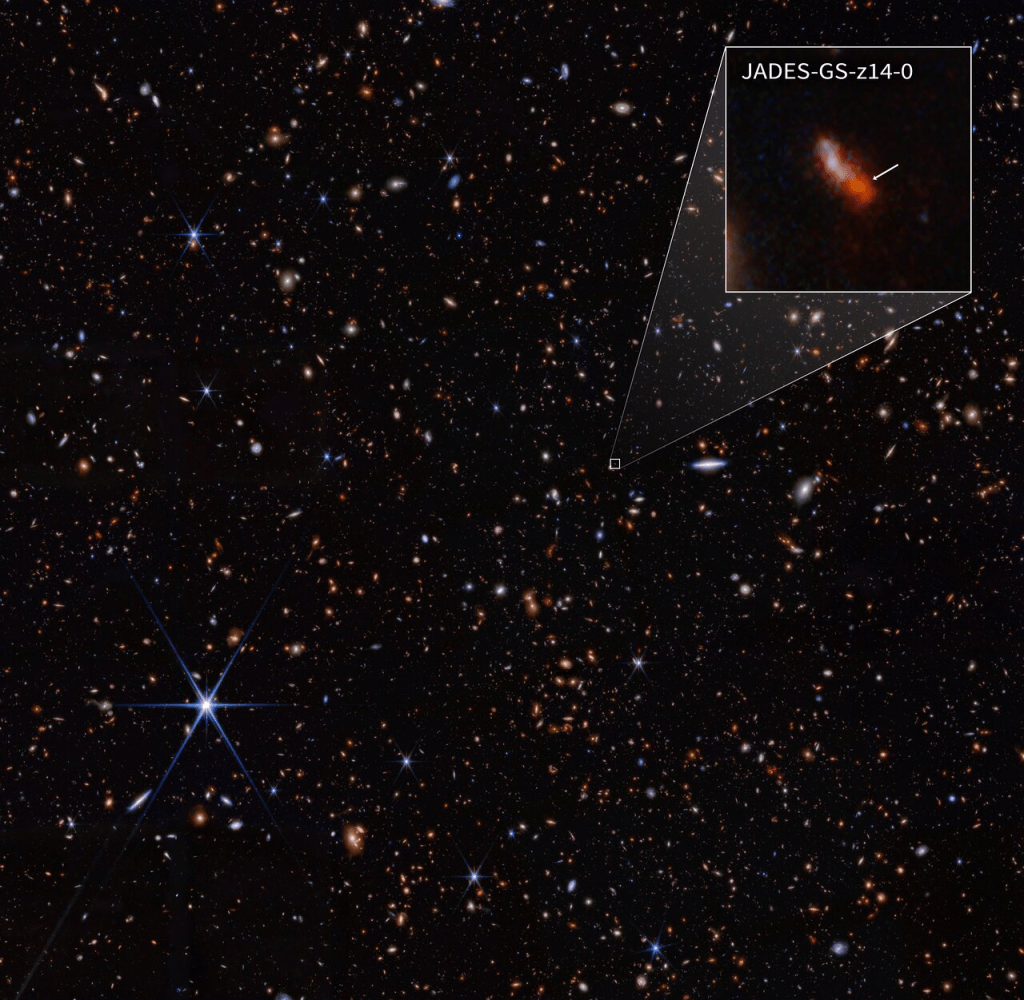
The JWST Advanced Deep Extragalactic Survey (JADES) was conducted between October 2023 and January 2024, and uncovered hundreds of candidate galaxies that were formed within the first 650 million years of the Big Bang. The time period in the infancy of the universe is known as the Cosmic Dawn. In January 2024, the Near-Infrared Spectrometer on board the Webb was turned to a target designated as JADES-GS-z14-0 or GS-z14 for nearly ten hours, confirming that the object was at a redshift of 14.32. This is the most distant galaxy known to science, shattering the previous record held by JADES-GS-z13-0 at a redshift of 13.2. GS-z14 was formed within the first 300 million years of the Big Bang. The discovery of oxygen from the source indicated that the first generation of stars had already formed and died out, cooking oxygen in their cores.
GS-z14 was discovered in a relatively small portion of the sky, indicating that there are a number of such distant, bright galaxies. It is likely that astronomers will stumble upon more such galaxies, including earlier ones. Now, GS-z14 is exceptionally luminous for its era, one of the brightest galaxies discovered at cosmic dawn, indicating a more rapid buildup of galaxies in the early universe than previously estimated. Unlike most other luminous high-redshift galaxies, GS-z14 is spatially resolved, indicating that its luminosity is dominated by an extended stellar population rather than an actively feeding supermassive black hole at its core, like most other LRDs. The galaxy is producing new stars at the rate of 14 to 25 solar masses per year, comparable to intense starbursts in the local universe. The amount of gas detected within the galaxy is well below the levels expected considering the metallicity of the galaxy. The dust content of the galaxy has not been detected.
An unusual interstellar medium
The interstellar medium of the galaxy exhibits extreme physical conditions, characterised by a very high ionisation rate and a surprisingly low density of gas. The low overall gas fraction, weak ultraviolet emissions combined with the lack of significant dust all point towards the powerful influence of stellar feedback and galactic outflows in shaping the properties of GS-z14. Stellar feedback here is how radiation pressure, solar winds and ultimately the supernova deaths of stars influence the surrounding galaxy. Analysis indicates a complex, multi-zone interstellar medium to reconcile the observations across different wavelengths, challenging the conventional ‘single-zone’ assumptions. The detection of both carbon and oxygen has allowed astronomers to determine the carbon-to-oxygen ratio, a value that is consistent for an environment enriched by core-collapse supernovae, which is the explosive death of massive stars that are suspected to have existed in the infancy of the universe. This is in-line with expectations from a young galaxy where lower-mass stars have not contributed to the chemical inventory.
The discovery of such a bright, massive and chemically enriched galaxy early in the history of the universe requires the development of new theoretical models that allow for highly efficient formation of stars, and rapid assembly of galaxies. Multiple lines of evidence including the powerful outflows, a low gas fraction and the high escape fraction all suggest that the earliest phase of galaxy growth is dominated by stellar feedback, that regulates subsequent star formation through the expulsion of fuel. The complexity of the interstellar medium also suggests that the conventional methods for estimating metallicity are biased by high-density, high-temperature regions that do not represent the bulk of the mass of the galaxy. GS-z14 has lived an interesting life within the first 300 million years of the universe. The analysis indicates that there may be many more such galaxies lurking in the fringes of the detection limits of our astronomical instruments, and that humans really do not understand the early universe that well at all.
Webb is giving scientists with unprecedented access to the cosmic dawn, a period of time in the early universe when the first stars began to shine in the first galaxies. This record is likely to be broken multiple times.
Image Credit: NASA, ESA, CSA, STScI, B. Robertson (UC Santa Cruz), B. Johnson (CfA), S. Tacchella (Cambridge), P. Cargile (CfA)
Sources:
Detection of [OIII]88μm in JADES-GS-z14-0 at z=14.1793
The eventful life of a luminous galaxy at z = 14: metal enrichment, feedback, and low gas fraction?

Leave a comment