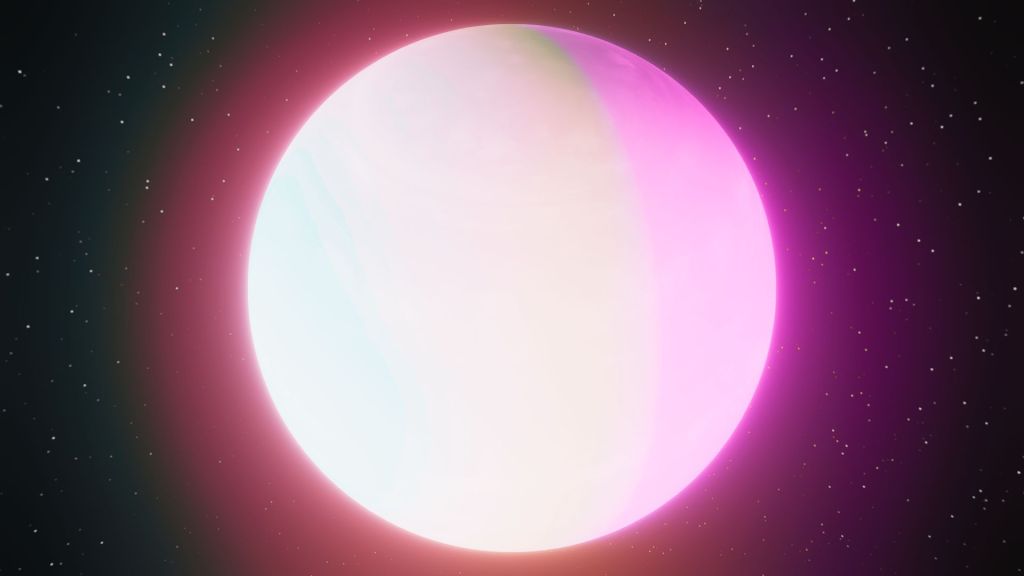
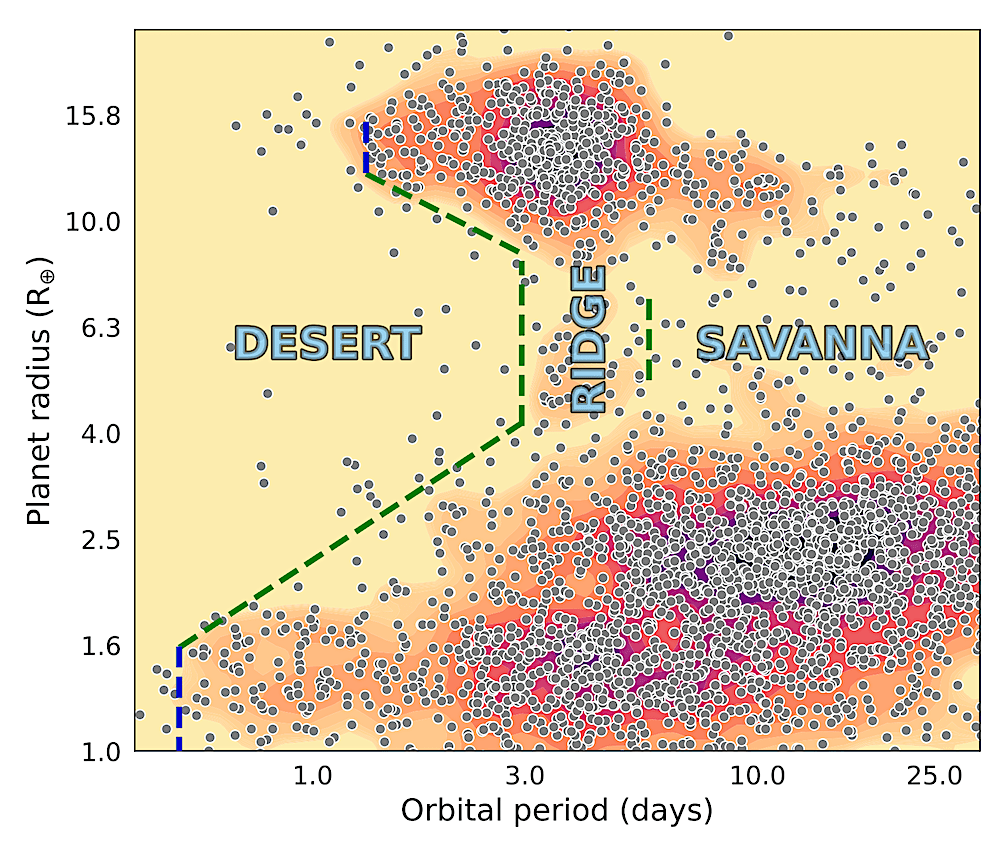
Humans have now discovered over 6,000 exoplanets, about a third of these are Neptune-sized worlds. Neptune is about four times the size of Earth, while Jupiter is 11. Planets up to twice or 2.5 times the radius of Earth are considered Super-Earths. Worlds between 2.5 and 10 Earth radii are all described as Neptune-Sized or Sub-Jovian. While a number of Hot Jupiters and Hot Super Earths are known, there are very few Hot Neptunes, resulting in what is known as the Hot Neptune Desert, or the Sub-Jovian Desert. Exo-Neptunes with orbital periods of between three and four days are exceedingly rare, indicating that worlds of this size are particularly sensitive to the energy output from the host stars.
The leading explanation for the Hot Neptune Desert is the photoevaporation of the outer layers. Essentially, the energy from the host star causes the outer layers to boil away. Intense X-rays and extreme ultraviolet (XUV) radiation from the host stars can strip away the primordial hydrogen-helium atmospheres of Neptune-sized worlds, eroding them down to their rocky cores. The terrestrial worlds in tight orbits around their host stars may well be the skeletons of lost Neptunes. The desert is not entirely barren though. At orbital periods longer than the desert, where years last longer than about 5.7 Earth days, there is a moderately populated region known as the Exo-Neptunian Savanna. The worlds in the savanna are generally less irradiated than the ones in the desert, and tend to have lower densities. The processes that shape the worlds in the savanna might be different that the mechanisms at work int he desert.
The Hot Neptune Ridge
If the parameter space of known worlds were mapped onto a landscape, then a ridge emerges between the desert and the savanna. There is an overdensity of planets between 5.5 and 8.5 Earth radii in the orbital range between 3.2 and 5.7 Earth days. This feature in the landscape stands out above the sparsely populated desert and the moderately populated savanna. The Neptunian Ridge is aligned to the Hot Jupiter Pileup, an overdensity of Jupiter-sized worlds in the same orbital range. This had led scientists to suspect that both the populations are shaped by the same underlying forces.
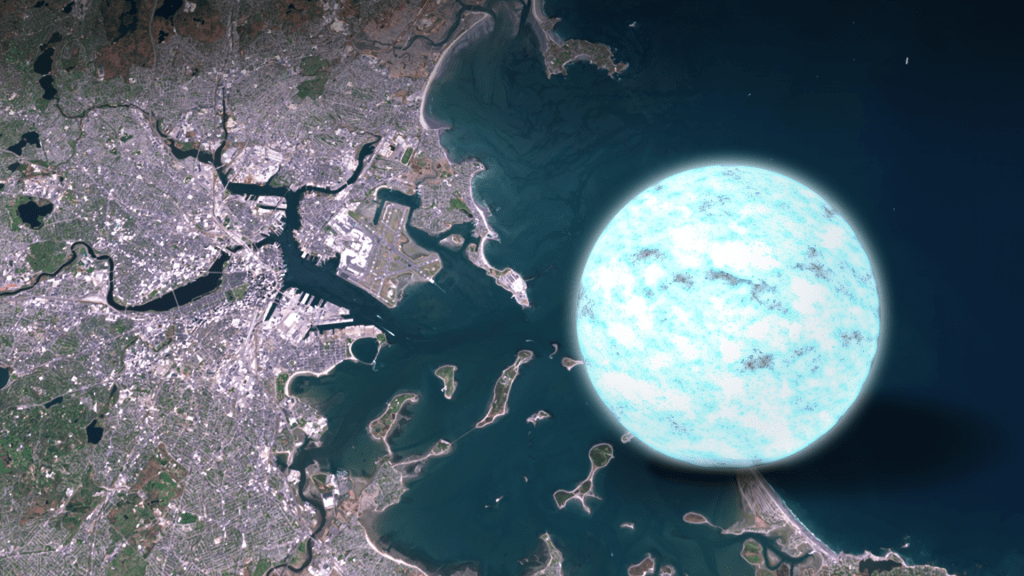
Stars are born from dense knots in molecular clouds, shaped by the radiation and gravitational interactions with surrounding stars. The cold gas and dust begins to collapse under the influence of gravity, with a small initial spin causing the infalling material to rotate. The rotation flattens the collapsing gas and dust into a disc. The dense nucleus turns into a hot corino and a protostar before being able to sustain nuclear fusion, marking the birth of a star. The planets are assembled in the surrounding leftover material. At tighter orbits, there is less material, and almost no gas and ice, which sublimate because of the radiation. This is why terrestrial worlds form readily in the inner planetary systems. In the outer reaches, gas and ice giants form where the material is not blown away. Such giant planets, may then migrate inwards towards the host star, resulting in Hot Jupiters and in theory, Hot Neptunes.
The structured Neptune Landscape
Stars are especially energetic in their infancy, flaring frequently and shining in intense ultraviolet light. It is believed that the Neptunian Ridge and Hot Jupiter Pileup are populated by worlds that moved closer to the host star through high-eccentricity tidal migration (HEM), after the XUV radiation phase of the host star. This explains why the worlds in the ridge tend to be denser than the worlds in the savanna, and often exhibit eccentric or misaligned orbits.
Src: ATREIDES

Leave a comment