
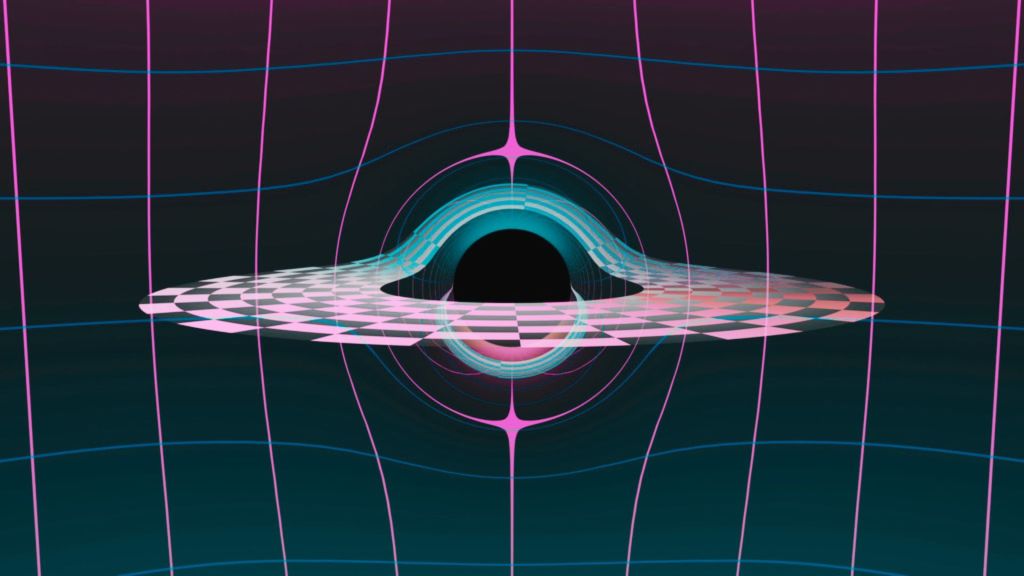
Black holes are only available in a select few varieties. Supermassive black holes occupy the cores of large, evolved galaxies, and contain upwards of 100,000 solar masses. Stellar mass black holes are formed from the collapse of the most massive stars, and can contain up to about 100 solar masses. Bridging this mass gap are elusive intermediate mass black holes. Not many of these are known, but they are suspected to lurk within the hearts of globular clusters. The smallest known black hole contains about 3.8 times the mass of the Sun, which is actually lower than the theoretical lower limit of the least massive black hole that can be formed by the violent death of a giant star. New research suggests that in theory, black holes of less than 0.02 solar masses can form.
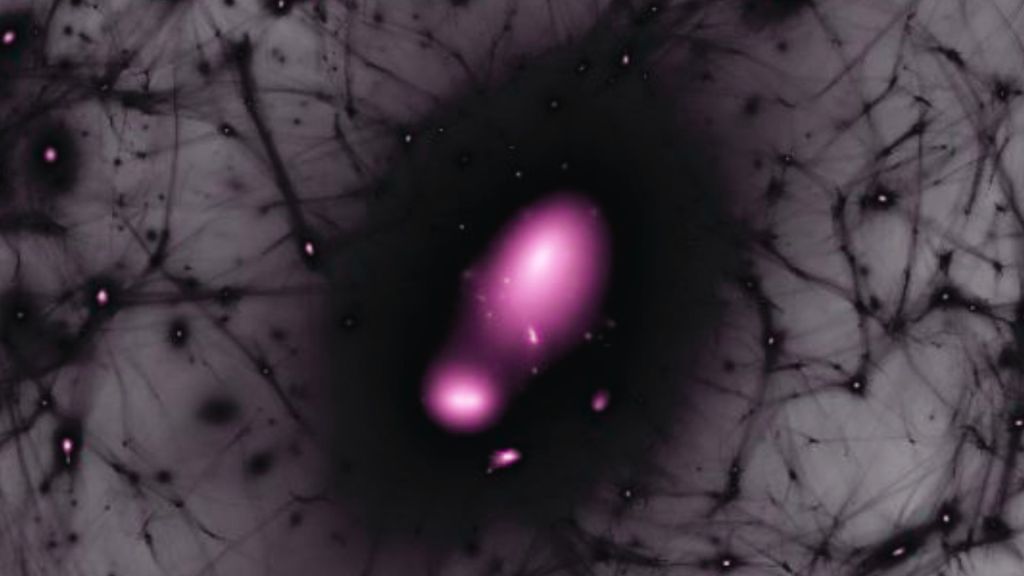
The process is simple, and involves a mysterious source of gravity that pervades the universe, that scientists have never identified, but are very sure exists: Dark Matter. If the particles that make up dark matter are cold, as in they do not move very fast, and if they do not destroy each other on encountering each other, then it is possible that these ‘axions’ would accumulate in the cores of gas giants. The concentration of axions would then collapse into a tiny black hole, that would then start feed on the surrounding planet, first swallowing up an ocean of metallic hydrogen and helium, a much thinner atmosphere of liquid hydrogen and helium, and finally the outermost atmosphere of multilayered clouds, before replacing the gas giant entirely. This process can potentially produce planetary mass black holes, and they may be observable over astronomical distances.
Detecting planetary mass black holes
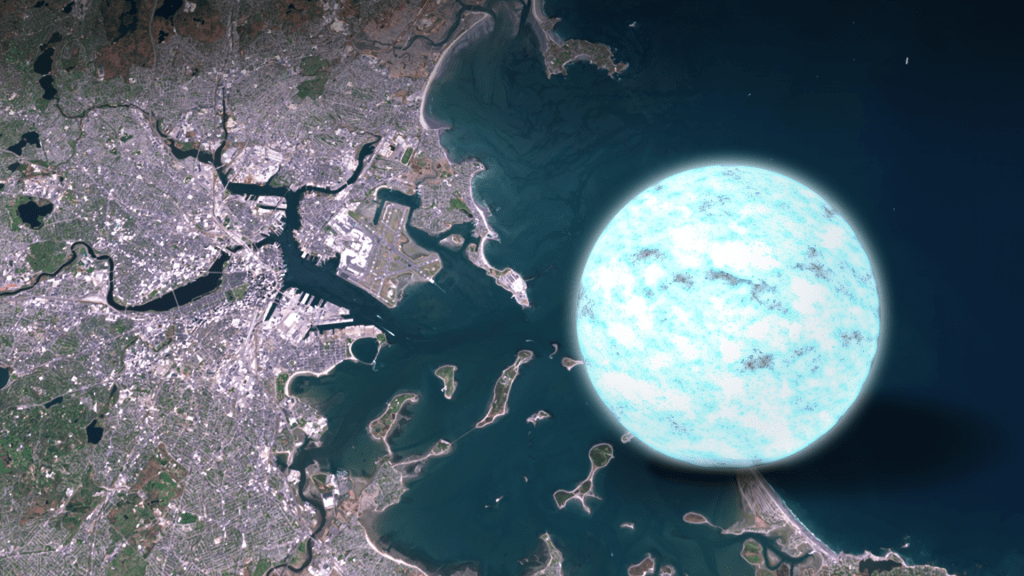
Planetary mass black holes would be incredibly compact. A black hole containing 10 Earth masses would be about the size of a tennis ball. There is actually an conventionally accepted pathway for the formation of small black holes. These are primordial black holes that could have emerged in the first few moments after the Big Bang. Anything smaller than about a sixth of Earth mass would have evaporated by now because of Hawking radiation. No primordial black holes have been detected. No planetary mass black holes have been detected either. The detection of smaller black holes will help scientists test and validate a number of hypotheses, including the formation of primordial black holes and the nature of dark matter.
If for example, a large number of gas giants are discovered in a wide variety of environments that have not collapsed into black holes, then it may indicate that dark matter is not cold or not self-annihilating. Discovering a population of planetary mass black holes would provide evidence in support of superheavy non-annihilating dark matter model. A black hole swallowing a gas giant from the inside out would be a violent and chaotic process. The lightweight ones would just evaporate away, resulting in the energetic radiation of electron and positron pairs. Conventional astronomical instruments do not possess the capabilities of detecting such energetic radiation. Future instruments though, may be able to pick out such signatures.

Leave a comment