
In 1965, two researchers at Bell Labs, discovered a persistent radio signal that did not seem to originate from any specific point in the sky. The signal remained consistent through all the seasons, and was noise, like radio static. Penzias and Wilson tried to find out where the noise was coming from, and methodically eliminated a number of potential sources, including cities and nuclear tests. The researchers even evicted pigeons that had occupied the antenna. When all possible sources were eliminated, the researchers concluded that the sky was glowing uniformly in all directions, today known as the Cosmic Microwave Background (CMB).
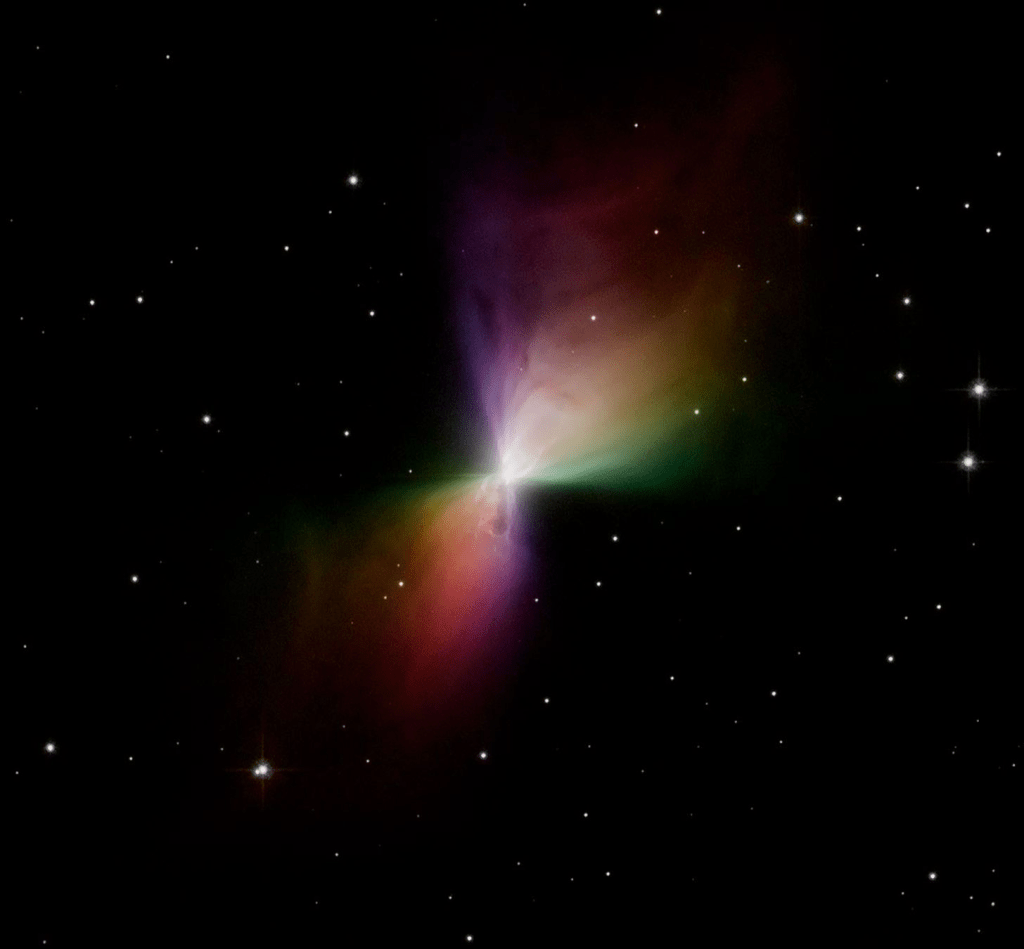
NASA, ESA and The Hubble Heritage Team (STScI/AURA); Acknowledgment: J. Biretta (STScI)
The CMB observation matched closely with the big bang theory, which predicted a uniform shockwave that should exist behind all the light sources in the sky, even the most distant and earliest galaxies. No other theory explains the CMB. The ambient temperature of the universe is around -270°C, just a shade above absolute zero, the coldest any place can get in the universe is -273°C. Cooling mechanisms of exceptional efficiency are required to drop temperatures beneath the CMB in space, and the universe spawns such natural phenomena. The Boomerang Nebula, at a distance of 5,000 lightyears from the Earth is a dying star that has run out of fuel for nuclear fusion, but has not yet violently shed its circumstellar envelope in a spherical shell, known as a planetary nebula for their resemblance to worlds in the sky.
Pre-planetary Nebula
The Boomerang Nebula is losing mass at an extreme rate, about a thousandth the mass of the Sun shoots out of the dying star every year. This pre-planetary nebula phase lasts for only a thousand years in life cycles of stars that can be billions of years long. Despite the extreme mass loss rate, the source is of unusually low luminosity. The waist of the hourglass-shaped structure is particularly dense as well. Astronomers suspect that the dying star had a binary companion, that spiraled inwards and fell in, resulting in the complex features observed. The ejected material is mostly gas with a little bit of dust, and it is expanding rapidly, leading to a sudden drop in temperatures. The temperatures can drop below CMB values because of adiabatic expansion, making the Boomerang Nebula the coldest naturally occurring place in the universe.

ESA/NASA
Astronomers have created a chronology of ejections, starting with ultra-cold outflows 3480 years ago, the central waist about 1975 years ago, and the most recent fast, bipolar outflows from 1050 years ago. The ejection of the outer envelope, the waist, and bipolar outflows matches closely with theoretical predictions of interactions with a binary companion. This binary companion was star or dead star in orbit around the dying star. Such an interaction would have resulted in a Common-Envelope Ejection (CCE) event, where the binary companion merges into the dying star. The ultracool shell of expanding gas and dust is mostly dark, but the energetic ultraviolet light from the surrounding are re-heating the dust grains, that then transfer the energy to the gas. The Boomerang Nebula is surrounded by a sphere with faint, patchy emissions because of photoelectric grain heating of the coolest material in the universe.
Sources:


Leave a comment