The James Webb Space Telescope is a time machine, allowing astronomers to study the farthest galaxies. The incredibly distant galaxy designated as GS-z13-1 in the GOODS-S field is one such example. This galaxy was formed within the first 330 million years of the Big Bang, and we should not even be able to see it, because the universe was opaque at that time, filled by a fog of neutral hydrogen. The light from the first stars reionised the hydrogen, rendering the universe transparent. No other instrument can see as far away and as far back as Webb, and scientists are not sure how to interpret data from the infancy of the universe.
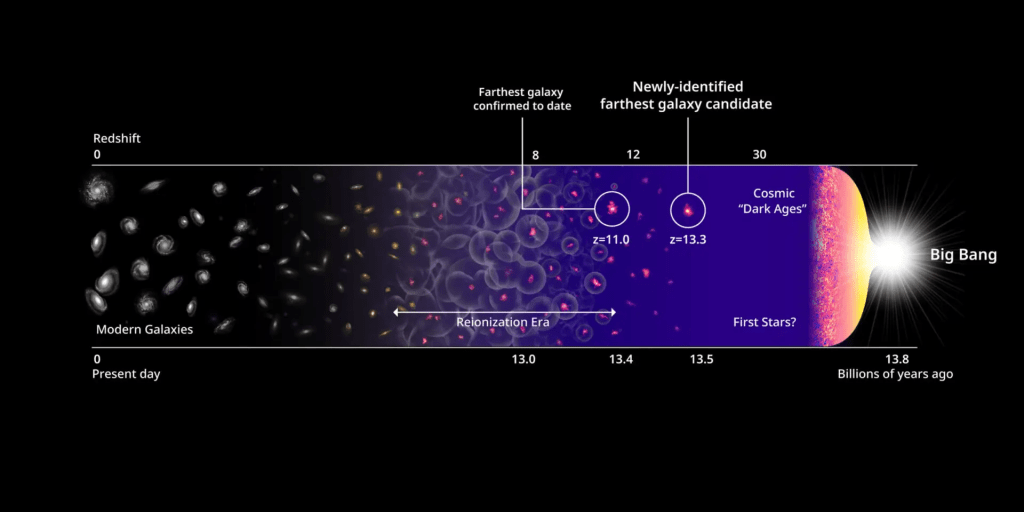
These first galaxies, brimming with the energetic light of the massive first generation of stars, lit up the universe during the Epoch of Reionisation. At a redshift greater than z=13, light has travelled for over 13 billion years to reach us. GS-z13-1 has a redshift of 13.0, but there is another, possibly even more distant galaxy, spotted by the ground-based ALMA called HD1. No single ground based observatory has the capabilities for imaging such distant objects, but HD1 was discovered using a virtual telescope, a global network of multiple astronomical instruments.
Carbon and Oxygen
HD1 is at a redshift of z=13.27, but the discovery is tentative, the signals are subtle, just a shade above the background noise. To determine if this galaxy really existed, astronomers used a clever technique called jack-knifing, that involves splitting the data into pieces, analysing each piece, and determining of the signals still hold up. Sadly, the faint fingerprints of oxygen and carbon melted away into the background noise under close examination.
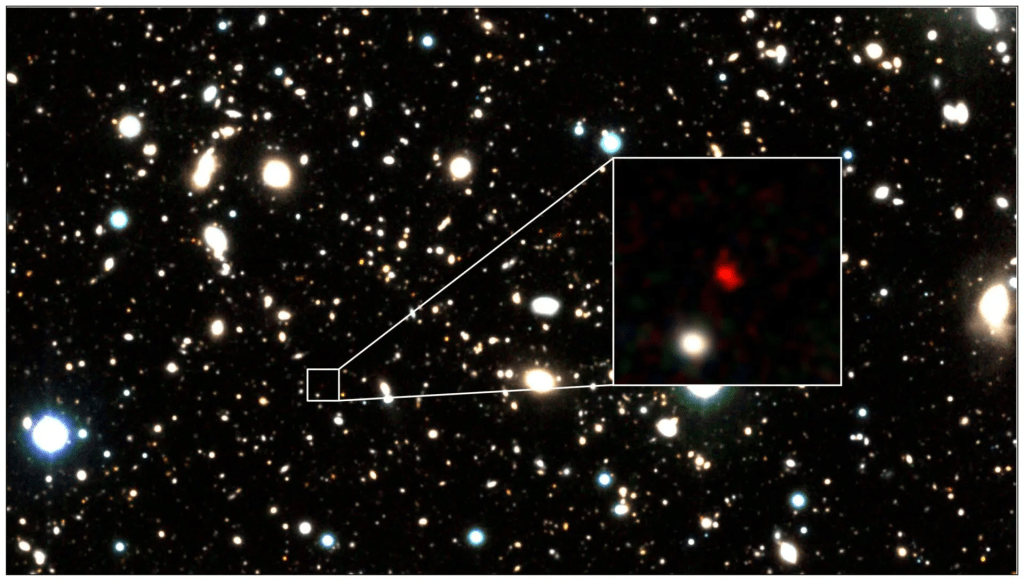
The scientists were able to calculate that the chance that both the carbon and oxygen signatures were real was only about 0.5 per cent, which is the same as flipping a coin and getting heads ten times in a row. HD1 could be a galaxy from the dawn of time, or a dusty dwarf galaxy at z=0.2 or a quiet galaxy at z=4. Only Webb has the sensitivity to conduct follow-up observations to conclusively determine the distance or redshift of HD1.
The Song of Lyman-Alpha
Lyman-alpha (Lyα) emissions are a telltale wavelength of light that acts as a signature of hydrogen. This signature has been detected with GS-z13-1, which could be the light from the first generation of stars, or an actively feeding supermassive black hole occupying the core of the galaxy. If the latter is true, then GS-z13-1 hosts one of the first such monsters to be spawned in the universe. Scientists have simulated and modelled the early universe, and have determined that despite significant attenuation by the opaque neutral hydrogen in the intergalactic medium, Lyα emissions can be detected from high-redshift galaxies under specific conditions. Attenuation is just a fancy word for the weakening of the intensity of lights, specifically in certain emission lines. Based on GS-z13-1, scientists have suggested a probability of around 10 per cent for observing strong Lyα emission from a galaxy of similar luminosity.
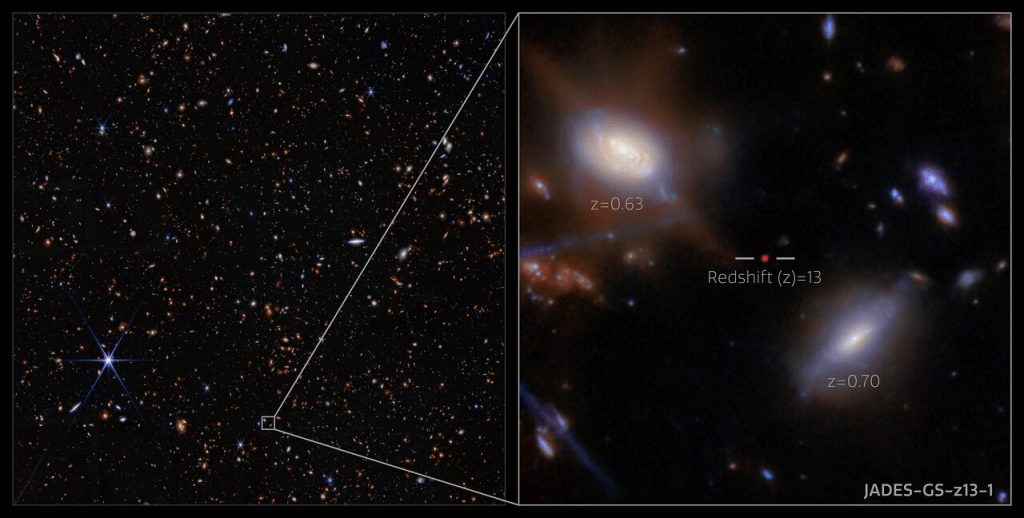
Together, these two galaxies highlight the complexities and challenges of studying the earliest galaxies from the Epoch of Reionisation. These galaxies appear as dots, at most a few pixels wide on the most sensitive astronomical instruments. Astronomers are on a quest to understand when and how the first galaxies formed, and how they reionised the neutral hydrogen in the early universe. Lyα is a common redshift indicator at lower redshifts, but is heavily attenuated in the Epoch of Reionisation. Lyα is absorbed by neutral hydrogen, but in some conditions, the signature can be observed at high redshifts. The systemic velocity of the galaxy allows the Lyα photons to redshift out of the damping wing before encountering neutral hydrogen. The density of hydrogen in the surrounding medium, and the size of the ionised bubble that the galaxy resides in are both determining factors.
Democracies and Oligarchies
Low mass galaxies can carve out larger bubbles of reionisation, and subsequently visibility, boosting the probability of detecting Lyα emissions. These are clusters of small, dwarf satellite galaxies that will eventually merge with the large galaxies, to assemble the spiral galaxies with central bars that we see in the neighbourhood. Such reionisation by many faint, distant, low-mass galaxies is called democratic reionisation. Oligarchic reionisation is driven by high-mass galaxies, and tends to result in smaller ionised regions around faint emitters, limiting their detectability. About one in ten galaxies are expected to be observable in Lyα at such high redshifts.
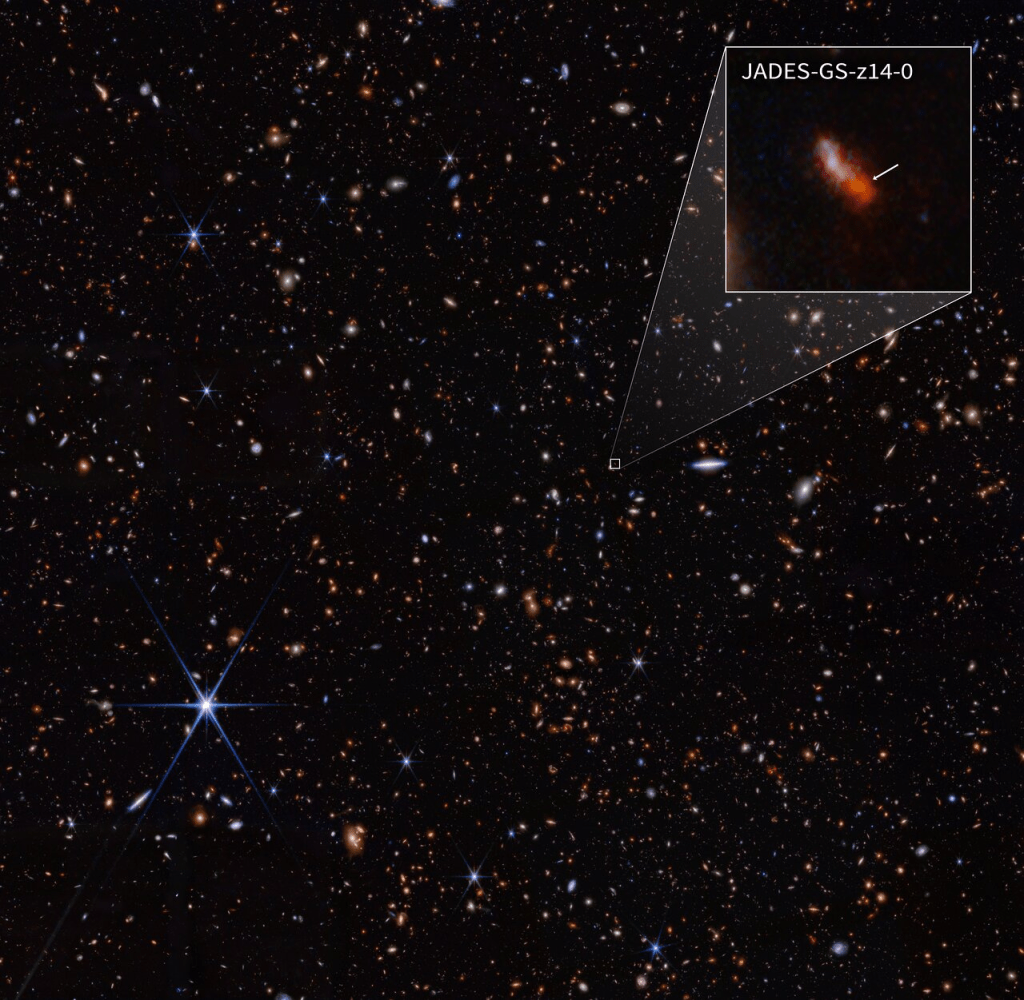
These are not the most distant galaxies discovered. That honour belongs to JADES-GS-z14-0. The borderline impossible redshift is included in the designation. The JWST Advanced Deep Extragalactic Survey (JADES), the Ultradeep NIRSpec and NIRCam Observations before the Epoch of Reionization (UNCOVER), the Grism Lens-Amplified Survey from Space (GLASS), and the Cosmic Evolution Early Release Science (CEERS) programme, all run on the James Webb Space Telescope are all deep field surveys where the small red dots in the background are the most interesting objects for astronomers. All of these programmes have yielded so-called Lyman-break galaxies, brimming with newborn stars – the first to be formed in the universe. That is a story for another day.
Image Credits:
Early Galaxies: NASA, ESA, and P. Oesch (Yale University)
HD1: Harikane et al.
JADES-GS-z13-1 in the GOODS-S field (NIRCam image, annotated): ESA/Webb, NASA, STScI, CSA, JADES Collaboration, Brant Robertson (UC Santa Cruz), Ben Johnson (CfA), Sandro Tacchella (Cambridge), Phill Cargile (CfA), J. Witstok, P. Jakobsen, A. Pagan (STScI), M. Zamani (ESA/Webb)
JADES-GS-z14-0: NASA, ESA, CSA, STScI, B. Robertson (UC Santa Cruz), B. Johnson (CfA), S. Tacchella (Cambridge), P. Cargile (CfA)
Sources:

Leave a comment