
In 1960, the British-American physicist and mathematician Freeman Dyson advanced the concept of a Dyson Sphere, a swarm of platforms encasing a star soaking up its entire energy output. Such a star-hugging megastructure is a requirement for any advancing civilisation with increasing energy requirements. Since the concept was introduced, it has sparked wild debates and late-night musings. The night sky may be littered with such structures they would all ultimately be abandoned with the inevitable demise of their occupants. Such Ozymandian Dyson Spheres would be decaying slowly, fragmenting over billions of years.
Dyson knew that a single, rigid shell would buckle under the insane mechanical stresses, and instead imagined a loose collection or swarm of independent structures of what were essentially solar panels. Any such alien megastructure would radiate some of the light absorbed from the star in infrared frequencies, that may be spotted from interstellar distances. Once the builders leave or go extinct, the abandoned structure would rot, crack and splinter. Some of these shards may have wandered into our neighbourhood. Interstellar asteroids, such as the interlopers ‘Oumuamua and Borisov may be the scattered bones of these shattered Dyson Spheres.
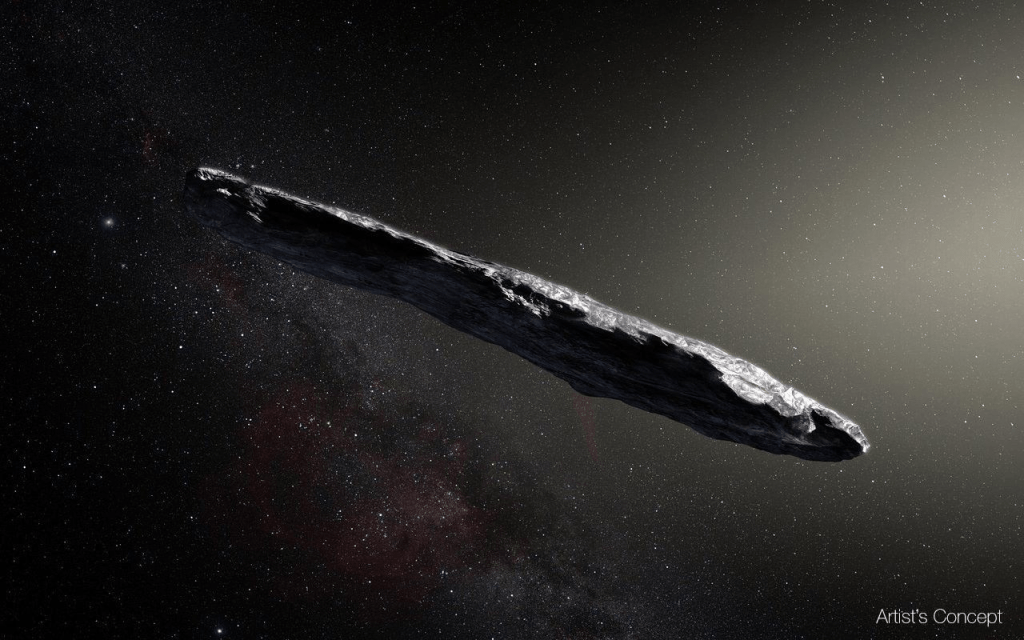
‘Oumuamua streaked through the Solar System in 2017. It had an elongated shape, unlike any asteroid in the Solar System. There was no cometary tail, no gas released as it approached the Sun. Astronomers observed an acceleration that could not be explained by gravity alone. This additional push could be because of outgassing, but no such releases were observed. An alternative theory is that the object was a fragment of a Dyson Sphere, once designed to catch starlight, the object may have been pushed by stellar radiation, like a solar sail.
A couple of interstellar meteors have ended up on the Earth as well. The fact that they survived the trip through the atmosphere at such incredible velocities, travelling in excess of 50 km per second. The material is much tougher than an iron meteorite, and contain a mixture of elements not found anywhere in the Solar System. Metallic spherules in the meteors contain almost no nickel, commonly used in human alloys. Some scientists have suggested that these meteors may be scraps of alien megastructures. The fragments of the first identified interstellar meteor have not been discovered yet, and are somewhere in the waters off Papua New Guinea. Dredging up the material could allow scientists to determine their origins.

A functional Dyson Sphere would be glowing in infrared, but a cold, dead Dyson Sphere would be incredibly hard to spot over interstellar distances. These Dyson Spheres or their ruins could be the ultimate proof that we are not alone, and that civilisations can escape The Great Filter, an unknown process that prevents civilisations from moving beyond their home planets. Astronomers are building up the capabilities to detect and spot interstellar objects. As we continue to scan the skies, we may be able to glimpse the ruins of fallen stellar empires.
Image Credits:
‘Oumuamua: NASA
Borisov: NASA, ESA, and D. Jewitt (UCLA)
Dyson Sphere: GPT 4o

Leave a comment