
Ozymandian Dyson spheres are abandoned, decaying megastructures of vanished alien civilisations, crumbling over billions of years, weathered by stellar activity or battered by asteroids, shedding fragments as anomalous interstellar objects. Civilisations that grow beyond their planets will have energy requirements that cannot be produced by a planet. Dyson Spheres can be swarms, bubbles, nested rings or shells of collectors surrounding stars to capture its entire energy output. Dyson Spheres are expected to be about the size of one Astronomical Unit across, the distance between Earth and the Sun. Smaller Dyson Spheres can potentially be constructed around the denser white dwarfs.



Look on my Works, ye Mighty, and despair.
Rigid shells would be unstable, which is why swarms are more feasible. The construction of a Dyson Sphere requires vast amounts of materials, including the disassembly of planets. By necessity, the structures would have to use as little material as possible. Such megastructures would also require a tremendous amount of upkeep, and are not considered sustainable for very long durations of time. When the builders inevitably vanish, the merciless hands of time take over. If civilisations advance enough to harness the energy outputs of stars, then the galaxy is likely to be littered with long abandoned megastructures, decaying husks crumbling into fragments over billions of years.
Tattered Whispers
The material making up Dyson spheres, swarms or rings would have to be lightweight, of low density, yet incredibly strong.


Across the galaxy, there may be swarms of orbiting collectors, delicate bubbles of light sails, and even a few rigid shells, facing an onslaught of destructive forces. The structures would be constantly battered by asteroids and micrometeoroid impacts, puncturing and eroding the structures over billions of years. No material, however advanced, can withstand such punishment indefinitely. The resulting fragments, especially if composed of lightweight materials such as polyester or polyimide films, graphene, carbon fiber, or metallic thin films would have low escape velocities. Gravitational nudges from passing planets can send the shattered fragments of abandoned alien megastructures careening out into space, and some of them may even have ended up on Earth.
Interstellar Meteorites
In 2017, the cigar-shaped ʻOumuamua passed through the Solar System. It was an elongated object with a low density. The strengths of the materials baffled astronomers. A couple of known interstellar meteor fragments have landed on the Earth as well. They were moving far to quickly to be from the Solar System, and were hypervelocity impactors. The fact that they survived the trip through the atmosphere and the subsequent impact is a demonstration of their incredible strength, well above the norm. The fragments contain beryllium, lanthanum and uranium in abundances hundreds of times higher than any material in the Solar System. If they were natural, they came from a planet with a magma ocean and an ice core. The material had tiny metallic spherules that lacked nickel, commonly found in human alloys.

These interstellar visitors, strangers in our midst, could bear telltale quirks, including their spin rates, their compositions and their shapes. These objects could demonstrate non-gravitational accelerations if they were once Solar Sails. Such an anomalous speed boost was detected from ‘Oumuamua, with one of the proposed theories being acceleration because of outgassing, after the interstellar object approached close to the Sun. Active Dyson Spheres glow from waste heat in infrared frequencies, but the Ozymandian wrecks would be cold and fragmented. The decay could peel back the outer layers and reveal the guts of Dyson Spheres, exposing hotter, inner layers, which would be visible in frequencies across the electromagnetic spectrum, from infrared to visible to ultraviolet.
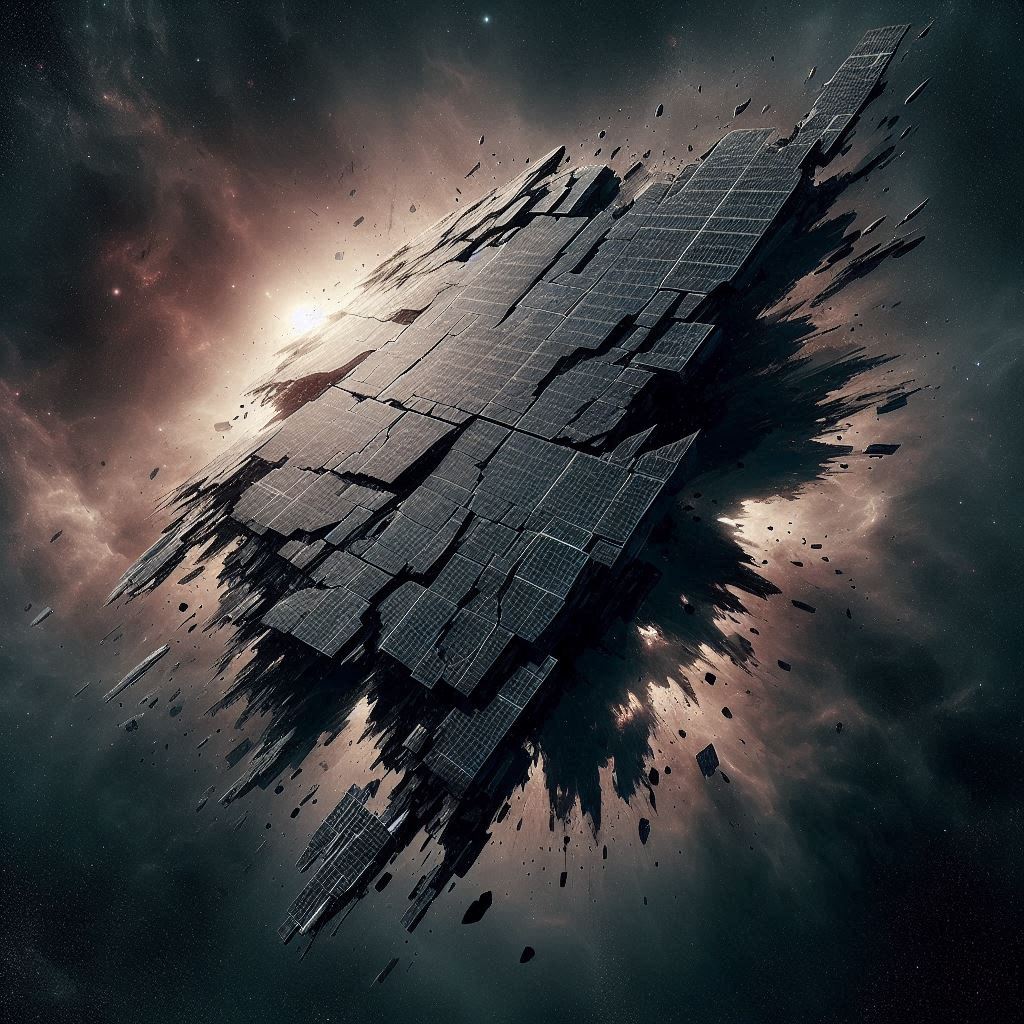

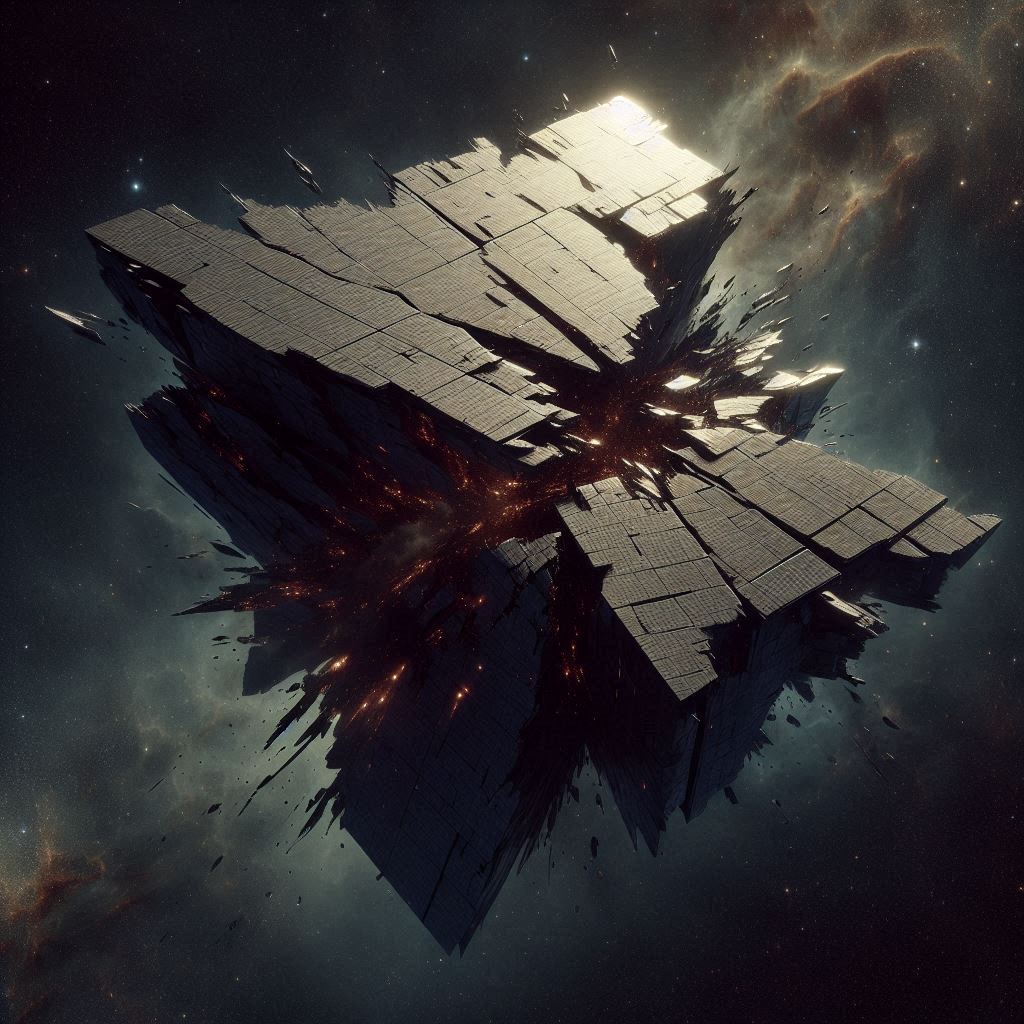
Ozymandian Dyson Spheres would continue to orbit their host stars in tatters. As fragments cross they stellar disk, they would cast irregular shadows, dips in the light curves too messy for planets or natural circumstellar disks. Such chaotic transits would not be a neat eclipse, but a jagged signature of debris, of an artificial construct. The hunt for Ozymandian Dyson spheres extends beyond the domain of astrology into the unlikely field of archaeology. These derelicts are the graveyards of ambition, the wreckage, an index of lost memories.
Image Credits:
Younger Memnon: COVE
Differentiated Spherules: Loeb et al., 2024
Fragments: Bing Image Creator


Leave a comment