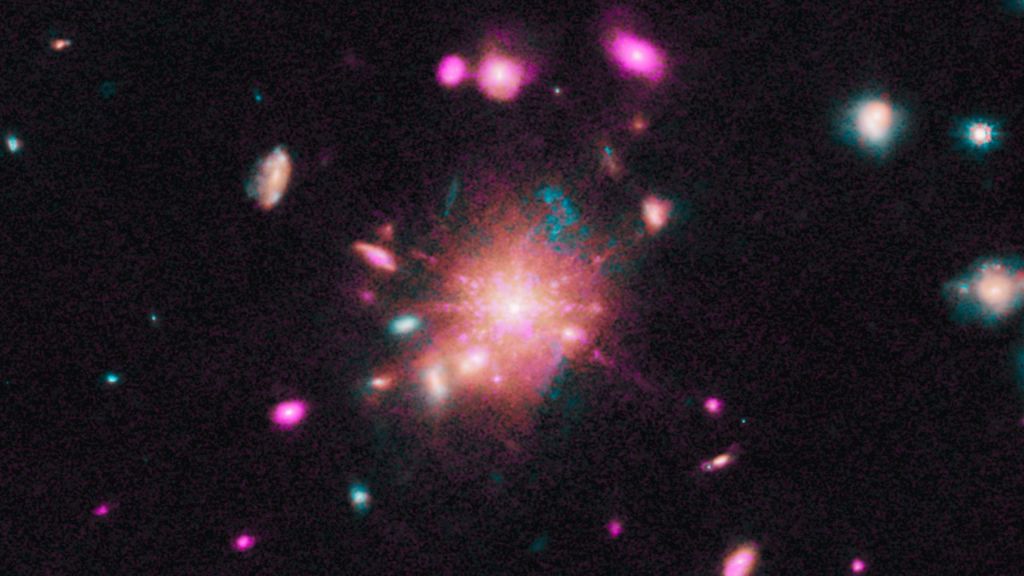
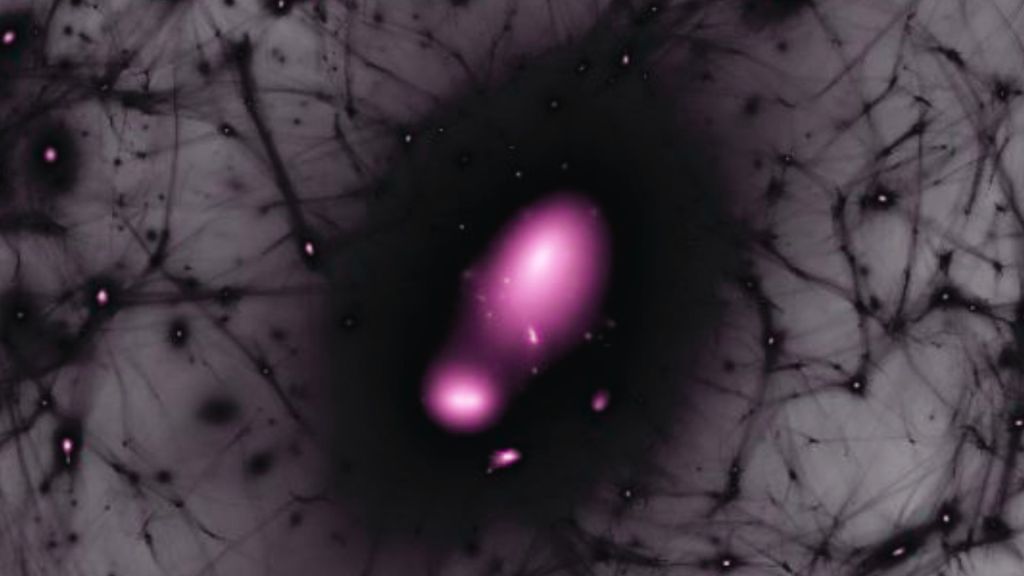
At a quarter of its present age, the universe was a chaotic toddler buzzing with the raw energy of creation. In a smaller, denser universe, a sprawling, tangled network of gas and dark matter stretching across millions of lightyears is taking shape: The Spiderweb Protocluster. About 3.8 billion years after a Big Bang, a ferocious radio galaxy called the Spiderweb Galaxy anchors the Spiderweb Protocluster, an association of galaxies bursting with star formation, one of the largest scale structures in the universe.
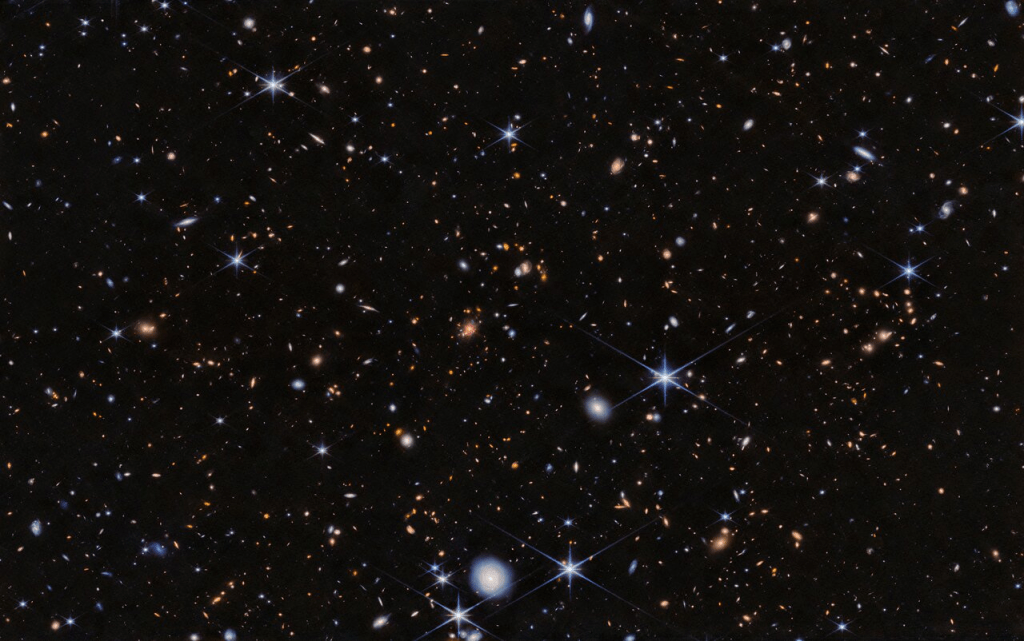
The Spiderweb Galaxy is a cosmic pileup, multiple galaxies are colliding and melding into it. If the Spiderweb Protocluster is a sprawling metropolis, then the Spiderweb Galaxy is the Central Business District. After the Big Bang, the universe was filled by a mist of mostly hydrogen and very little helium, the lightest elements in the periodic table. As the temperatures started dropping, the gas started clumping up into dense knots, drawing in more gas under the influence of gravity. The temperatures rose as massive clouds of hydrogen collapsed into the first stars, giants made from the pristine material of creation. The heavier elements were cooked by the nuclear reactions in their cores. The massive stars in these early galaxies ionised the hydrogen gas, releasing a characteristic type of light in ultraviolet frequencies. Galaxies bearing the signature are called Lyman-α emitters (LAEs). Towards the core of the Spiderweb Protocluster are a gravitationally bound concentration of Lyman-α emitters.

The Spiderweb Protocluster houses a wide spectrum of early galaxies apart from LAEs, that vary in characteristics depending on the amount of star forming material they contain, the quantities of surrounding dust, and the rate of star formation. There are Hα Emitters (HAEs) that are bright in red light in optical frequencies, Extremely Red Objects (EROs) shrouded in dust, Submillimeter-Bright Galaxies (SMGs) that shine in infrared, and galaxies with vast quantities of cold hydrogen, reservoirs from which new stars can be born. EROs and SMGs are obscured by vast quantities of dust, that infrared light shines through. LAEs have very little dust, with UV light breaking through. HAEs have a moderate amount of dust with optical frequencies passing easily. The rate of star formation increases from LAEs to HAEs to SMGs. The LAEs are the oldest, while HAEs, EROs, SMGs and the galaxies rich in molecular hydrogen are commonly seen in the cosmic noon, between 2 and 4 billion years of the Big Bang, just where the Spiderweb Protocluster is located in space and time.

The Spiderweb Protocluster is embedded within a vast envelope of dark matter, forming a pocket that has broken free of the expansion of the universe. The mass concentration in the Spiderweb Protocluster does not follow the Hubble Flow, and is evolving under its own rules. Tracking the galaxies reveals a subtle pattern in the velocity dispersion, a rhythm similar to a heartbeat with two peaks, that echoes across the vast expanse of the Spiderweb Protocluster. Astronomers recently caught a glimpse of a proto-intracluster medium (ICM), hot diffuse gas that fills mature galaxy clusters. Embryonic ICM is rare at such immense distances. Mapping the ICM reveals a strong, cool core that could be funneling gas straight into the Spiderweb Galaxy, feeding the supermassive black hole at its core, and driving star formation at the rate of 1,400 solar masses per year, well in excess of the Milky Way that produces only two. The Spiderweb Galaxy has an extended Lyman-α halo, and is on track to become a bright central cluster galaxy, the monsters that occupy the hearts of nearby or more evolved galaxy clusters.
Quenching Galaxies
The posse of satellites surrounding the Spiderweb Galaxy are shedding stars through tidal stripping and mergers, tendrils and tails of stars and gas being traded and exchanged across the galaxies falling in have created an extended stellar halo around the Spiderweb Galaxy. There are regions of star formation between the clumps of galaxies, with stellar nurseries in the intergalactic medium. At the densest regions of the Spiderweb Protocluster are massive reservoirs of cold molecular gas, the raw material from which stars are born. This is raw creation revealed at one of the largest scales possible, with only filaments of galaxies larger.
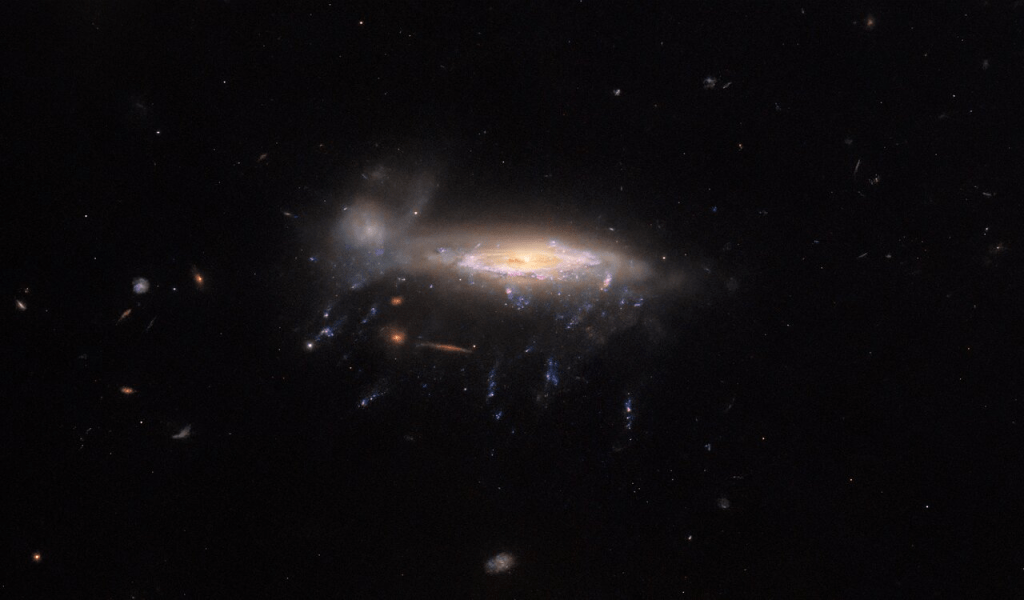
The rate of star formation is unsustainable, and is expected to decline over time, because of a number of processes. The formation of the stars deplete the reservoirs of gas available to form new stars. The pileups of galaxies is going to result in actively feeding supermassive black holes, surrounded by disks of tortured infalling material. The extreme friction can cause the swirling material to glow in frequencies across the electromagnetic spectrum, outshining entire galaxies. Powerful polar jets from these bright black holes or active galactic nuclei will heat or expel the cold reservoirs of pristine gas, that can no longer collapse into new stars. As the ICM begins to play a more dominant role in the neighbourhood, it will start stripping the galaxies of its star forming gas and dust. This will result in jellyfish galaxies, trailing stripped away molecular clouds, that will then glow in the light of star formation. The Spiderweb Protocluster will continue to evolve while being decoupled from the Hubble Flow. The subclusters are expected to merge further till the Spiderweb Cluster stabilises as a single massive galaxy cluster.
Image Credits:
Spiderweb Protocluster: ESA/Webb, NASA & CSA, H. Dannerbauer
Jellyfish Galaxy JO204: ESA/Hubble & NASA, M. Gullieuszik and the GASP team

Leave a comment