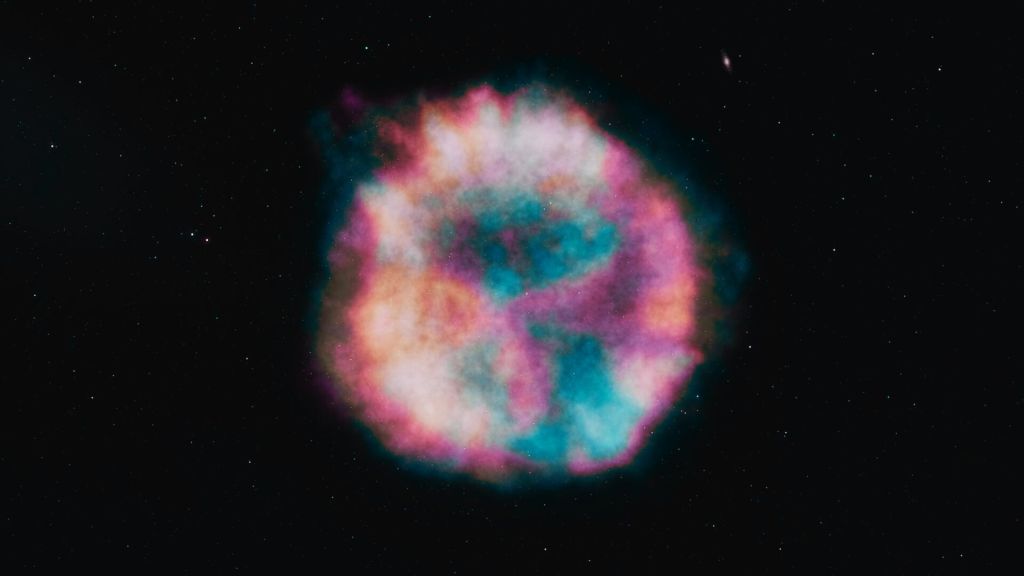
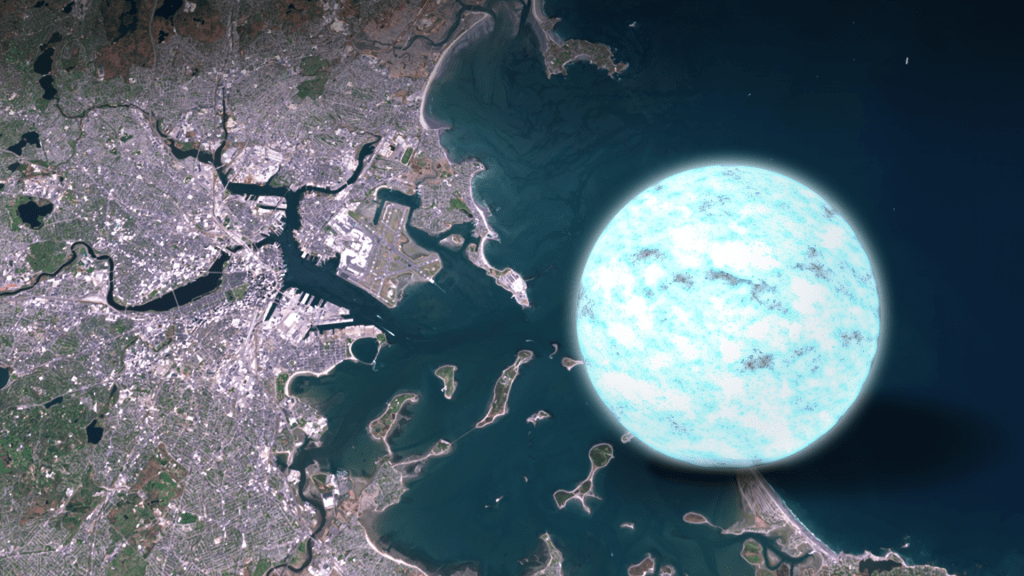
Cassiopeia A is an expanding shell of gas and dust violently shed in the death throes of a massive star. It is the youngest supernova remnant in the Milky Way, formed after the nuclear furnace in the core of a massive star ran out of fuel. The iron core collapsed, with all the matter clumping together as tightly as the nuclei of atoms. The protons stole electrons to transform into neutrons, releasing neutrinos. The temperatures and pressures rose rapidly in the dense blob of neutrons, measuring about 30 kilometres across, with matter getting just about as dense as it can without collapsing into a singularity. When the neutrons reached the limit to which they could be crushed, the rapid implosion rebounded, putting immense pressure outwards into the collapsing star. The outer layers of the dying star were energetically ejected, forming the rapidly expanding supernova remnant.
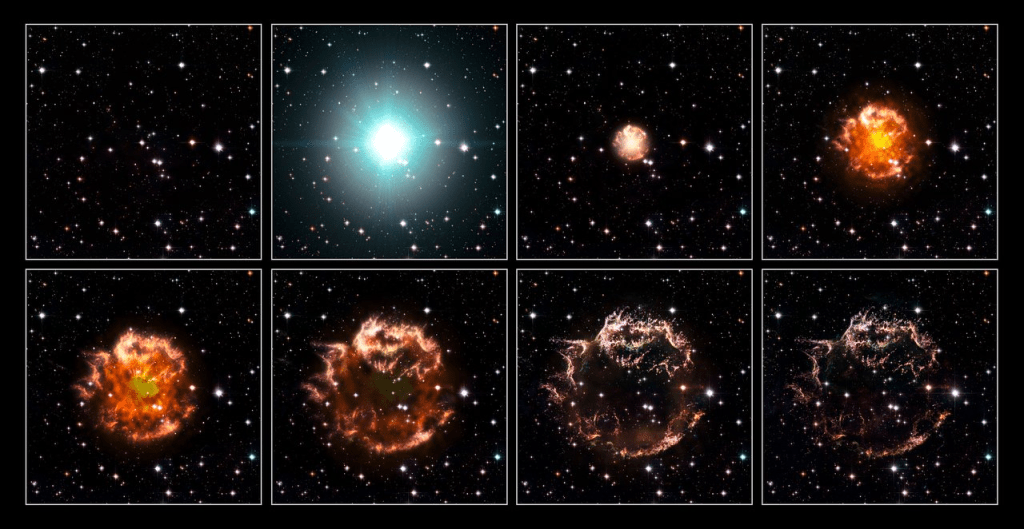
When stable, a star fuses hydrogen into helium. When the hydrogen runs out, it starts fusing helium, then works its way progressively through the periodic table, forging carbon, oxygen, neon, magnesium and silicon before arriving at iron, which is the end of the line. Within the giant stars, once the core exceeds 1.4 times the mass of the Sun, the electrons no longer resist being squeezed in closer together, leading to the collapse of the iron core, and the supernova. Searches have revealed a central compact object, the remnant core of the dead star. The circumstellar material is distributed asymmetrically around the remnant, hinting at a binary companion to the progenitor star. No such object has been found, and this ghostly companion may have merged with the progenitor star shortly before it exploded in a supernova.
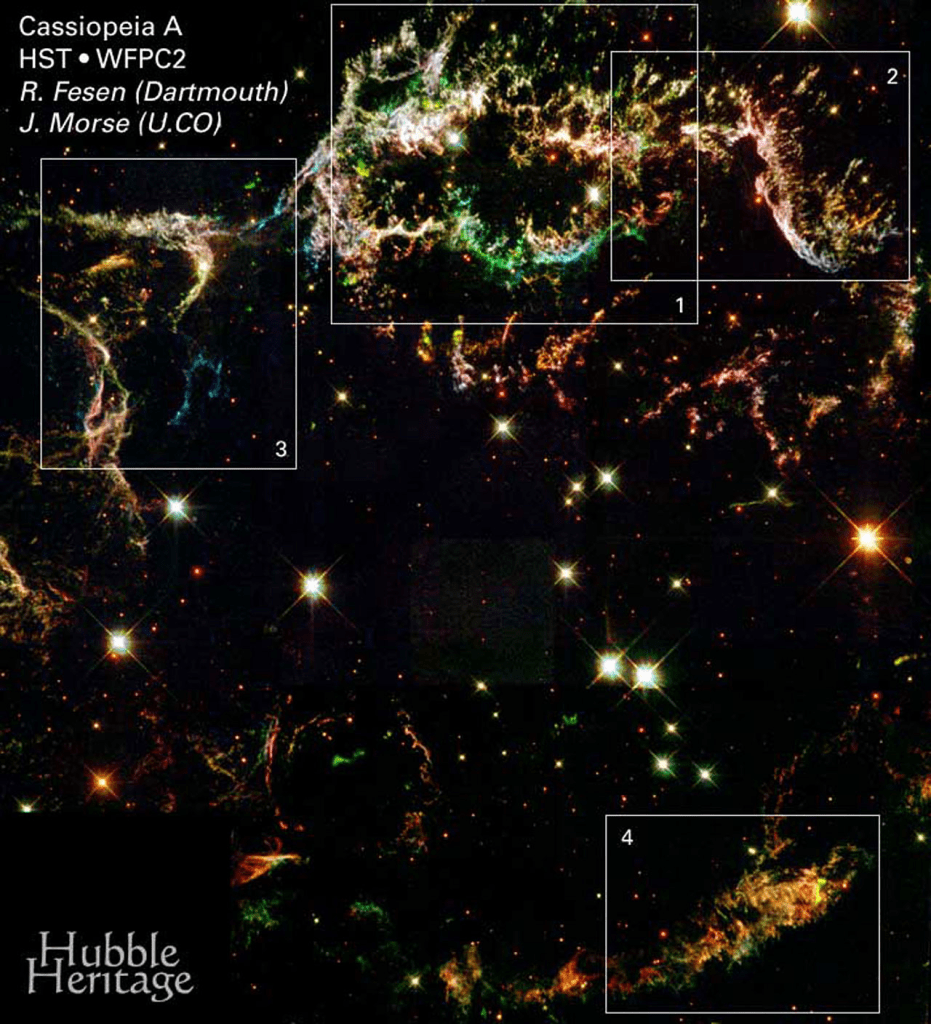
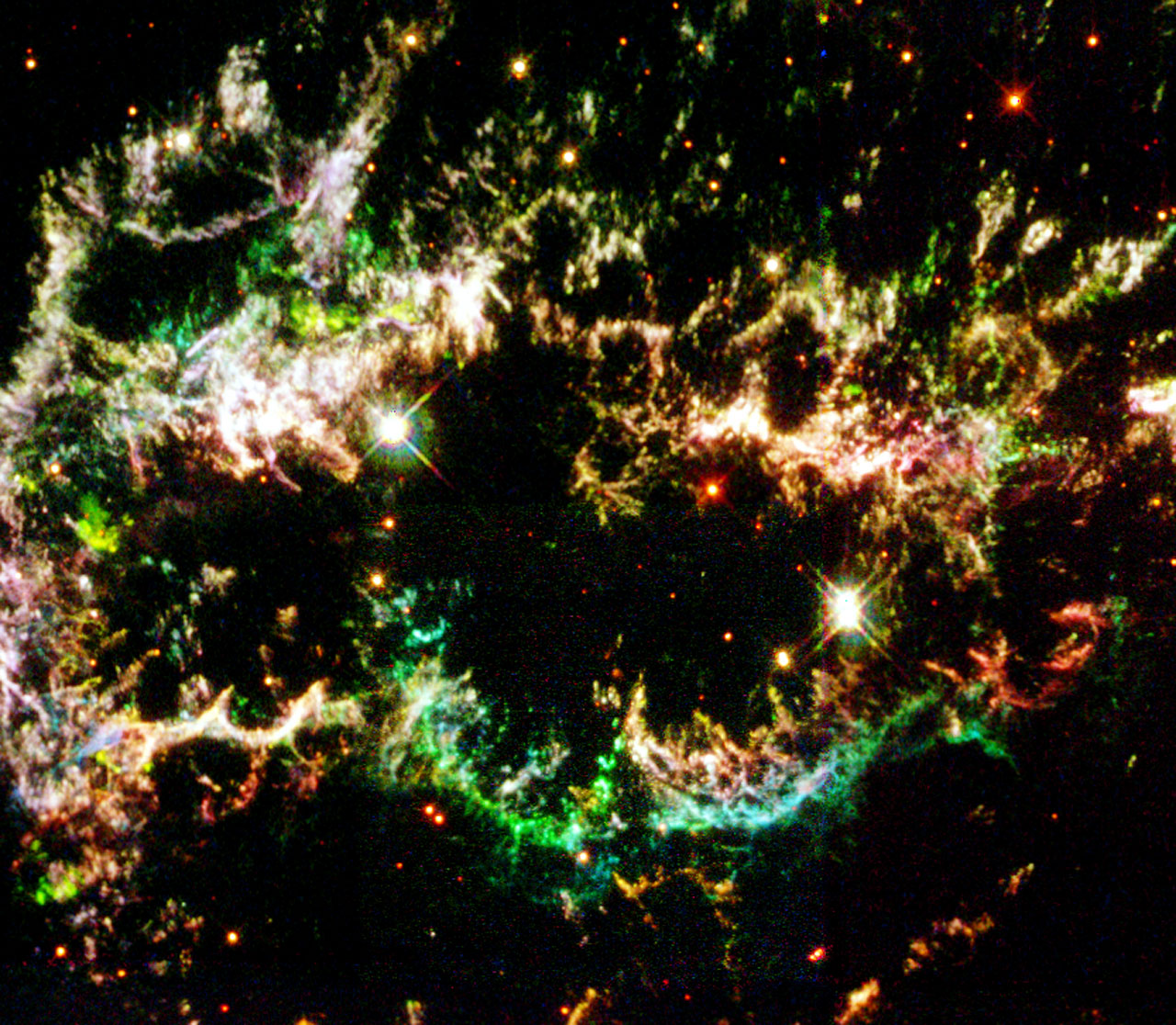
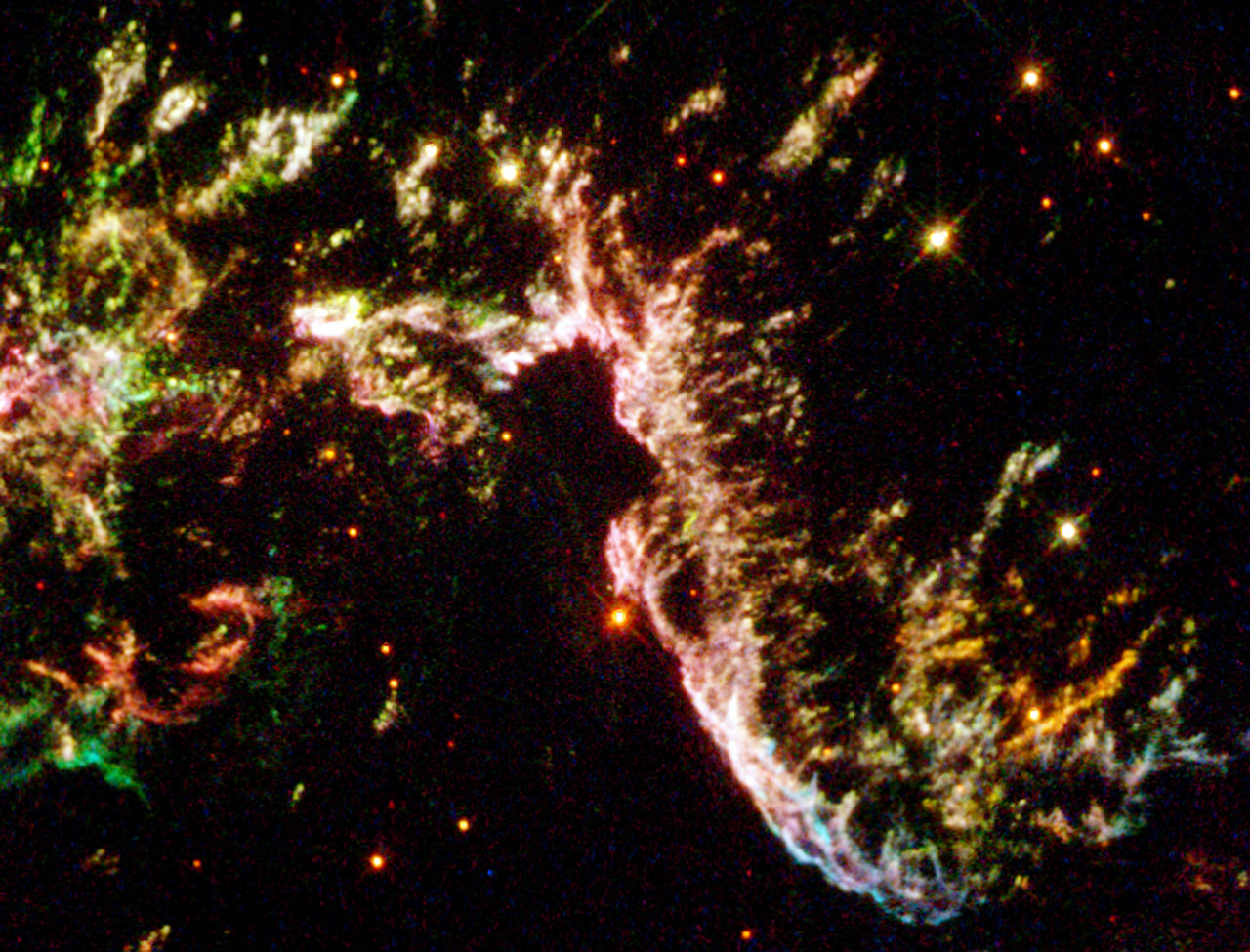
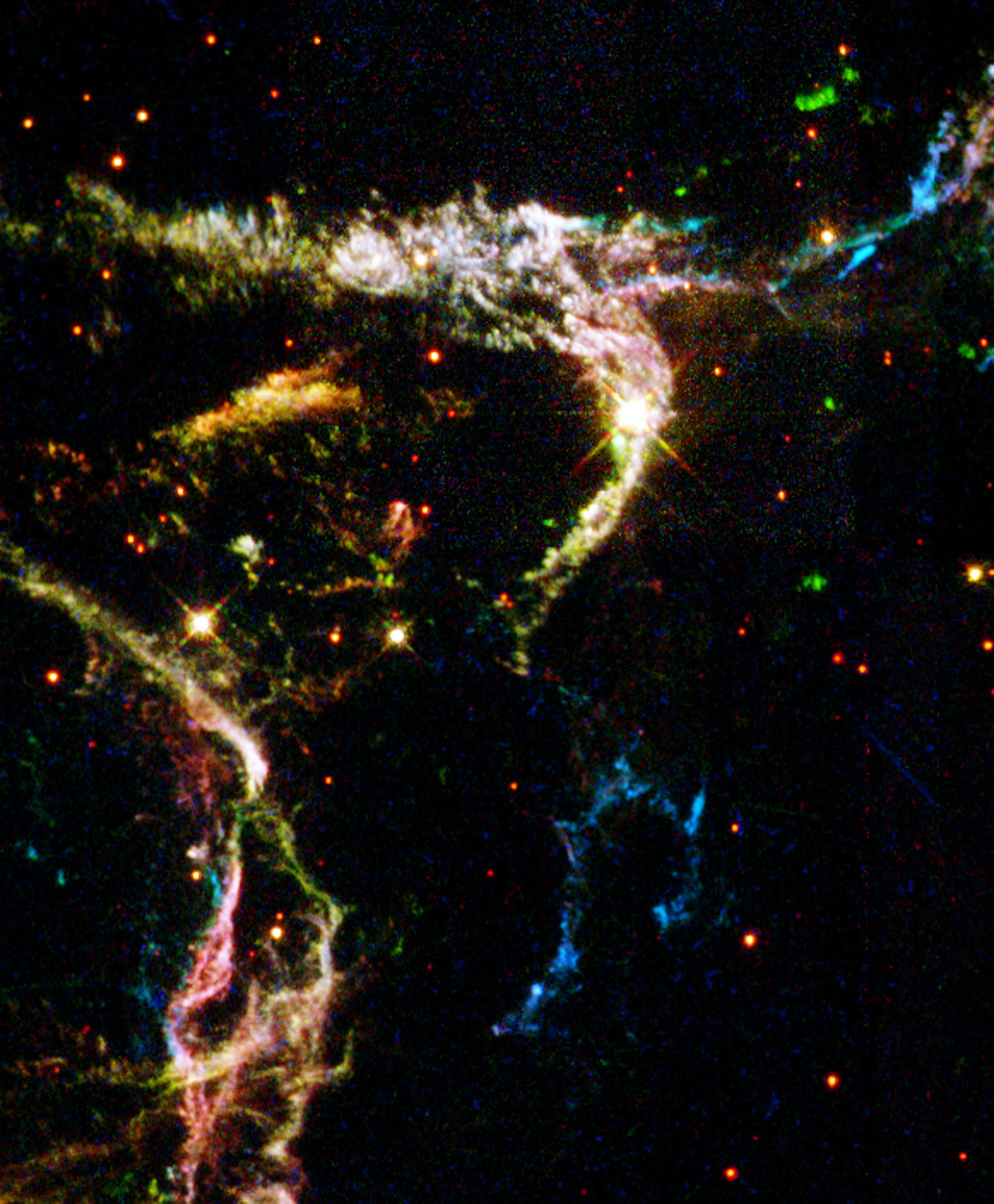

While the star went supernova 10,000 years ago, it started depleting its nuclear fuel 100,000 years ago, and has been shedding its outer layers, forming a cloud of circumstellar material. The material ejected during the supernova is slamming into this cloud of previously ejected material, producing shock waves. As the supernova ejection encounters resistance from the surrounding gas and dust, some of the shock waves deflect backwards, or inwards, resulting in reverse shocks. Embedded within the remnant are tiny knots of gas, dense clumps of supernova ejecta that are fragments of the interior layers of the read star, that are heated and glowing from the interaction with the reverse shockwave. These knots are enriched with the heavier elements, oxygen, sulphur and argon.

The supernova remnant is punching through the circumstellar medium and the interstellar medium. The reverse shock waves are revealing the clumps of matter in the circumstellar medium, which are not symmetrical. The progenitor star had shed nearly all of its hydrogen envelope before its core collapsed. There are traces of about a dozen or so shells, formed during the twilight years of the star, when it was episodically dumping its outer layers. The supernova remnant is punching through the nested bubbles, shaping the material shed earlier, carving cavities and intricate ring structures. Compared to the incredible velocity of the supernova ejecta, the circumstellar medium appears nearly stationary. The difference in speeds is churning of the material, forming knots and filaments.
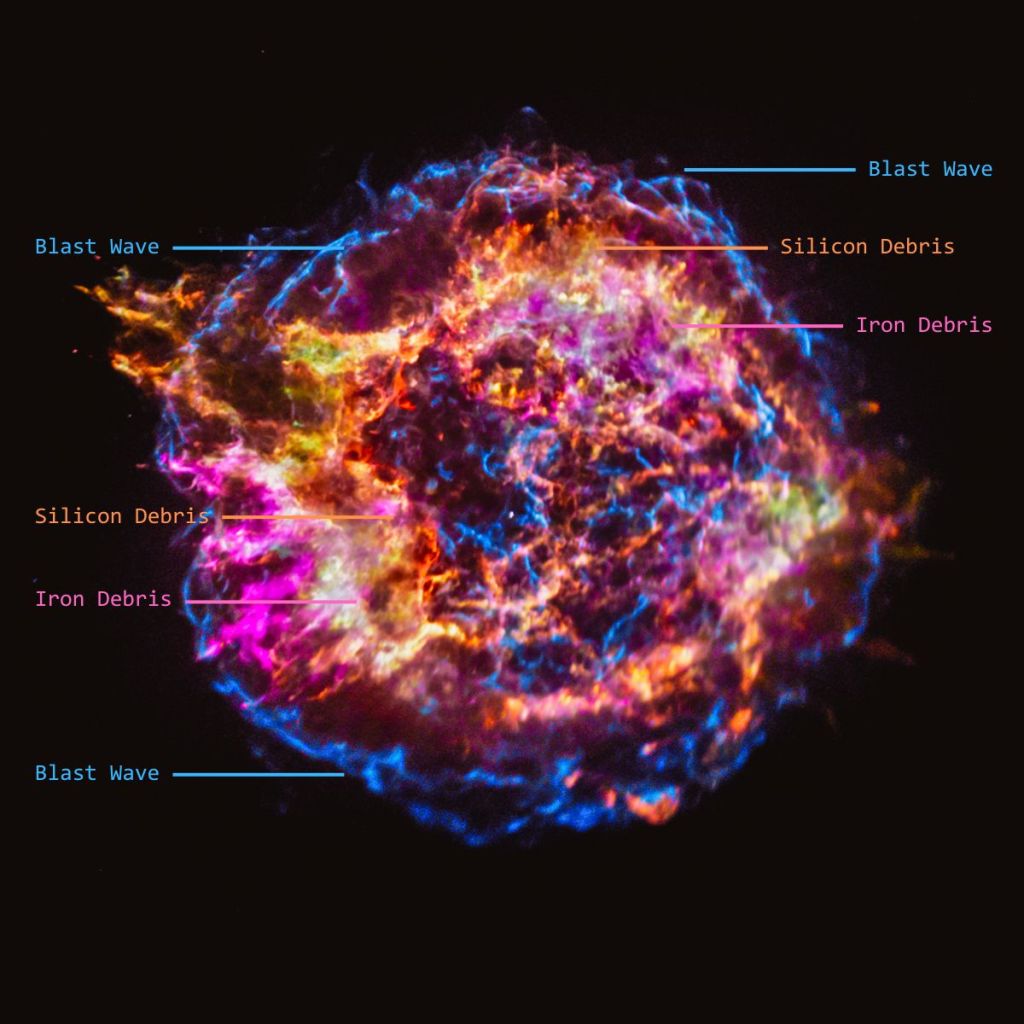
The clumps of material within the remnant have varying elemental distributions. There are some knots that are metallic and enriched with heavier elements, while others are pristine, consisting mostly of hydrogen. The origin of the pristine knots are not well understood. The enriched knots are fragments of the interior layers of the dead star, that are heated by the expanding shockwave. Glowing streamers trace interactions between the ejecta and the reverse shockwave. When the expanding shockwave encounters the previously shed material, it slows down, with the energy converting to heat, emitting light in particular colours depending on the composition.

The intense heat generated by the shocked ejecta results in glowing streamers, that reveal crucial information about their chemical compositions. The streamers trace the interactions between the ejecta and the reverse shock, highlighting the deceleration and subsequent heating of the debris from the supernova. Within the main shell is a network of intricately structured oxygen-rich filaments. Simulations indicate that these filaments form normally during the early stages of a supernova explosion, because of the expanding bubbles heated by escaping neutrinos, and hydrodynamic instabilities or turbulence during the propagation of the blast. The intricate topology of the expanding bubbles leads to the formation of oxygen-rich ejecta that are further refined by nitrogen bubbles. These filaments serve as an index of the conditions during the initial stages of the supernova explosion.
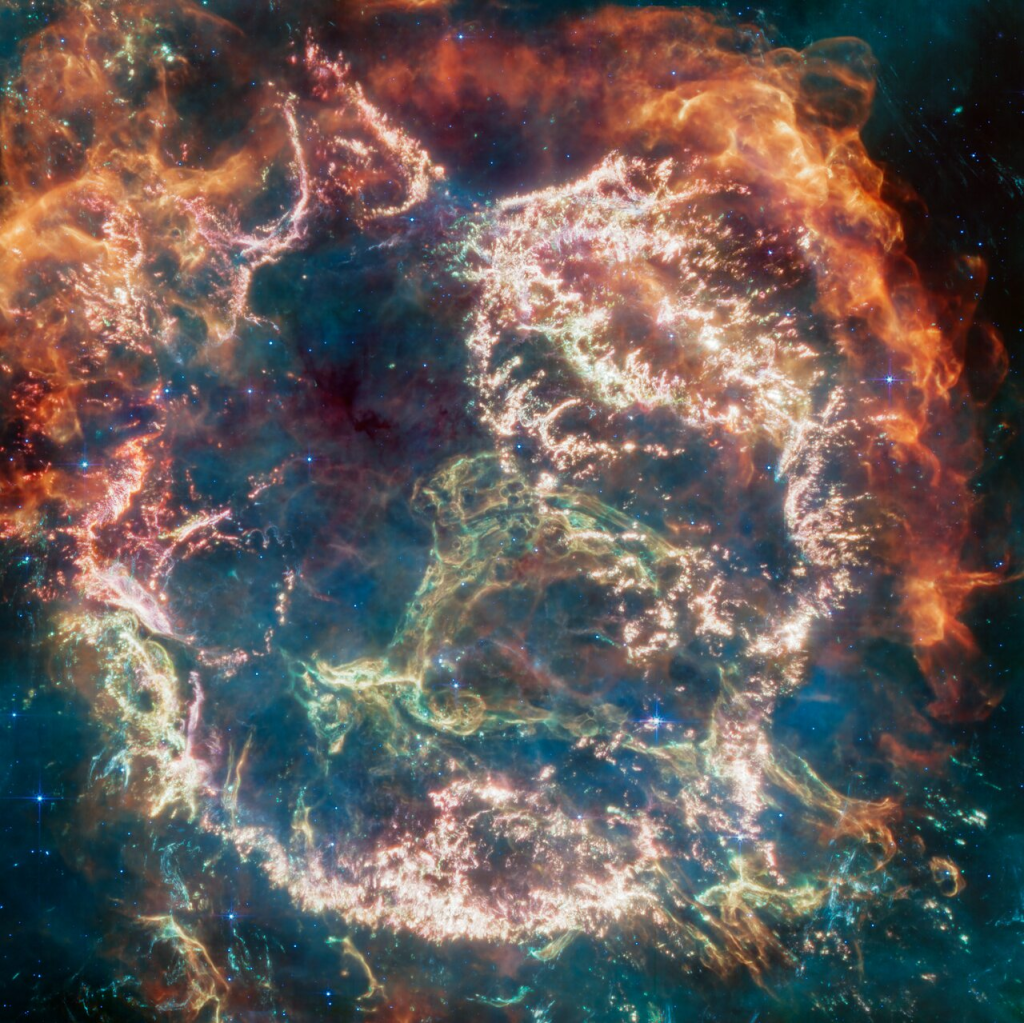
The wall of green in the middle of the supernova remnant is a foreground feature, a structure made up of circumstellar material being shocked by the supernova remnant. The Green Monster is pockmarked, by a gallery of rings that are not yet fully explained. The jury is out on whether they are created by clumps of ejecta shooting through the nebula, or they are in fact dense, cold circumstellar envelopes, with the faster moving, heated material finding easier ways around.
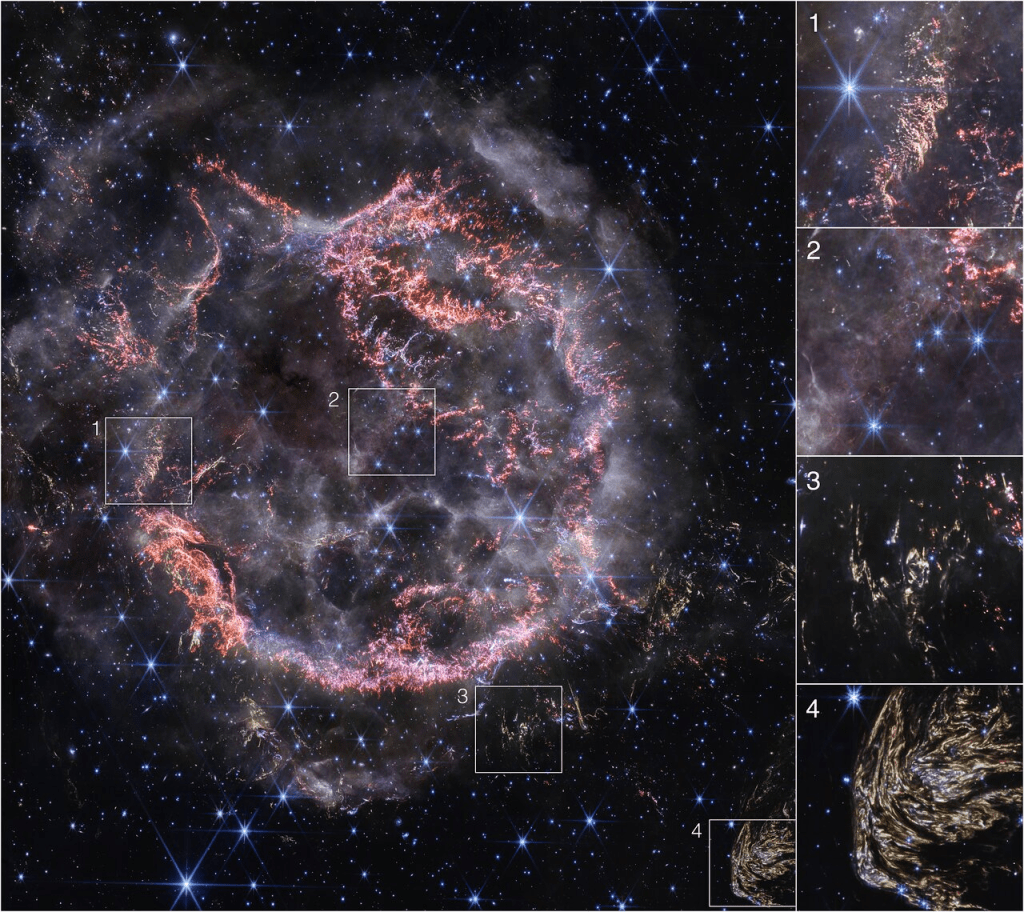


The tiny, dense clumps of gas indicate that the star shattered like glass during the supernova explosion. The ejecta and the shock fronts have a complex geometry. Portions of the ejecta are from the innermost regions of the star, revealing its interior when it was alive. Within the interior of Cas A are unshocked ejecta, that have not yet encountered the reverse shock. This pristine material retains the original composition and kinematic properties from the moment of the supernova explosion. This unshocked material provides a window into the process of nucleosynthesis, as the star cooked up progressively heavier elements.

The circumstellar medium contains grains of dust, that are also heated along with the gas by the passage of the forward shock. These are thermal emissions, but Cas A also produces non-thermal emissions. Cas A is one of the brightest radio sources in the night sky because of synchrotron radiation, electrons accelerated to relativistic speeds at the shock fronts. Both the forward and reverse shockfronts produce the synchrotron radiation, that reveal the strength of the magnetic fields as well as the efficiency of particle acceleration. The energetic expansion of Cas A and its associated shockwaves are disrupting interstellar molecular clouds. The high-velocity ejecta combined with the shock can compress, heat and disrupt the clouds. These molecular clouds are stellar nurseries. Some of the material is dispersed and eroded before the formation of new stars, while the interactions can also create dense knots of gas that trigger the formation of a new generation of stars.
Circumstellar medium

Synchrotron Radiation

Cloud Destruction

Light Echo (Baby Cas A)
Rupture
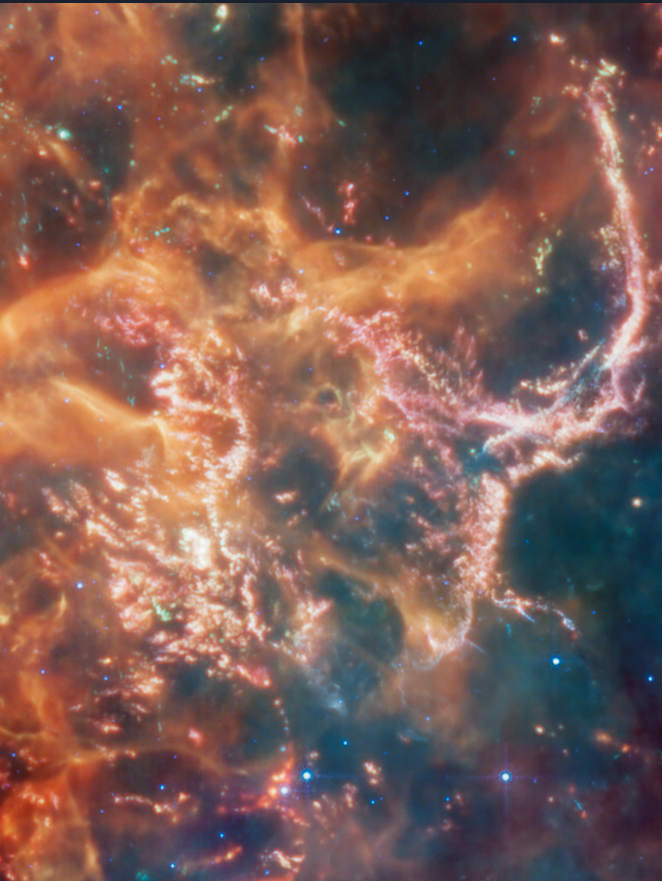
CSM Holes

Blowout
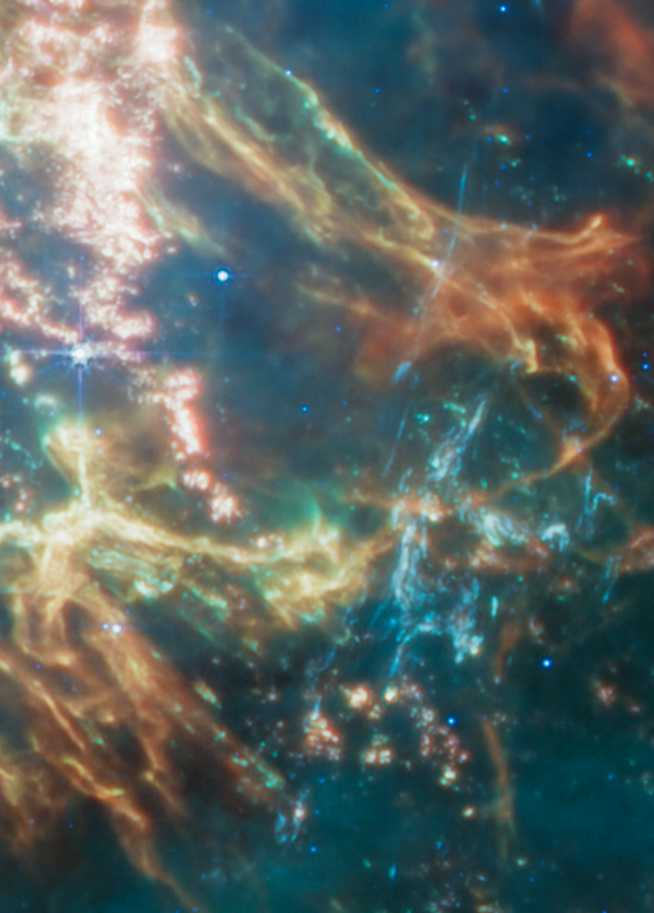
Monster

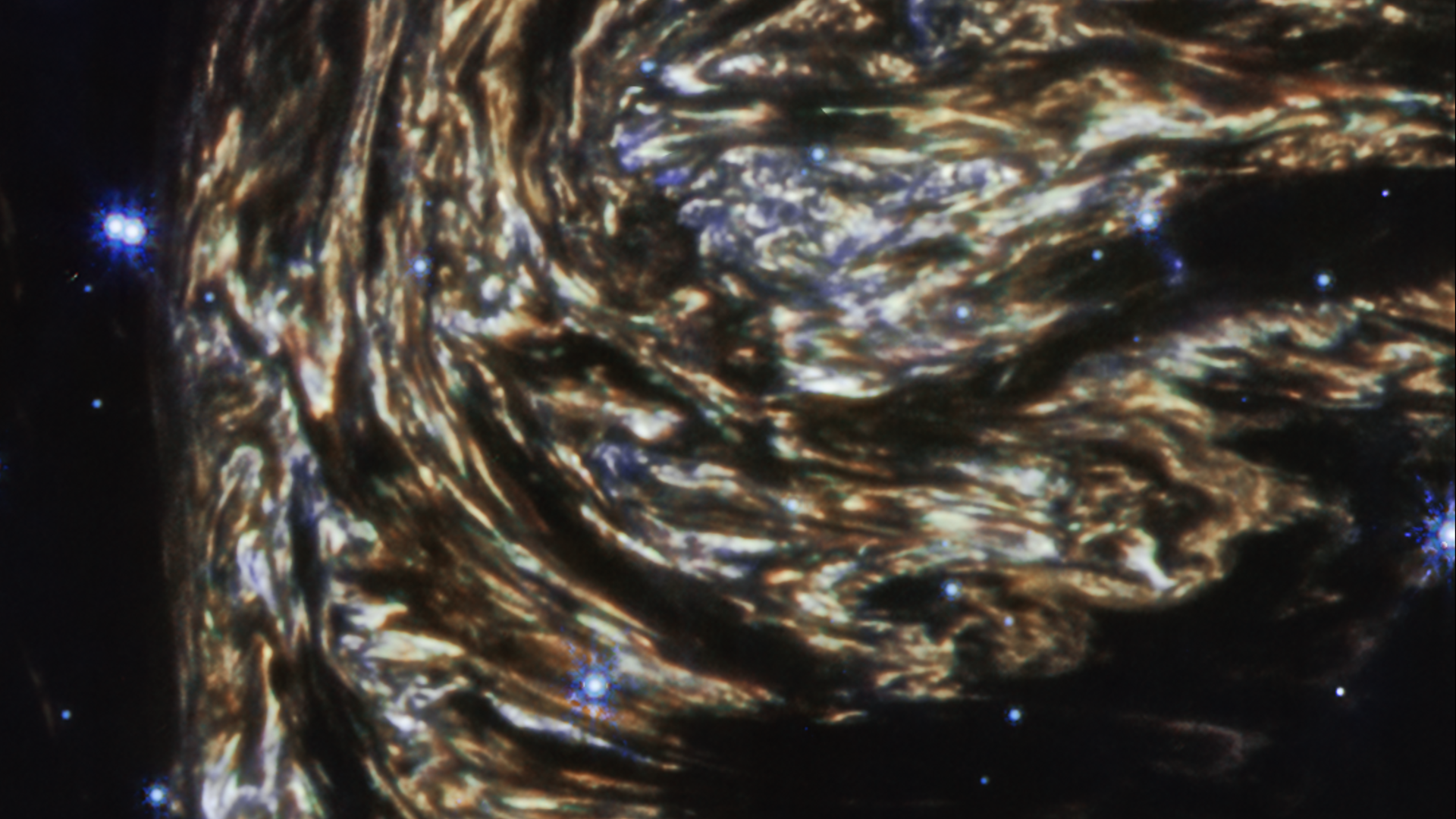
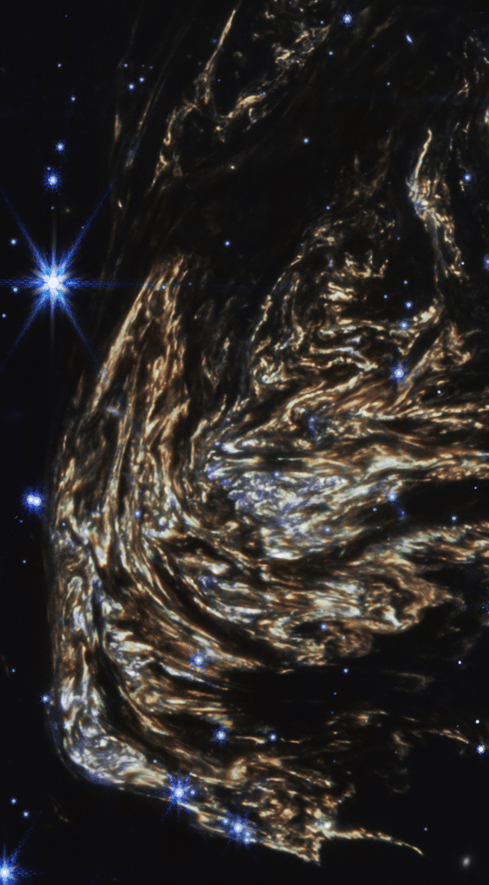
Towards the northeast corner of the supernova remnant is a rupture that extends beyond the shell and exhibits high velocities, up to 16,000 kilometres per second. This material is chemically distinct from the bulk of the ejecta, and is rich in sulphur, calcium and argon, indicating that it emerged from deep within the progenitor star, from within the explosive layer of neon. The structure may be related to asymmetries in the explosion. Towards the west is a blowout, which is also an expansion or a rupture that may have been caused by asymmetries in the explosion, or the inhomogeneous circumstellar medium.
Light Echoes
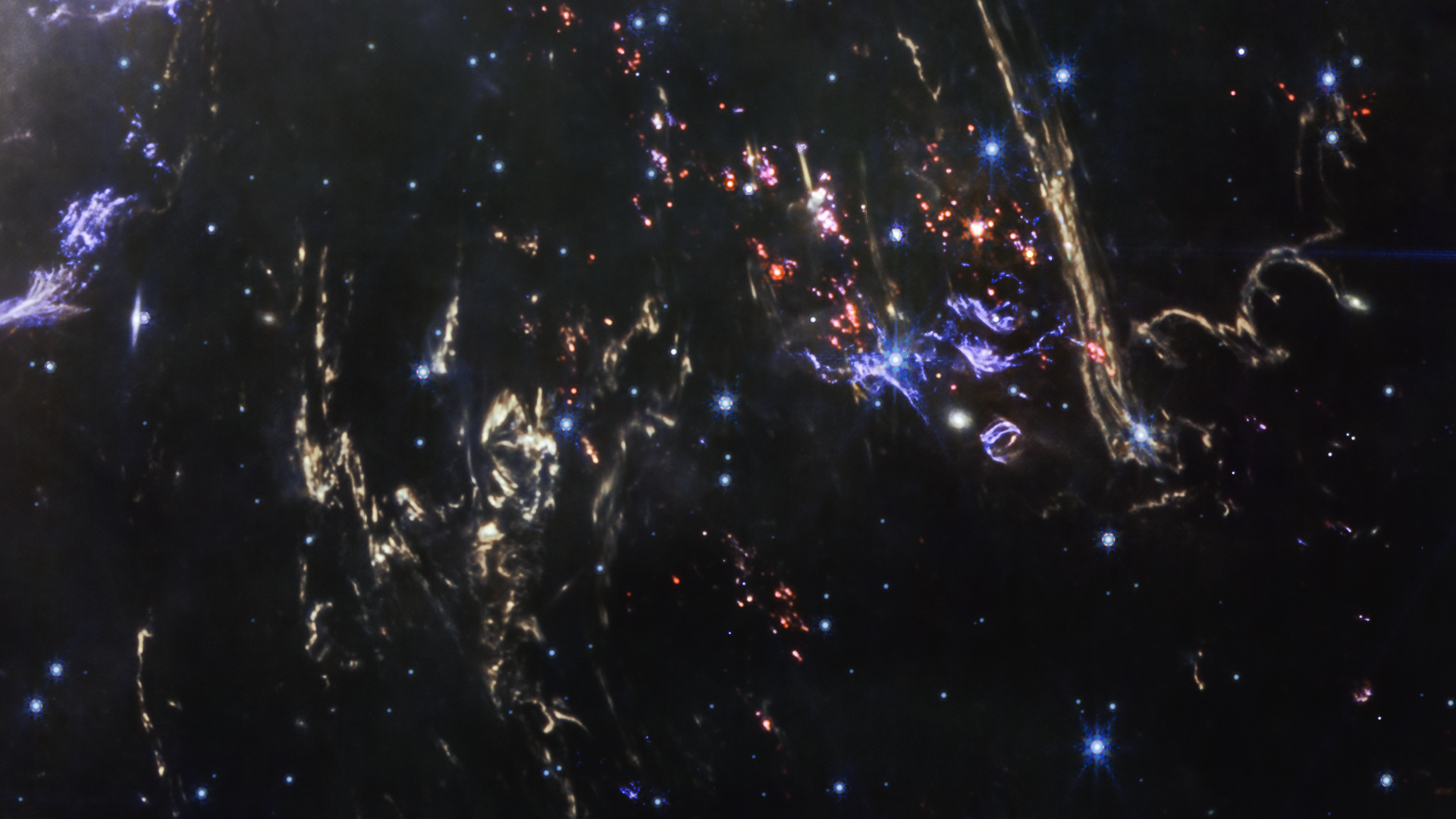
The light echoes were created by the interstellar dust clouds scattering the initial flash of light from the supernova explosion. These light echoes appear as expanding rings of light, centred on the position of the supernova. The variations in the light echoes reveal the distribution and the density of the interstellar dust, providing a three dimensional scan of the interstellar material. One of these light echoes, towards the corner of the image is known as Baby Cas A, because it resembles a smaller version of the supernova remnant. In addition to the scattering by the light, the dust grains heated by the supernova flash are reemitting the absorbed light long after the explosion, and are known as thermal light echoes.

These light echoes are perhaps the most subtle and beautiful aspects of the colourful supernova remnant. The regions of interstellar dust scattering the light are located at progressively greater distances from the supernova, causing the light echoes to expand at the speed of light. Cas A is visible only for a short time, and is a transient feature, that will soon disappear and fade into the void. For now, the supernova remnant is a haunting monument marking the violent death of a giant star. Below is a gallery of simulated vistas of worlds within Cassiopeia A.


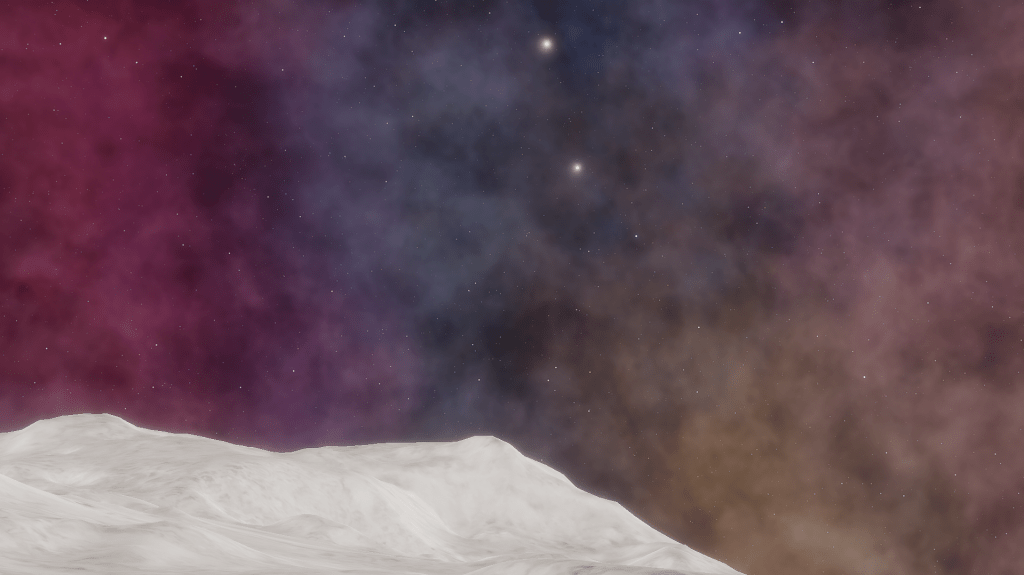

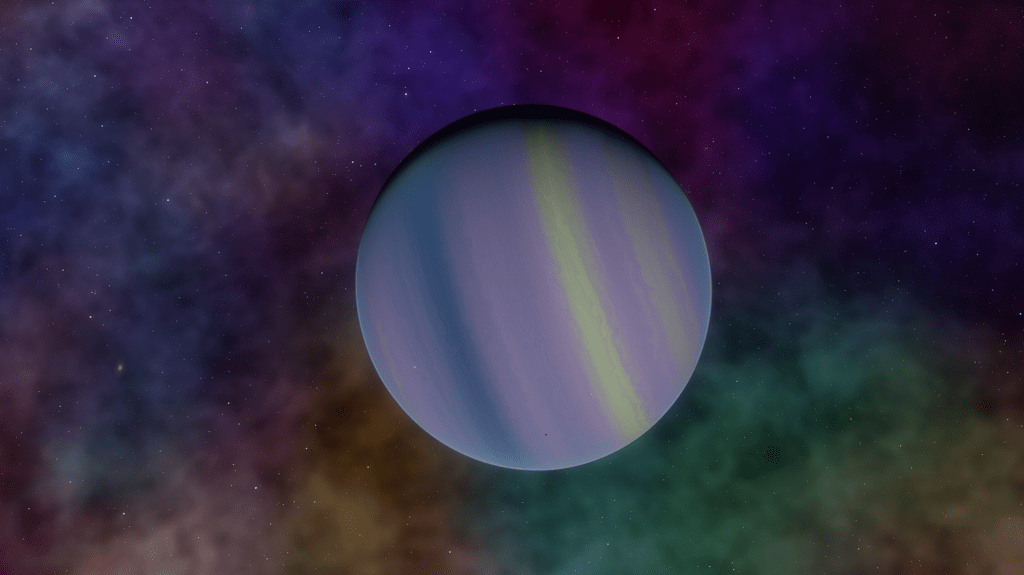
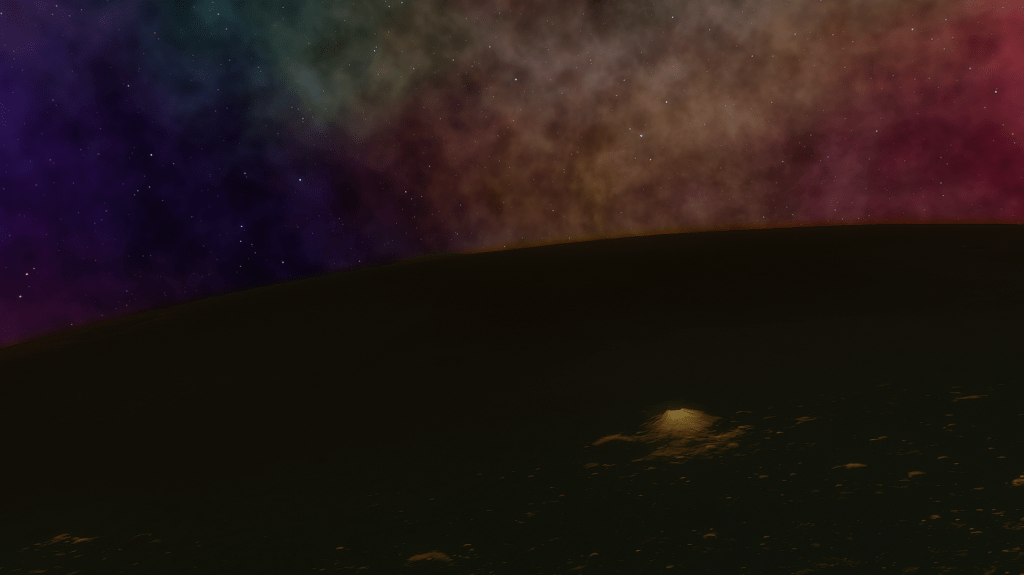
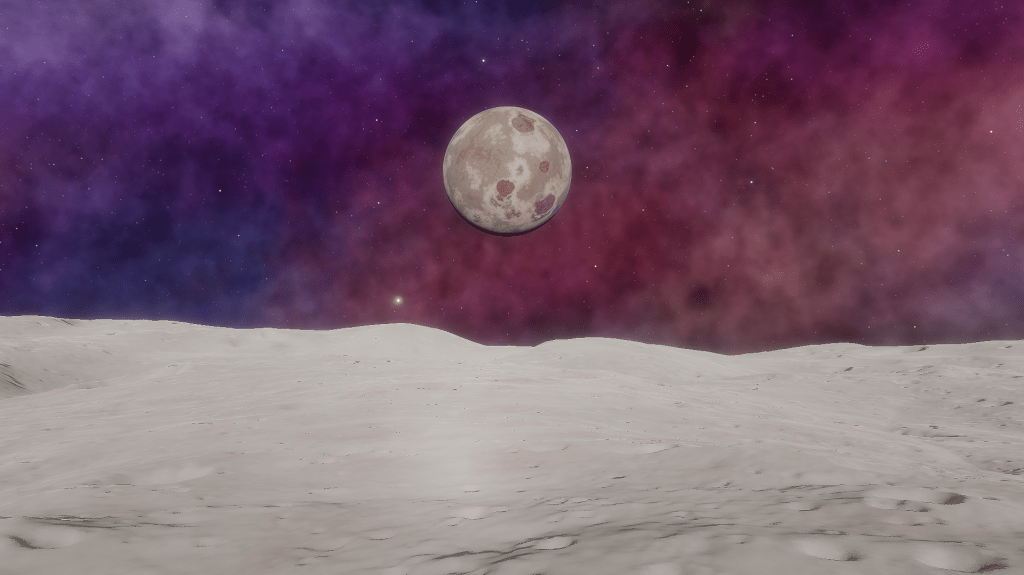
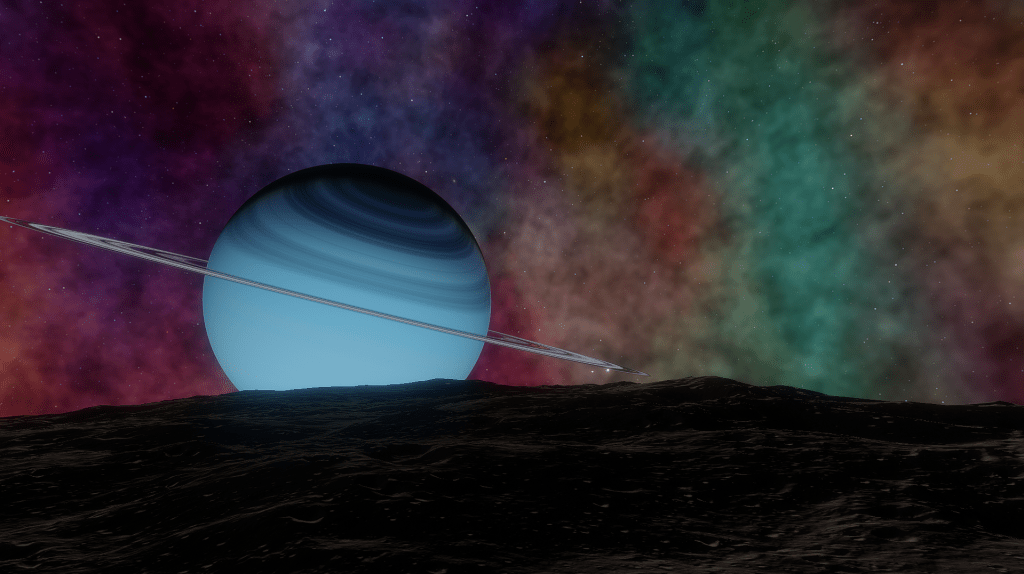
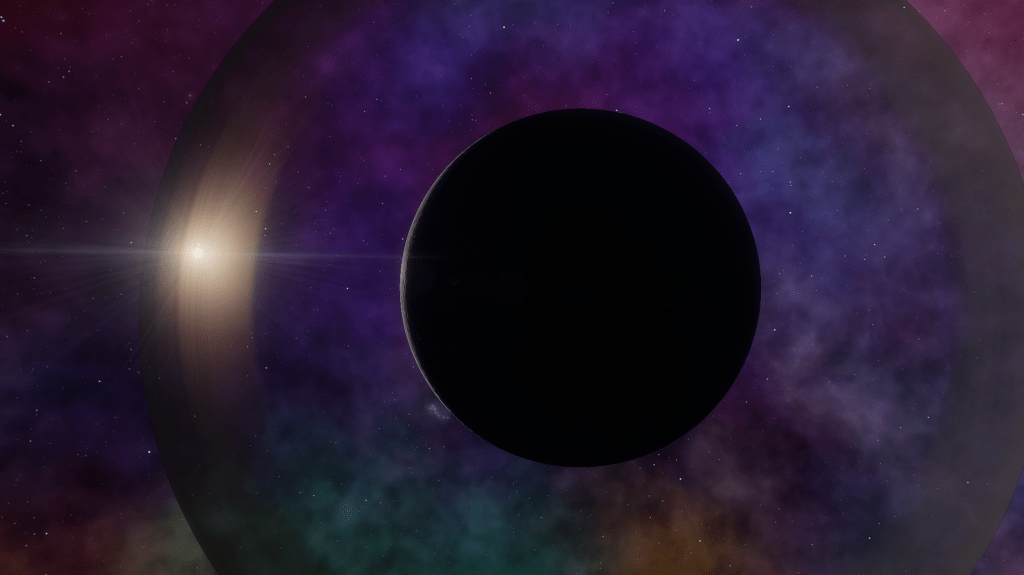
Image Credits:
Cassiopeia A – Animation sequence [artist’s impression]: NASA, ESA, and the Hubble Heritage (STScI/AURA)-ESA/Hubble Collaboration. Acknowledgement: Robert A. Fesen (Dartmouth College, USA) and James Long (ESA/Hubble)
Cassiopeia A by Hubble: NASA/ESA and the Hubble Heritage Team (STScI/AURA)
Cassiopeia A Elements: NASA/CXC/SAO
Cas A (MIRI image): NASA, ESA, CSA, D. Milisavljevic (Purdue University), T. Temim (Princeton University), I. De Looze (UGent), J. DePasquale (STScI)
X-ray, Optical, & Infrared Images of Cassiopeia A: Credit: X-ray: NASA/CXC/SAO, NASA/JPL/Caltech/NuStar; Optical: NASA/STScI/HST; IR: NASA/STScI/JWST, NASA/JPL/CalTech/SST; Image Processing: NASA/CXC/SAO/J. Schmidt, K. Arcand, and J. Major
Light echoes near Cassiopeia A: NASA, ESA, CSA, STScI, J. Jencson (IPAC-Caltech)
Cassiopeia A exoplanets: Space Engine
Sources:
Evidence for past interaction with an asymmetric circumstellar shell in the young SNR Cassiopeia A
Cassiopeia A’s Reverse Shock and its Effects on the Expanding SN Ejecta
Filamentary Ejecta Network in Cassiopeia~A Reveals Fingerprints of the Supernova Explosion Mechanism
A JWST Survey of the Supernova Remnant Cassiopeia A
High-entropy ejecta plumes in Cassiopeia A from neutrino-driven convection
The dust mass in Cassiopeia A from infrared and optical line flux differences
Filamentary Ejecta Network in Cassiopeia~A Reveals Fingerprints of the Supernova Explosion Mechanism
Dust destruction by the reverse shock in the Cassiopeia A supernova remnant

Leave a comment