
About 100,000 years ago, a massive star began running out of nuclear fuel, and started dumping hot gas into the surrounding environment. About 10,000 years ago, the nuclear furnace at the core of the star depleted all its fuel and collapsed, violently shedding the outer layers in a rapidly expanding bubble, called Cassiopeia A (Cas A). The blast wave is slamming into the ashes of the dead star, illuminating the expanding shells of gas and dust. The densities, velocities, temperatures and chemical compositions of the material are revealed with an infrared gaze, allowing any intelligent observers to conduct an autopsy.

Cas A is among the youngest supernova remnants, providing a pristine snapshot of the violent demise of a massive star. It is a touchstone for stellar forensics. Within the expanding bubble of gas and dust, shockwaves are racing outwards at thousands of kilometres per second, radioactive nickel is decaying into cobalt and iron. In the chaos of filamentary tendrils and glowing knots of ejecta, a shimmering, verdant specter emerges, dubbed the Green Monster. The Green Monster is in front of the remnant, not within it, indicating that it was shed 30,000 to 100,000 years before the star went supernova. This apparition is made from the skin of the dead star, a fragment quietly shed in eons past. With X-ray vision, it is possible to find the Green Monster was ejected from the dead star long before it met its explosive end. The spectral fingerprint of the specter match regions of known shocked circumstellar material (CSM), gas and dust shed by the progenitor star in its twilight years.
Bubble Wrap
The most intriguing feature of the green monster are vast cavities that pockmark the Green Monster. The gallery of circles are nearly perfect, almost like a grater. The holes might be created by shards of supernova ejecta moving between 8,000 and 10,500 kilometres per second. The shocks pile material into glowing rings around the impact sites, birthing tangential shocks. In the chaotic boundary where shocked ejecta meets the CSM, protruding fingers of ejecta might punch through like needles, leaving behind the holes and rings. They might also be created by bullets of CSM accelerated by the supernova, punching through the gas and dust. There is a tantalizing possibility that these structures are not holes at all, but clumps.

This nebulous cloud of gas and dust is visible because of the heated material remitting absorbed radiation. The temperature variations in the material has to be factored in when understanding what is going on within the Green Monster. The holes may be caused by dense knots of gas and dust, invisible because of how cold they are. The fast-moving shocked material may be traveling around these dense knots. Such densities of mass are ideal conditions for the formation of new stars, and these holes may well be circumstellar envelopes.
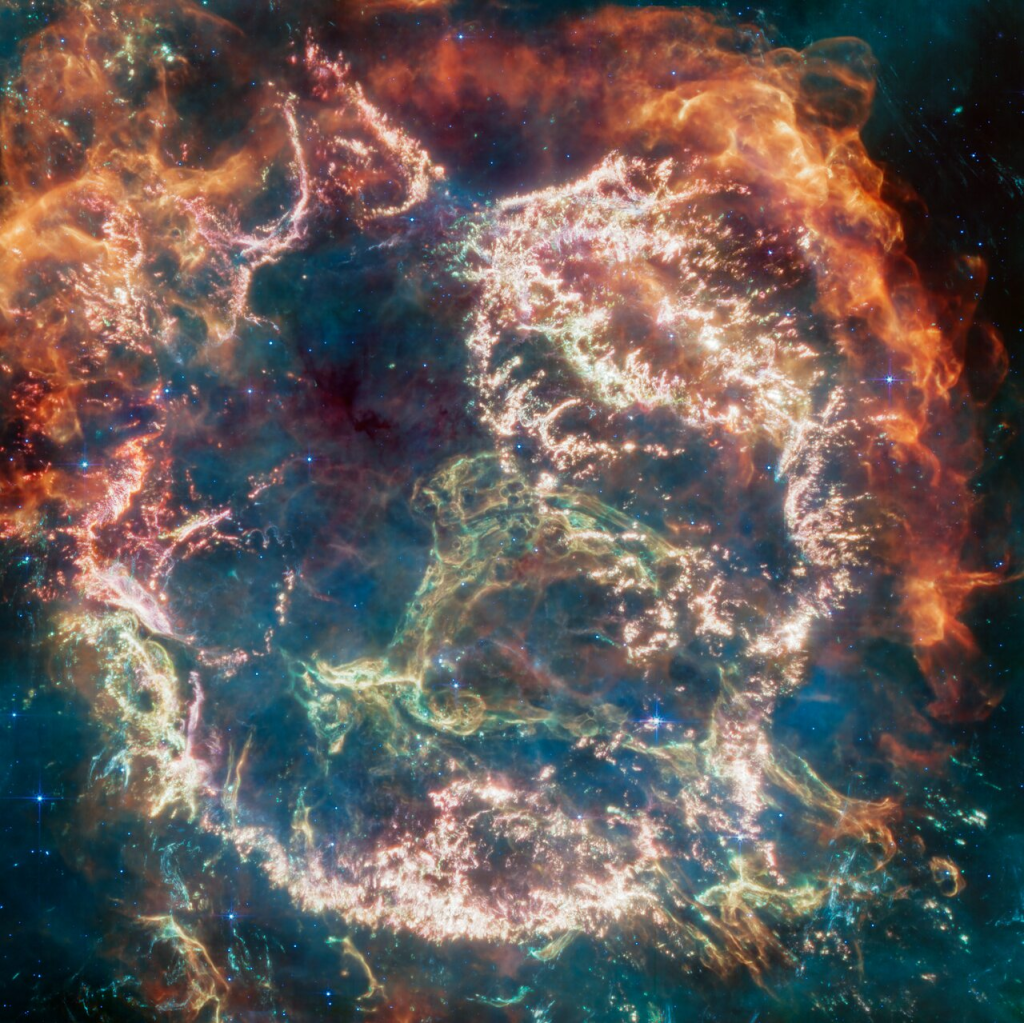
The Green Monster is not the only material from before the demise of the dead star outside of its remnant. There are also faint wisps, that are not moving as fast as the rest of the remnant, appearing to be in the same place. These diffuse clouds of gas and dust, quasi-stationary flocculi are more commonly clustered around one side of the star. Such a asymmetrical shedding of mass from a star is difficult to explain, unless it was orbited by a binary companion. The progenitor star appears to be solitary though, and all attempts to find its expected binary companion have failed. Another star that orbited the doomed giant could stir its winds into chaos, but no survivor can be found. This ghost star awaits discovery. One tantalizing explanation is that the binary companion merged with the progenitor star shortly before its stellar demise.
Image Credits:
Green Monster Outline: Credit: X-ray: NASA/CXC/SAO; Optical: NASA/ESA/STScI; IR: NASA/ESA/CSA/STScI/Milisavljevic et al, NASA/JPL/CalTech; Image Processing: NASA/CXC/SAO/J. Schmidt and K. Arcand
Chandra Image of Cassiopeia A, Labeled: NASA/CXC/SAO
Cas A (MIRI image): NASA, ESA, CSA, D. Milisavljevic (Purdue University), T. Temim (Princeton University), I. De Looze (UGent), J. DePasquale (STScI)
Sources:
A JWST Survey of the Supernova Remnant Cassiopeia A
X-Ray Diagnostics of Cassiopeia A’s “Green Monster”: Evidence for Dense Shocked Circumstellar Plasma

Leave a comment