
The Firefly Sparkle galaxy flickered into existence less than 600 million years after the Big Bang. 10 star clusters are embedded within the warm glow of background stars in the young galaxy. Firefly Sparkle got its name thanks to these glittering star clusters. Each of the clusters are in different stages of star formation. The other galaxies discovered at the dawn of time are much larger.

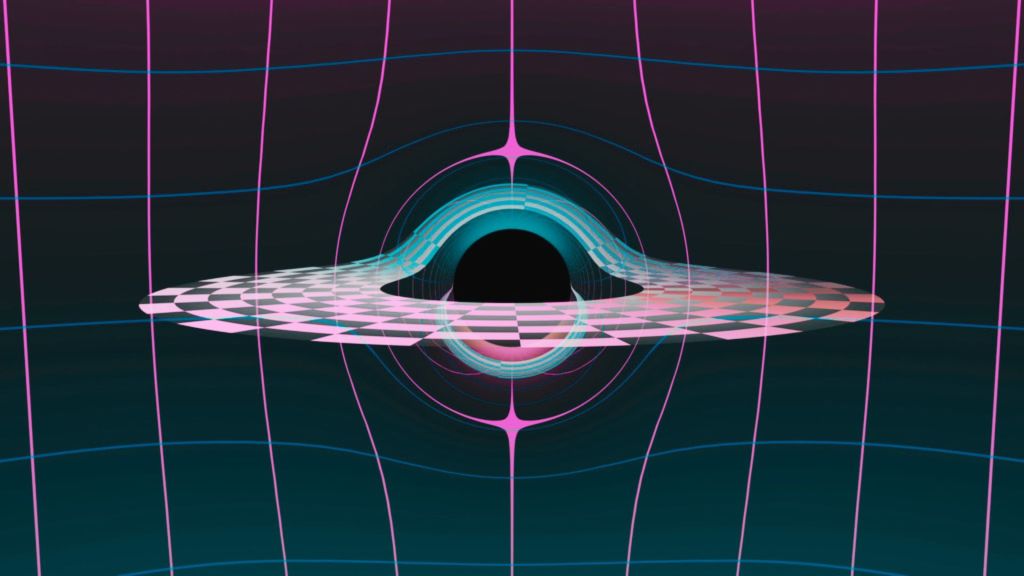
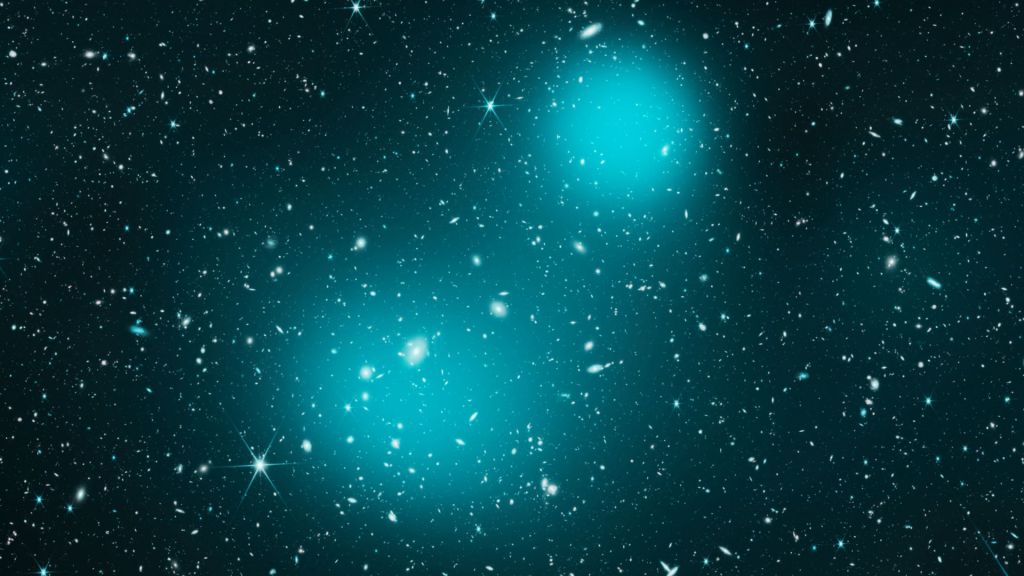
Firefly Sparkle was discovered because it lies along a wrinkle in space time, its distant light distorted and amplified by the foreground galaxy cluster designated as MACS J1423, containing thousands of galaxies. The gravitational lensing by the foreground mass density amplifies the light from the distant background galaxy by as much as 40 times. Firefly Sparkle is a surprisingly complex and extremely clustered galaxy, providing a rare and valuable window into the process of galaxy assembly and star formation in the infancy of the Universe.
A missing link
Scientists have a good handle on how galaxies in the local universe form, which is another way of saying we know how galaxies are assembled today. The large galaxies with well defined structures are built through a series of interactions and mergers. The Milky Way, Andromeda and the Triangulum galaxies are all headed towards a merger in the future, in about 10 billion years. Eventually, in about 150 billion years, these three galaxies and all the associated companion galaxies in the Local Group are expected to merge into one large elliptical galaxy. The early universe was a very different space, with massive stars collapsing from clouds of pristine hydrogen gas, the likes of which were never seen again. To understand the overall process of galaxy assembly, it is necessary to bridge the processes of the early universe with those of today. Firefly Sparkle may be able to connect the two regimes.
The earliest building blocks of the massive galaxies we see today, are believed to contain as much mass as the largest globular clusters, which are associations of stars that assume a spherical shape under the influence of gravity, and can remain stable for billions of years. Firefly Sparkle is in the estimated mass range. The arrangements of the ten clusters within Firefly Sparkle suggests that they are all gravitationally bound, with interactions with nearby galaxies resulting in a ‘starburst’ phase of boosted star formation. The galaxy is not just made up of the ten bright star clusters, there is a faint, diffuse arc of other stars in the galaxy.
Reconstructing Firefly Sparkle
Untwisting the distorted view of the galaxy reveals a teardrop shape. The bulk of the light from the galaxy is emitted by the ten star clusters, with star formation occurring in a staggered manner. The stars have not yet settled into a bulge or a disc, leaving Firefly Sparkle with a lumpy appearance. The ten clusters within the galaxies are extremely dense, indicating that stars formed in concentrated bursts when the universe was younger. Each of the star clusters are glowing in different colours of infrared light, indicating that they are in various phases of star formation.
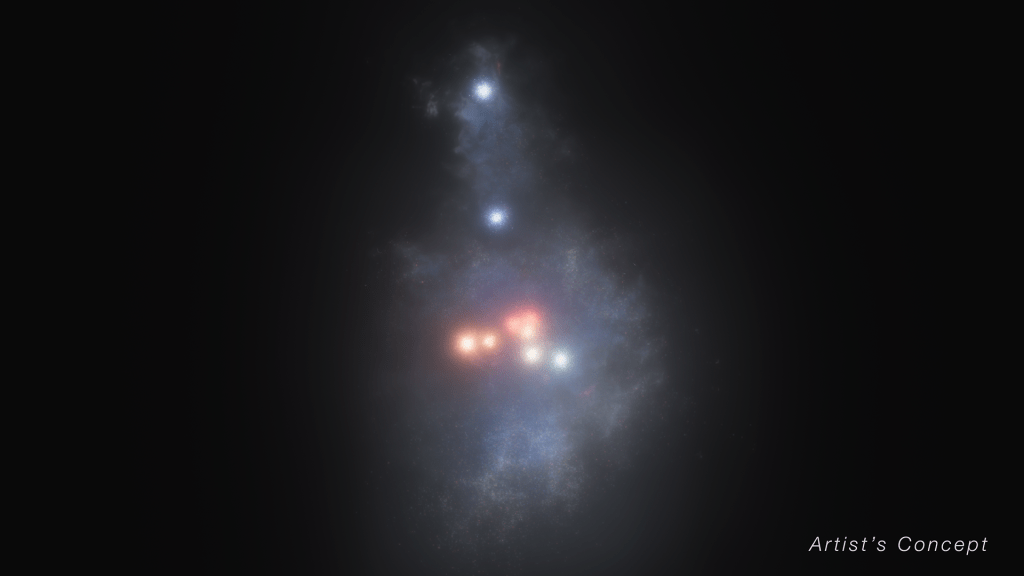
The conditions within these star clusters are extreme. The largest cluster has a temperature of 40,000 degrees Kelvin, hotter than the most massive stars. The age of the galaxy makes it metal poor. The stars were formed from pristine clouds of hydrogen and helium, before the heavier elements were cooked in the nuclear furnaces at the hearts of the first generation of stars. Each of the clusters measure less than 23 lightyears across, but pack in nearly half the mass of the galaxy.
Galaxy Assembly
There are two dim red spots that are companion galaxies to Firefly Sparkle, separated by distances of 6,500 and 42,000 lightyears. These galaxies are expected to eventually merge into Firefly Sparkle. The separation between the companion galaxies and Firefly Sparkle is less than half the width of the Milky Way, which measures about 100,000 lightyears across.
Firefly Sparkle and its two companions are spiraling around each other as they fall towards the barycenter, the center of mass of the three galaxies. These gravitational encounters redistribute the gas and dust in the galaxy, encouraging the formation of new stars. The star clusters may evolve into the globular clusters that we see in the neighbourhood. Through a series of mergers, Firefly Sparkle may eventually become a large spiral galaxy hosting a supermassive black hole, and then an evolved elliptical galaxy, shining with the light of old, aging stars.
Sources:
Linking High-z and Low-z: Are We Observing the Progenitors of the Milky Way with JWST?
Formation of a low-mass galaxy from star clusters in a 600-million-year-old Universe
Image Credits:
NASA, ESA, CSA, STScI, C. Willott (NRC-Canada), L. Mowla (Wellesley College), K. Iyer (Columbia)
Reconstruction: NASA, ESA, CSA, Ralf Crawford (STScI). Science: Lamiya Mowla (Wellesley College), Guillaume Desprez (Saint Mary’s University)

Leave a comment