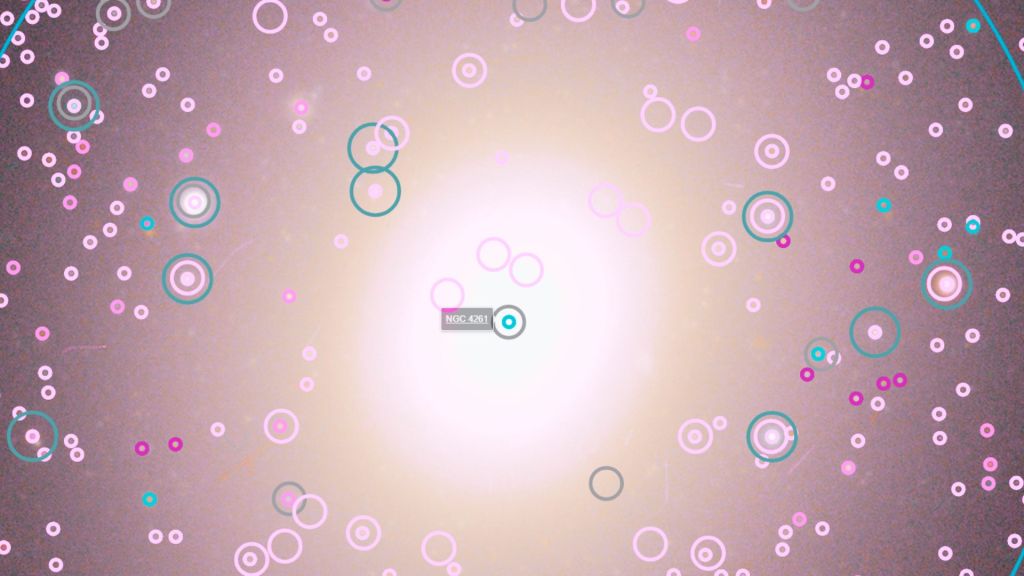
NGC 4261 is a galaxy within the Virgo Cluster that looks mostly unremarkable from a distance. It is an elliptical galaxy that contains an active galactic nuclei (AGN), the galaxy core that hosts an actively feeding supermassive black hole. The extreme friction in the tortured material falling inwards causes the black hole to glow brightly, in frequencies across the electromagnetic spectrum, outshining all the stars in the surrounding galaxy. NGC 4261 begins to reveal its secrets as you gaze into its depths, and it is necessary to use the whole spectrum, from radio to infrared to ultraviolet to X-rays.
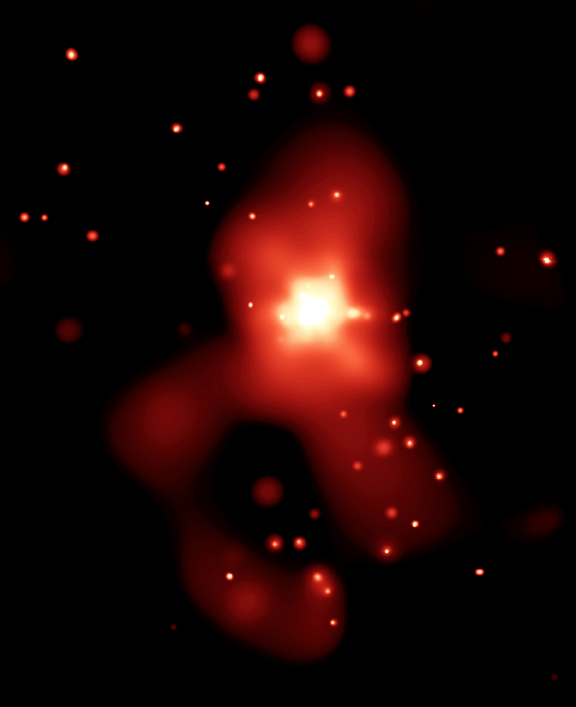
The central black hole contains as much mass as 1.6 billion suns. This supermassive black hole is an engine that has created dusty discs of infalling material. These discs span some 1,000 light-years across, and are spinning around the black hole. Some of the infalling material escapes at relativistic speeds, from polar jets. For an active galactic nuclei, the supermassive black hole is not particularly bright. The galaxy core is glowing steadily though, and is classified as a Low-Ionization Nuclear Emission-line Region (LINER), which are the lowest luminosity AGNs.
Peering further into the depths of the accretion disks, requires a technique called very-long baseline interferometry (VLBI), which reveals a delicate inner disk. Measuring less than a lightyear across, this inner disk is delicate and thin, with a height-to-radius ratio of 0.01. The outer disk acts as a reservoir, funneling gas and dust into the black hole. In the inner disk, matter is crushed together, with the density of matter increasing.
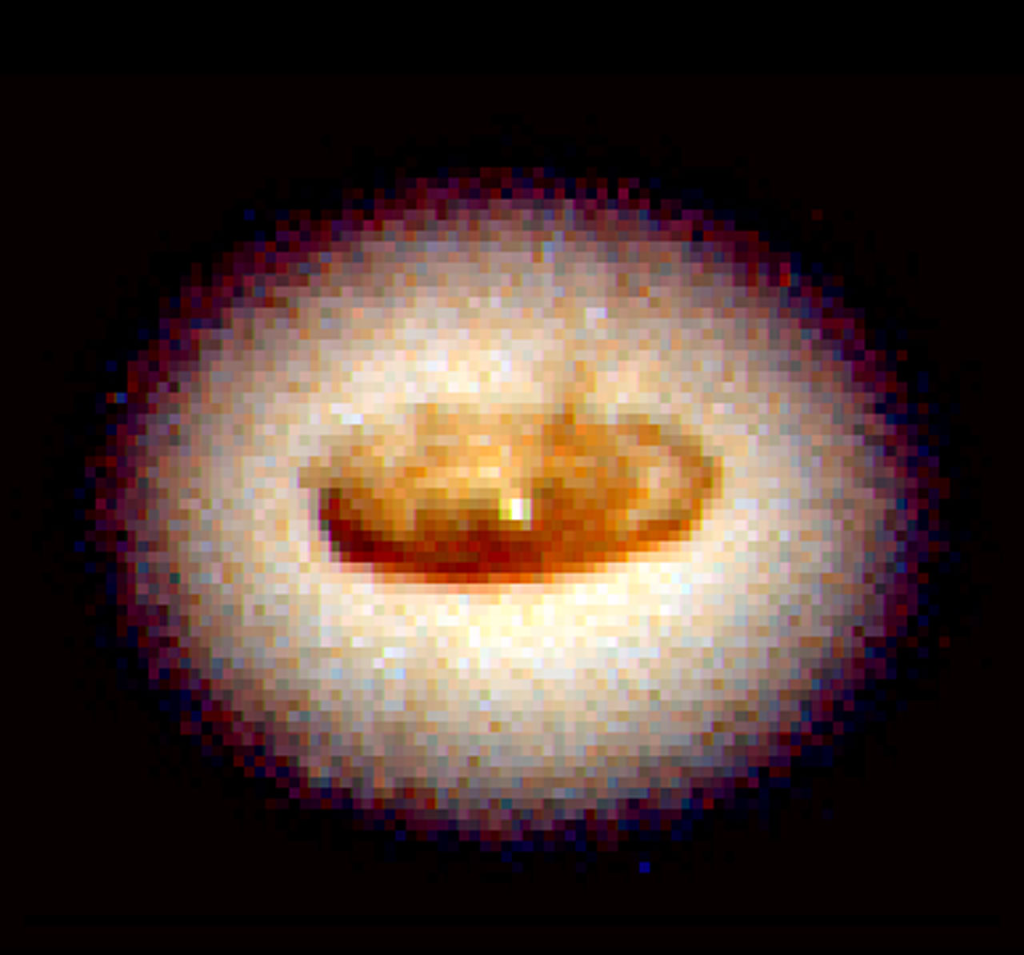
There is a third, nested disk, measuring 326 lightyears across. Hydrogen cyanide and formylium ions have been discovered in this region. This disk also spins in tandem with the black hole, and may even be producing new stars. There are elusive hints that this disk may even contain water. The black hole will keep gulping down the material in the disks, which cannot last forever.
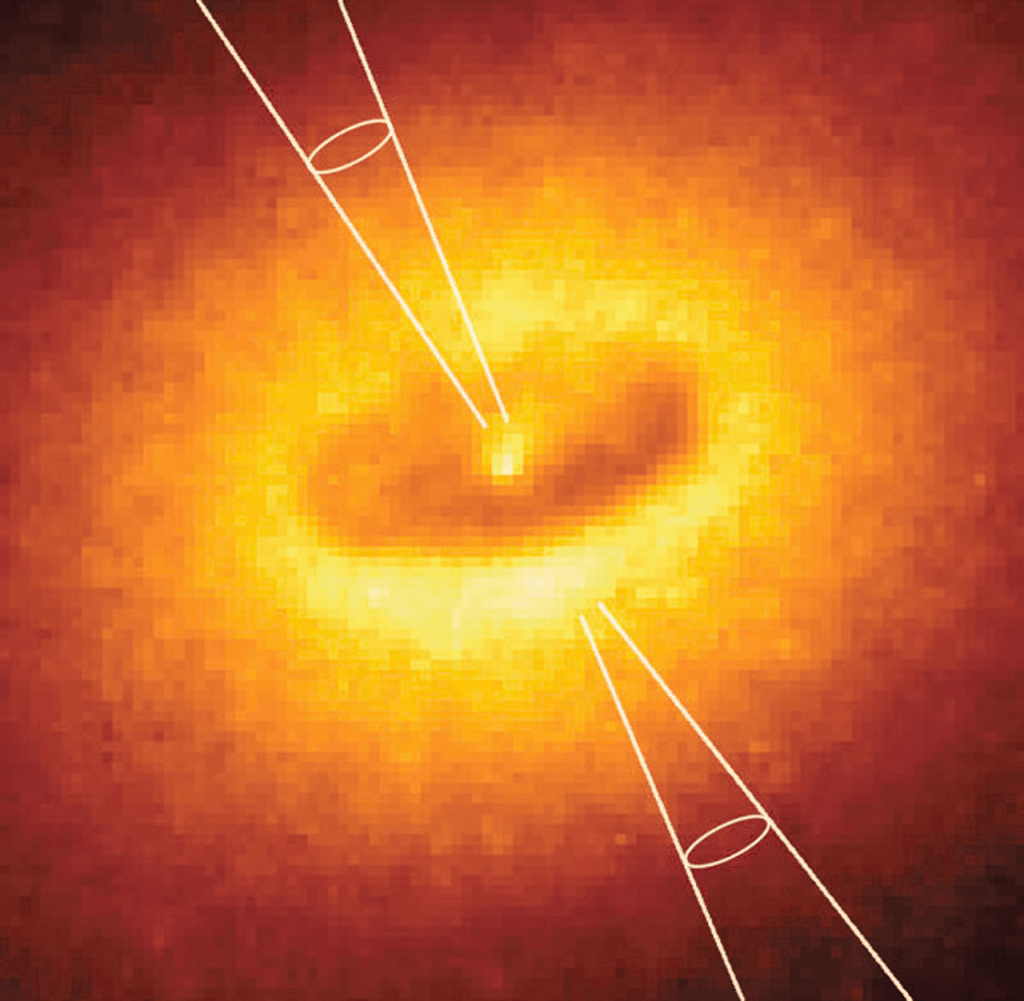
The jets stretch across thousands of lightyears, carrying more energy in a second than a billion trillion supernovas. The features of the jets are not symmetrical, and are driving massive lobes of superhot gas, or plasma. Researchers suspect that a merger with another galaxy dumped an excess of gas and dust into NGC 4261, resulting in the formation of the spectacular accretion disks and the bright black hole.
The globular clusters within NGC 4261, dense associations of ancient stars that assume a spherical shape under the influence of gravity, are scattered unevenly. Their distribution of globular clusters hints at a merger with another galaxy in the past. Some of these globular clusters host ultraluminous X-ray sources, mysterious objects that shine brighter than stars should.
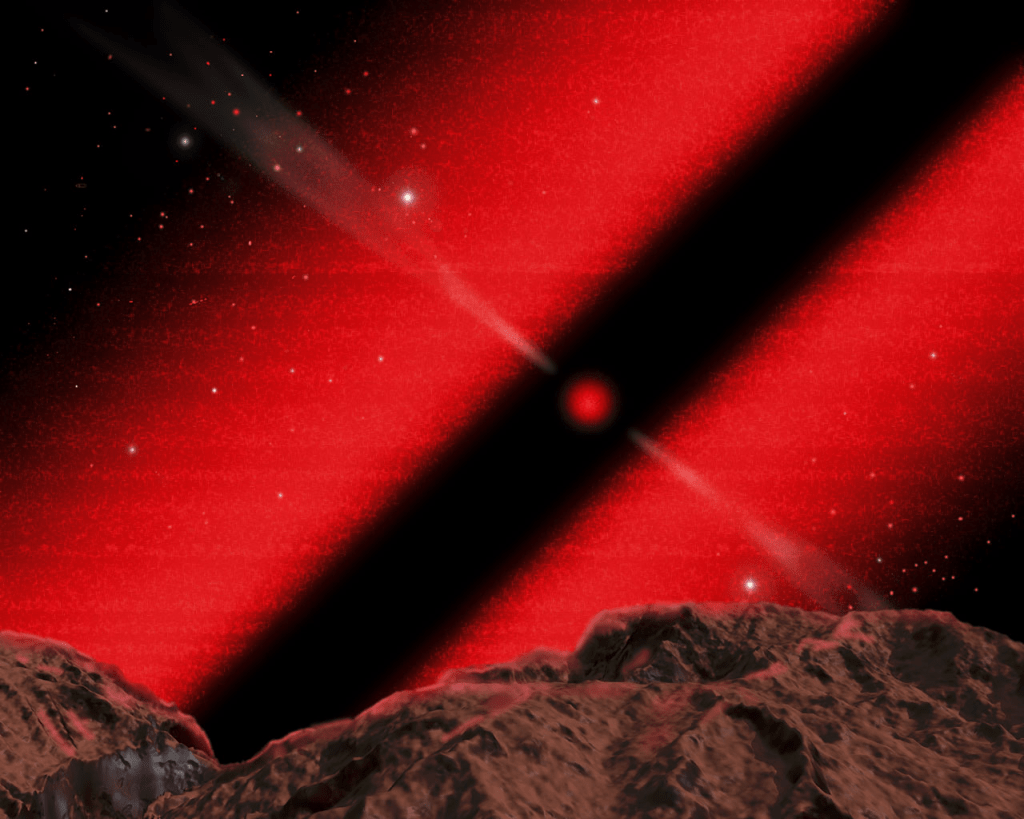
Elliptical galaxies such as NGC 4261 are aged relics, with a slow rate of star formation. The radiation from the AGN casts a harsh glow, and the jets could flash-sterlize entire worlds. Yet dense clumps of dust within the disk can form new stars, with worlds being assembled in orbits around them, and a few of these may even host life, considering that water may be rich in the region. Any life that survives on an exoplanet in the host galaxy would see the disks stretch across the skies, perpendicular to the ginormous jets punching through the night sky.
Image Credits:
NGC 4261: Legacy Surveys / D.Lang (Perimeter Institute)
Chandra X-ray Image of NGC 4261: NASA/CXC/A. Zezas et al.
NGC 4261 WFPC with illustration of jet: NASA & ESA
Core of galaxy NGC 4261: L. Ferrarese (Johns Hopkins University) and NASA/ESA
Core of Galaxy NGC 4261- Artist Concept: J. Gitlin ( Space Telescope Science Institute)

Leave a comment