
Quasi-stellar objects or quasars are bright objects at such incredible distances that they appear as point sources. These are black holes in the cores of early galaxies, surrounded by discs of infalling gas and dust. The extreme friction makes the tortured material in the accretion discs glow in frequencies across the electromagnetic spectrum, outshining all the stars in the surrounding galaxies. Some of the energy from the infalling material is released by the central black hole in the form of polar jets. These jets can briefly illumminate clouds of gas and dust, that would otherwise be invisible.
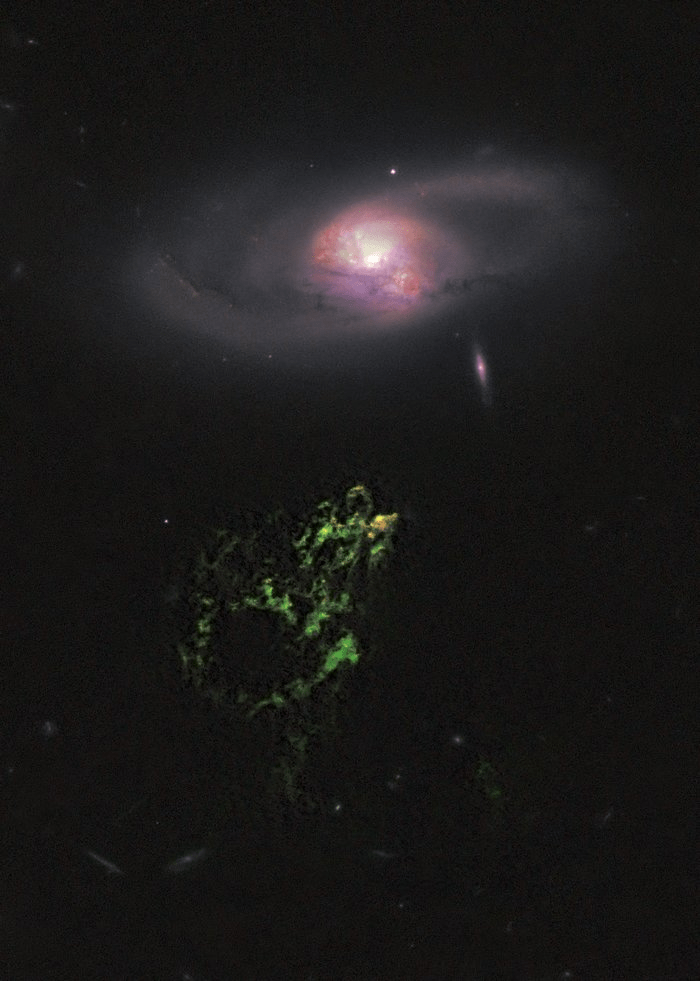
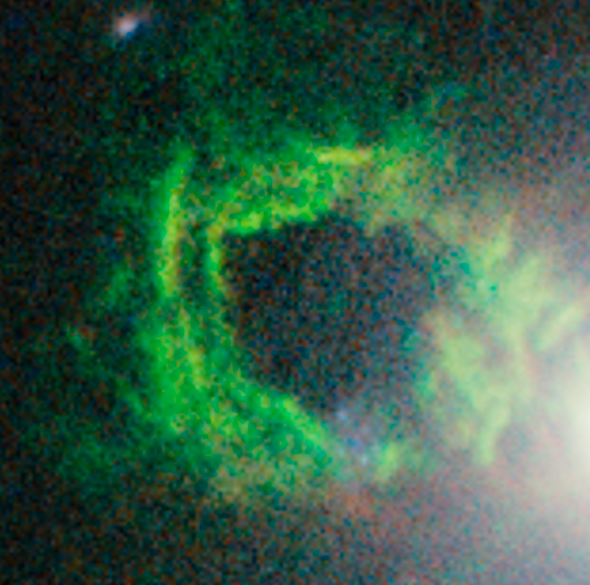
The filaments of gas in the image above are about 300,000 lightyears away from the galaxy, and contains oxygen, helium, nitrogen, sulphur and neon. The gases absorb the light from the quasar, then reemit it over thousands of years, in a process called photoionisation. The green glow is the unmistakable signature of oxygen. The yellowish-orange region is brimming with clusters of newborn stars. Below are eight more galaxies surrounded by gas ionised by quasars.
NGC 5252
Virgo
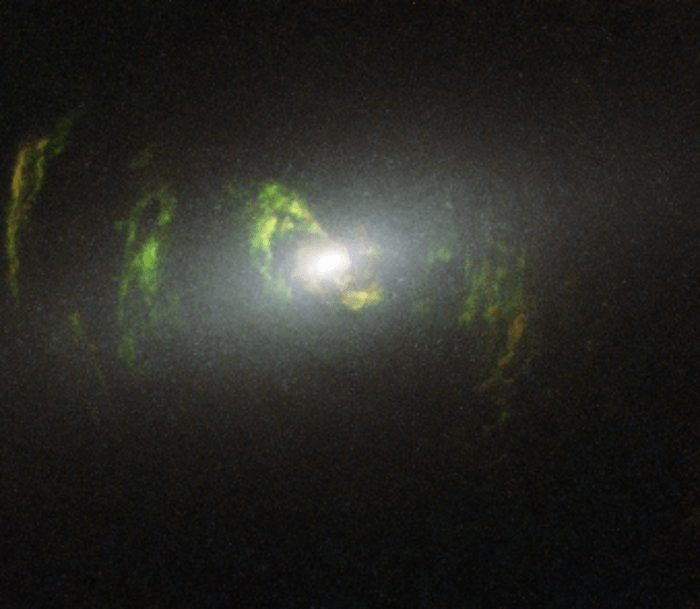
NGC 5972
Serpens Caput
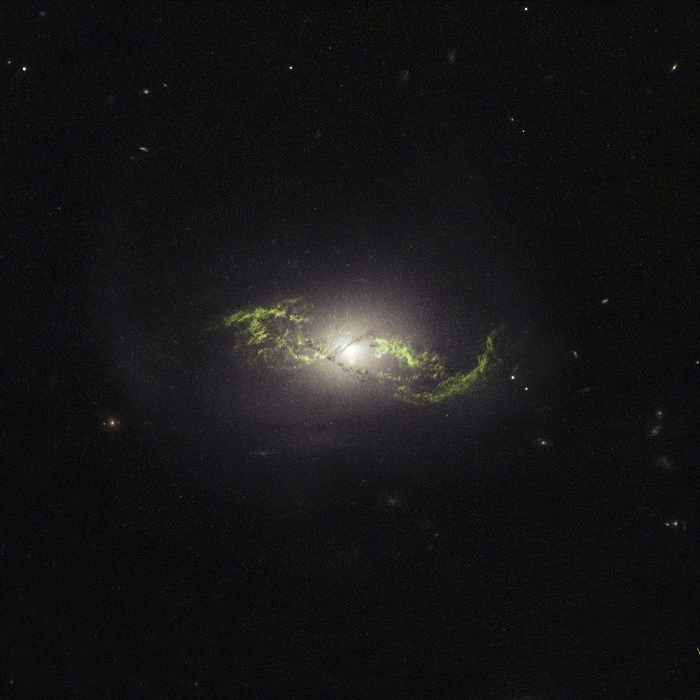
Teacup Galaxy
Bootes

UGC 11185
Lyra

UGC 7342
Coma Berenices

Mrk 1498
Draco

SDSS 2201+11
Pegasus

SDSS 1510+07
Bootes

Nearly 100 per cent of the matter and antimatter created during the Big Bang annihilated each other, dissipating in energy. A mysterious assymetry resulted in a marginal quantity of matter surviving, everything that makes up the universe. This was in the form of hydrogen and helium, the lightest elements in the periodic table, with trace quantities of helium. All the heavier elements in the cosmos were cooked in the nuclear furnaces within the hearts of stars, and then dispersed through space through stellar winds and supernova explosions. These tendrils of gas and dust, contain within them, the ingredients for complex chemistries.


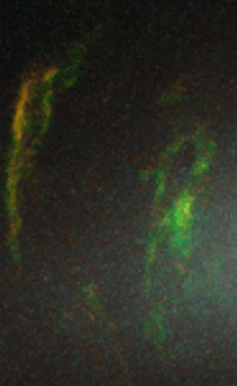


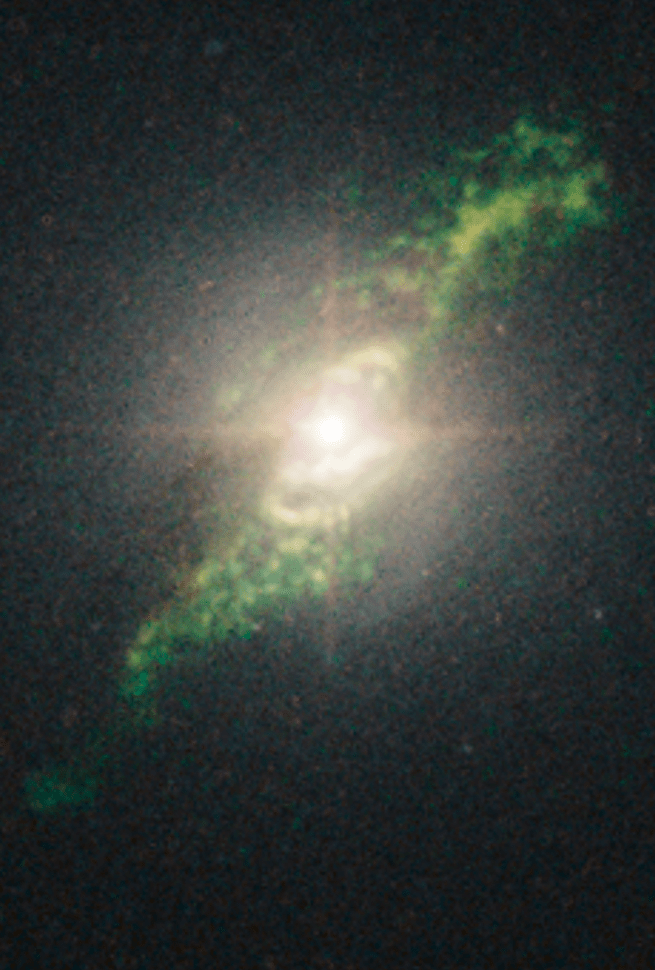
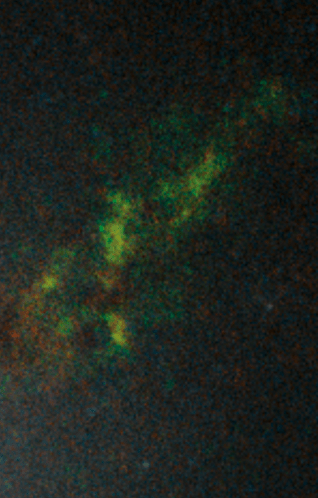

The filaments of gas and dust are in and make up the circumgalactic medium, a region surrounding galaxies that play a role in the life cycles of galaxies. This is a diffuse halo of gas and dust, a dumping ground of material formed by stellar processes, and a reservoir for star formation. The green signature of oxygen indicates that this is not pristine gas, but has been enriched with heavier elements by successive generations of stars.

This green filament resembles a distorted double helix. Similar material is found within stellar nurseries, dense clouds of cold gas and dust intertwined with the spiral arms of galaxies, and were unexpected at such great distances from their hosts. The polar jets from the monster black holes hurl out plasma at relativistic speeds, forming extragalactic bubbles of indescribable magnitude. In the example below captured from a ground-based radio telescope, the host galaxy is the tiny dot in the middle.
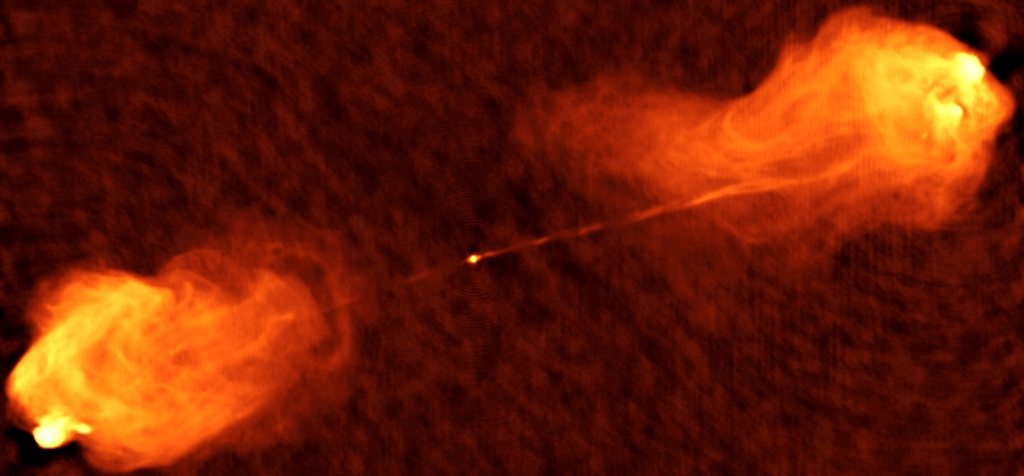
Image Credits:
Hanny’s Voorwerp, IC 2497: NASA, ESA, William Keel (University of Alabama, Tuscaloosa), and the Galaxy Zoo team
Eight Green Filaments: NASA, ESA, Galaxy Zoo Team and W. Keel (University of Alabama, USA)
Legacy Astronomical Images, “Cygnus A,” NRAO/AUI Archives, accessed February 27, 2025.

Leave a comment