
Studies of vast stellar nurseries have revealed the regions around protostars are brimming with activity. These warm, dense pockets surrounding embryonic stars acquiring the mass to sustain nuclear fusion, create a bustling region of chemistry, known as hot corinos. As the protostars feed on the surrounding dust and gas, plasma envelopes glow in the light of complex organic molecules (COMs).
Hot corinos are compact zones near protostars where temperatures rise, and molecular richness thrives. They forge prebiotic compounds long before the formation of comets or terrestrial worlds with water flowing on the surface. The paradigm of the Warm Little Pond describes the conditions in which life can emerge on rocky planets. Another kind of chemical soup appears in interstellar space.
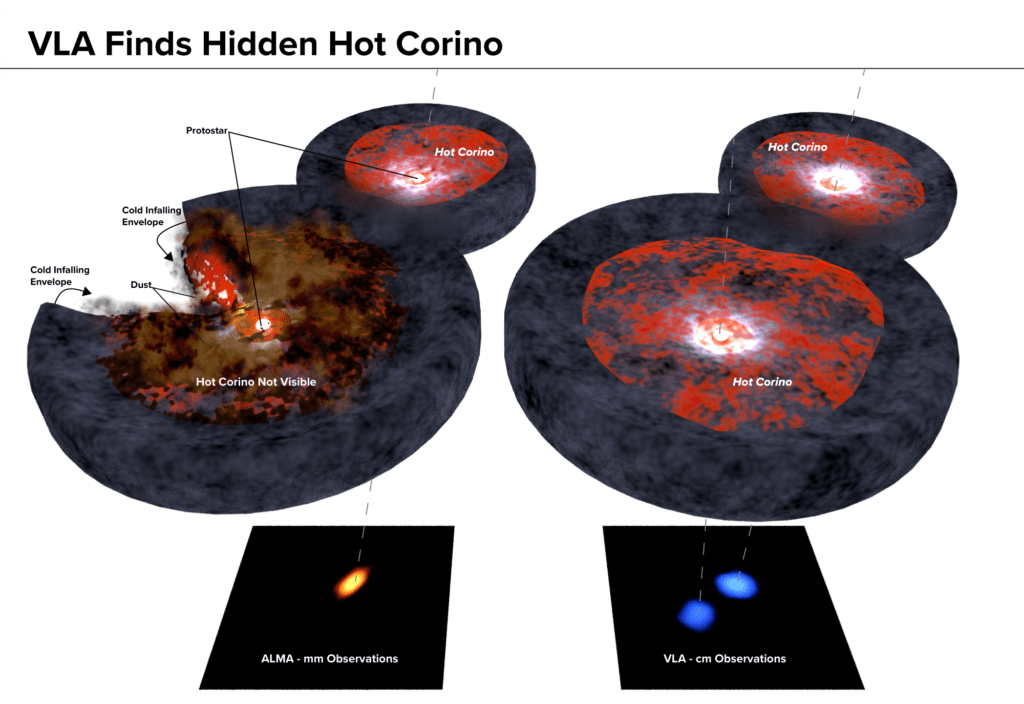
Structure of Hot Corinos, Bill Saxton, NRAO/AUI/NSF
Within Hot Carinos, COMs swirl in their gaseous states, methanol, methyl formate, ethanol, and acetaldehyde all interact. Water ice clings to dust grains providing opportunities for combinations with carbon monoxide and methanol. As the protostar warms, these ices sublimate, freeing molecules into the gas. The dust grains are tiny workshops. Chemical reactions on their icy surfaces craft COMs, altering the ice’s original mix into new species. Energetic jolts from UV radiation and cosmic sources spark further changes, driving reactions within the ices. Once sublimated, gas-phase processes tweak COM abundances, adding chapters to the chemical tale.
Radio telescopes catch emission lines from gas-phase molecules, mapping their spread and quantity. Infrared scopes peer into ice absorption features, decoding their makeup. Laboratory astrochemistry ties it all together—experiments identify molecules, measure their traits, and trace their evolution.
Hot corinos defy easy answers. Density, temperature, and radiation muddle their chemical signals. High-resolution views are needed to untangle their motion and structure. More data on gas and ice across many corinos will sharpen the picture. Better models, blending physics and chemistry, aim to mimic their evolution accurately. Hot corinos are crucibles of prebiotic molecules, hinting at the deeply cosmic roots of life.
Cover Image: Illustration of a Protostar, NASA.



Leave a comment