Imagine a time when the universe was a dark, simmering void, full of potential. No galaxies spun in majestic spirals and no planets cradled life. Most of the matter and antimatter created by the Big Bang destroyed each other, with a marginal fraction of matter surviving because of a mysterious asymmetry. This matter was mostly hydrogen and helium, with very little lithium, the lightest elements in the periodic table. From dense clumps in the the dark clouds of gas in this primordial emptiness, the first stars ignited, blazing nuclear furnaces that would forge not only all the heavier elements of the cosmos but also one of its most precious and weird molecules: water. The Earth’s oceans and the rain that nourishes our fields are part of a far grander saga—one that stretches back to the earliest epochs of existence, when water emerged from the fiery hearts of ancient supernovae, setting the stage for galaxies, planets, and perhaps life itself.
Long before the Sun cast its light on our world, the universe was populated by titans known as Population III stars—massive, metal-poor behemoths born from the pristine gas of the cosmic dawn. These stars, forming at redshifts around 20, when the universe was just a fraction of its current age, were the first nucleosynthetic engines. Unlike the stars we know today, enriched with the debris of prior generations, these primordial giants burned hot and fast, their cores fusing hydrogen and helium into heavier elements such as oxygen and iron—key ingredients for the chemistry of life.
When their fuel was spent, these stars did not fade quietly. They erupted in cataclysmic supernovae, explosions so powerful they rivaled the brightness of entire galaxies. Two flavors of these detonations stand out: core-collapse supernovae, born from stars of moderate heft, and pair-instability supernovae, the spectacular deaths of true stellar giants. Together, they acted as cosmic water factories, seeding the universe with the raw materials for a molecule that would one day become synonymous with habitability.
The Birth of Water
To peer into this distant past, scientists turn not to telescopes but to the quiet hum of supercomputers. Numerical simulations weave a vivid tapestry of these ancient events, revealing how water first splashed into being. Picture a star of 13 solar masses, forming within a cosmological halo—a gravitational cradle of gas—weighing 1.1 million times the Sun’s mass, some 12 million years after its birth at a redshift of 22.2. This star ends its life in a core-collapse supernova, a blast releasing energy equivalent to a trillion trillion nuclear bombs, ejecting a modest 0.051 solar masses of oxygen into the surrounding void.
Contrast this with a leviathan of 200 solar masses, coalescing in a heftier halo of 22 million solar masses at a redshift of 17.8. After a mere 2.6 million years, it succumbs to a pair-instability supernova, an explosion 28 times more energetic than its core-collapse cousin, hurling 55 solar masses of oxygen into space. These simulations show that before their fiery ends, both stars bathe their surroundings in ultraviolet light, carving out bubbles of ionized hydrogen—H II regions—that remain trapped within their halos, dense pockets of gas primed for alchemy.
As these stars detonate, the wreckage cools rapidly. Hydrogen molecules, or H₂, form in abundance, outpacing the recombination of ionized gas. This H₂, a nimble catalyst, sets the stage for water’s debut.
Wet Ash of Dead Stars
In the expanding remnants of these supernovae, a quiet miracle unfolds. Oxygen, freshly forged in the stellar cores, mingles with hydrogen and H₂, reacting to form water vapor. Some of this H₂ even clings to nascent dust grains, tiny flecks of carbon and silicon forged in the blast, boosting water production further. Across the halos, diffuse water vapor emerges, its presence subtle yet pervasive—mass fractions ranging from a scant trillionth in the core-collapse remnant to a hundredth of a trillionth in the pair-instability debris.
Over millions of years, the water mass grows slowly, a testament to the low densities of these expanding shells. In the core-collapse supernova’s halo, water accumulates to a mere hundred-millionth of a solar mass after 20 million years. The pair-instability remnant fares better, reaching a millionth of a solar mass in just 2 to 3 million years. Yet the real action lies in the dense shells swept up by the supernova shocks. Here, in the pair-instability remnant, water thrives, its mass fraction spiking where gas densities and reaction rates soar.
Dense Cores
The true bounty of water emerges not in the diffuse expanse but in dense, self-gravitating cores within these halos. In the core-collapse supernova’s aftermath, turbulence churns the gas into clumps that collide with the ejecta, mixing oxygen and hydrogen into a brew enriched to a ten-thousandth of the Sun’s metallicity. Over 90 million years, this core collapses to a radius of 0.1 parsecs—about a third of a light-year—packing 1,627 solar masses into a dense knot with a central density 240 million times that of Earth’s air. Its water mass reaches a hundred-thousandth of a solar mass, a modest but significant haul.
The pair-instability supernova tells a different story. Its explosion spawns a compact clump through hydrodynamical instabilities, enriched to 4% of solar metallicity. In just 3 million years, this core shrinks to a hundredth of a parsec, cramming 35 solar masses into a space so dense—600 trillion times the atmosphere of the Earth—that dust cooling kicks in, hastening its collapse. Here, water flourishes, reaching a mass of nearly a hundredth of a solar mass, with mass fractions rivalling those in richer environments.
Seeds of Planets
These water-rich cores are more than cosmic curiosities—they are nurseries for worlds. The core-collapse remnant, with its faint metallicity, could spawn protoplanetary disks that fragment into gas giants akin to Jupiter. The pair-instability core, richer in metals, might birth rocky planetesimals orbiting low-mass stars. Both disks would brim with primordial water, their mass fractions dwarfing those in the Milky Way’s diffuse clouds—10 to 30 times greater in the core-collapse case, and nearing Solar System levels in the pair-instability fragment.
Could these disks harbor habitable zones? In the pair-instability core, equilibrium temperatures might allow liquid water to pool on nascent planets, a tantalizing hint of worlds where life could take root. The universe, it seems, was crafting the ingredients for habitability long before Earth’s story began.
Zoom out, and the implications ripple across the cosmos. As primordial halos merged into the first galaxies, their water-laden remnants came along for the ride. Diffuse water mass fractions in these early galaxies might have reached a tenth of a trillionth—only ten times less than in the Milky Way today. Yet survival was no guarantee. Massive, metal-poor stars could shred water with ultraviolet light, while chemical reactions gnawed at its fragile bonds. Rising dust fractions, however, might have shielded it, preserving this cosmic elixir for future generations.
How do we glimpse this ancient alchemy? Water leaves signatures in spectral lines, detectable by the Atacama Large Millimeter Array (ALMA). Already, ALMA has spotted water lines in a galaxy at redshift 5.656, hints of what might await at redshift 15 or beyond. Some speculate a cosmic background of maser emissions could glow from the end of the Cosmic Dark Ages, a chorus of water amplifying the light of the first stars.
Wet Foundations
From the fiery deaths of Population III stars to the dense cores of their remnants, water emerged as a quiet architect of the cosmos. It enriched the first galaxies, laced protoplanetary disks with the stuff of oceans, and perhaps even whispered the possibility of life in a universe still finding its footing. The next time you sip from a glass, consider this: the water you drink traces its lineage to those primordial supernovae, cosmic forges that drenched the dawn of time.
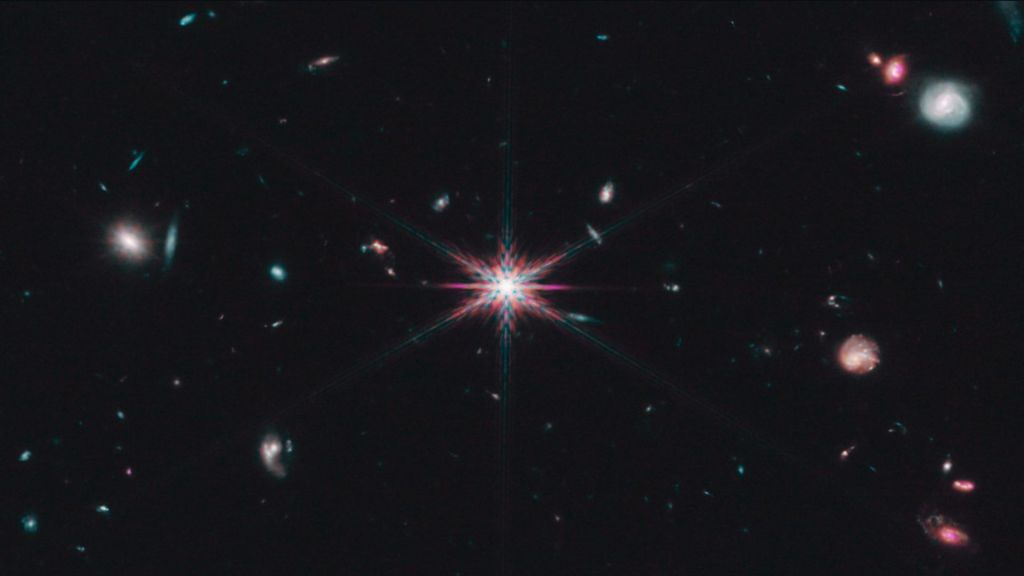
Cover Image: Quasar J0100+2802 captured by the James Webb Space Telescope, NASA, ESA, CSA, S. Lilly (ETH Zurich), D. Kashino (Nagoya University), J. Matthee (ETH Zurich), C. Eilers (MIT), R. Simcoe (MIT), R. Bordoloi (MIT), R. Mackenzie (ETH Zurich), A. Pagan (STScI).

Leave a comment