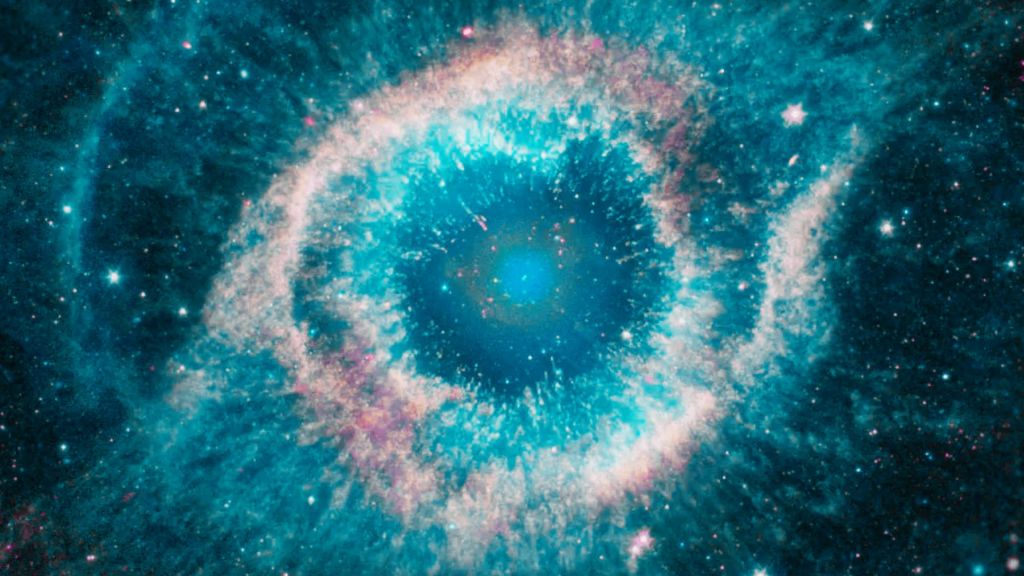
The Helix Nebula, a planetary nebula lying 650 light-years away in the constellation Aquarius, has long captured the imagination of astronomers and the public alike. Often described as the ‘Eye of God’ due to its striking resemblance to a cosmic iris, it is the remnant of a dying star shedding its outer layers into space. Hidden within this glowing veil of ionized gas, an astonishing revelation has emerged: thousands of planetary-mass objects, previously concealed in darkness, have been illuminated by the fading star’s radiation. These worlds, according to a compelling but alternative theory, are composed primarily of dark matter planets, and are undergoing a transformation. Their frozen atmospheres expanding to sizes that defy traditional planetary scales. The planetary nebula may just contain vast network of worlds, suspended in the afterglow of a dying star.
As the central white dwarf of the Helix Nebula emits intense radiation, it vaporizes the icy hydrogen and helium that once coated these frozen planets. The result is an immense atmospheric expansion—Earth-sized planets can approach the sizes of ice giants, while Jupiter-sized planets can swell up to three times that size. This process not only reveals the presence of ‘dark matter’ planets but also marks them with luminous, photoionized atmospheres, similar to the puffball Hot Jupiters. The gaseous halos and their comet-like wakes become visible in both optical and infrared observations, painting a vivid portrait of planetary metamorphosis at a cosmic scale.
Globulettes: The seeds of Exoplanets
As these planets expand and drift within the Helix Nebula, their vast atmospheres create unexpected interactions. The frictional forces arising from overlapping planetary atmospheres may cause individual objects to clump together, forming structures known as globulettes. These small, dense planetary conglomerates serve as embryonic seeds for larger celestial bodies, potentially giving rise to brown dwarfs and free-floating planetary-mass objects. The presence of polycyclic aromatic hydrocarbons (PAHs) further amplifies this process. PAH-rich planets experience increased radiation pressure, which sorts them at the boundary of the nebula’s cavities according to their level of biological activity. This suggests that the composition of these planets, particularly their organic chemistry, plays a crucial role in their dynamic behaviour and ultimate fate.
The observations within the Helix Nebula challenge our fundamental understanding of planet formation. Conventional planetary science assumes that planets coalesce from protoplanetary disks surrounding young stars, yet the Helix Nebula presents an alternative view—one in which planets emerge from ancient dark matter reservoirs and evolve under the intense forces of radiation and turbulence. This new perspective, rooted in Hydro-Gravitational-Dynamics (HGD) cosmology, suggests that planetary-mass objects were not only formed in the early universe but have remained hidden in darkness, awaiting the right conditions to be revealed.
At the Oort cavity boundary of the nebula, planets appear to be systematically arranged according to their biological complexity, with radiation pressure sorting them based on PAH content and heat transfer properties. This finding raises profound questions about the role of cosmic environments in shaping planetary evolution and even the potential for life beyond Earth. Could planetary nebulae act as incubators for the reorganization and redistribution of planets? If so, planetary formation may be a far more complex and dynamic process than we currently recognize.
A Dark Matter Galaxy
The implications extend beyond the Helix Nebula itself. If dark matter consists of ancient planets rather than exotic, unknown particles, then the universe is teeming with planetary bodies—many of them harbouring the right conditions for life. Each galaxy could be a vast repository of planetary-mass objects, drifting unseen in the cold darkness of interstellar space. The Helix Nebula provides a rare window into this hidden population, allowing astronomers to study the structure, distribution, and behaviour of dark matter planets on an unprecedented scale.
These findings directly challenge the standard cosmological model, which traditionally neglects the effects of photon viscosity during the plasma epoch and gas viscosity during the transition from the early universe to the present state. HGD cosmology argues that these overlooked factors are critical to understanding the formation and distribution of cosmic structures, including planets, nebulae, and galaxies themselves. If the Helix Nebula’s planetary population is any indication, the universe may be far more structured—and more biologically rich—than previously imagined.
The Helix Nebula has become a celestial laboratory, offering unprecedented insights into planet formation, dark matter distribution, and even the cosmic pathways of life. As astronomers continue to refine their observations, new mysteries will emerge, each one reshaping our understanding of the universe. The next generation of telescopes, capable of capturing even finer details of planetary nebulae, will provide the data needed to confirm—or refute—these radical ideas.
If these expanded planets and their globulettes indeed represent a hidden framework of cosmic evolution, then planetary nebulae such as the Helix Nebula may not be just the remnants of dying stars, but rather the birthplaces of new worlds.
Cover Image: The Helix Nebula, X-ray: NASA/CXC; Ultraviolet: NASA/JPL-Caltech/SSC; Optical: NASA/STScI(M. Meixner)/ESA/NRAO(T.A. Rector); Infrared: NASA/JPL-Caltech/K. Su
Sources:
Primordial Planets Explain Interstellar Dust, the Formation of Life: and Falsify Dark Energy
Primordial planets, comets and moons foster life in the cosmos
Interpretation of the helix planetary nebula using hydro-gravitational theory

Leave a comment