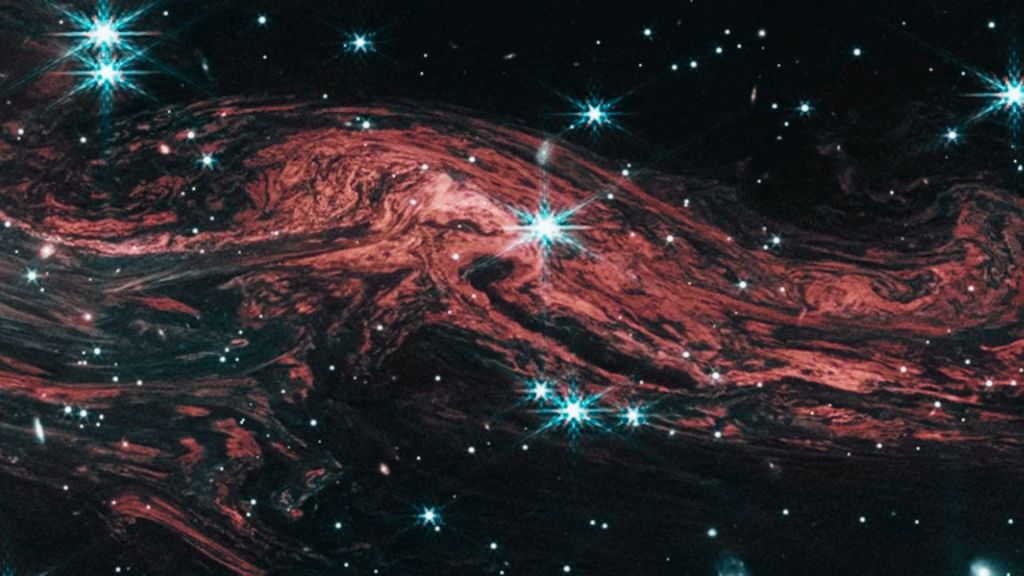
The study of interstellar grains is an esoteric branch of astrophysics. It is a gateway to understanding the origins of organic molecules, the conditions of early planetary systems, and possibly even the spread of life. As telescopes pierce deeper into space and spectroscopic techniques become more refined, the simplistic assumptions about cosmic dust are dissolving in the face of mounting evidence. For decades, our understanding of these grains has been shaped by the work of Fred Hoyle and Chandra Wickramasinghe, whose pioneering theories laid the groundwork for the graphite-silicate-organic grain model—a model that challenges standard cosmology and its assumptions about the formation of interstellar matter.
In the early 1960s, the prevailing theory suggested that interstellar grains were mere dirty ice particles, formed and grown in the sparse, cold voids of interstellar space. This view was comfortable, aligning with the classical notion that planets, stars, and even interstellar matter were born in place, within isolated regions of space. However, the ice model quickly ran into theoretical and observational issues. The physics of grain growth in such low-density environments made the idea untenable, and new observations hinted at a more complex composition for the dust that drifted between the stars.
In 1962, Hoyle and Wickramasinghe provided an alternative, suggesting that interstellar grains were not ice, but graphite particles—refractory materials that condensed in the outflows of cool, evolved stars rather than forming in interstellar clouds. This was a paradigm shift. Instead of grains forming spontaneously in space, they were being ejected from stars, enriched with carbon and other heavy elements. Over the next few decades, these theories evolved in response to new data, refining the composition of these grains to include silicates and complex organic molecules. Each new development brought more evidence that the dust in interstellar space had origins deeply connected to both stellar evolution and organic chemistry.
Intergalactic Biosphere
A provocative idea emerged from this work: a significant fraction of interstellar grains might have a biological provenance. Small, dark grains of dust, nearly invisible, provided an alternative solution to the problem of dark matter, a mysterious substance that adds mass to galaxies, and prevents them from spinning themselves apart. This interstellar dust consists of grains similar in size to microbes and biological debris… with the panspermia hypothesis advancing the radical notion that the two are the same.
If organic molecules could form within interstellar dust, and if this dust was the remnant of past biological processes, then the material between the stars might be the scattered detritus of universal life that emerged in the infancy of the cosmos. Hoyle and Wickramasinghe proposed that the complex organics detected in space—polycyclic aromatic hydrocarbons (PAHs), polysaccharides, and even potential bacterial remnants—could be the degraded remnants of biological matter. This idea was controversial, as it suggested that life might not be confined to planets but could be an integral component of the fabric of spacetime.
Life rides on Dust
If interstellar grains are connected to biological material, they may not only represent remnants of past life but also active transporters of it. The hypothesis that life originated in a cosmological setting rather than within the narrow confines of Earth’s biosphere is supported by probability arguments that can be simplified as: a single planet is an implausibly small arena for an event as complex as the emergence of life. Interstellar grains, shielding microorganisms from radiation and cosmic hazards, could serve as natural interstellar or even intergalactic vehicles, dispersing life across planetary systems. This would mean that microbial life exists not as an isolated accident on Earth, but as a galactic—or even universal—phenomenon.
Recent observations lend weight to these ideas. Infrared spectroscopy of interstellar dust reveals organic chemicals that resemble those found in living systems. The detection of aromatic-aliphatic nanoparticles, whose complexity defies non-biological explanations, suggests an organic origin that extends beyond simple chemistry. If you find petrol in space, better start looking for the fossils. Furthermore, the discovery of complex molecules in the atmospheres of comets—cosmic visitors that may have originated in interstellar space—points to a deep connection between interstellar grains and the chemistry of life.
Dark matter planets, hidden within the vast cosmic voids, may be cradles of organic chemistry, their oceans providing the stable environments necessary for prebiotic chemistry to unfold. These planets, shrouded in darkness, could have been laboratories of organic synthesis for billions of years, seeding the galaxy with life-bearing grains.
A Cosmic Unification
The study of interstellar grains has undergone a profound transformation over the past half-century, moving from simple models of ice particles to a dynamic picture of refractory grains, complex organics, and perhaps even microbial life. While largely ignored by mainstream science, the hypothesis of panspermia continues to provide a framework for interpreting new astronomical discoveries. The idea that interstellar grains may be both the remnants and vehicles of life remains a powerful unifying hypothesis, linking disparate observations across astrophysics, chemistry, and biology. If their theories hold true, then the universe may not just be a stage for life—it may be an active medium for its creation and dissemination.
Cover Image: Interstellar dust lit by the expanding ‘thermal light echo’ from a supernova captured by the James Webb Space Telescope. NASA, ESA, CSA, STScI, J. Jencson (Caltech/IPAC)
Additional Sources:
Formation of Planets by Hydrogravitational Dynamics
Primordial planets, comets and moons foster life in the cosmos

Leave a comment