For centuries, humans have debated the origins of life, with prevailing theories painting a picture of an isolated, improbable event—the chance emergence of self-replicating molecules in a primordial soup, perhaps deep within Earth’s oceans, perhaps on intermittently dry land. But what if abiogenesis was not an isolated miracle, but a cosmic inevitability? What if life, rather than being a late and local occurrence, exploded into existence across the universe in a sudden burst—an event similar to the Big Bang itself?
This bold idea, the ‘Biological Big Bang,’ challenges conventional wisdom. Instead of a fragile and unlikely genesis, it envisions life emerging rapidly and spreading across vast cosmic distances. Rather than a single spark in a lifeless void, life may have been seeded in the earliest planetary environments, evolving in tandem with the universe itself.
The Circle of Life
The standard narrative of planetary formation suggests that life could only arise after stars had forged heavy elements, built planets, and provided the stable environments necessary for chemistry to become biology. But emerging models suggest an alternative: planets may have formed far earlier than traditionally believed, in the dense, primordial aftermath of the Big Bang.
In the first few hundred thousand years, as the universe transitioned from plasma to gas, matter began to coalesce. Hydrogen-helium planets—far older than the rocky worlds we know—could have formed in vast numbers within dense million-solar-mass clumps. These primordial planets, existing in tightly packed clusters, would have played a pivotal role in the cosmic cycle, merging to ignite the first stars and fuelling the chaotic interplay of matter that spread life’s essential ingredients.
Cosmic Nursery
If planets emerged early, they may have also provided stable, life-friendly environments far sooner than previously assumed. The interiors of these primordial planets, warmed by radioactive decay and insulated by thick icy shells, could have harbored liquid water for millions of years—more than enough time for organic chemistry to transition into something more complex.
At high pressures, dense oceans of water at critical temperatures (~647 K) may have pooled above metallic cores, creating conditions ripe for rapid chemical reactions. Within these environments, the fundamental molecules of life—amino acids, lipids, and nucleotides—could have assembled into primitive self-replicators, not just in one isolated world, but across an entire cosmic nursery of planets.
Primordial Goo
Unlike the classic view of abiogenesis occurring in one ocean on one planet, the Biological Big Bang proposes a vast network of planetary exchanges. Within the tightly packed clumps where primordial planets resided, matter could have frequently transferred from world to world. Collisions, volcanic eruptions, and even gentle atmospheric exchanges could have allowed prebiotic chemistry to evolve collectively, forming a true universal “primordial soup.”
These exchanges weren’t limited to direct planetary contact. Comets—rich in organic material and potential incubators of microbial life—could have acted as both amplifiers and dispersers. As they migrated through interstellar space, they might have carried the molecular blueprints of life, depositing them into clouds of dust and gas that later condensed into new planetary systems.
A Biological Big Bang
If the conditions were right, life may have arisen simultaneously across many planetary interiors between 2 and 8 million years after the first planets formed. This would mark a radical departure from the idea of life as an Earth-centric phenomenon. Instead, life could have been an expected outcome of planetary evolution, emerging in a synchronized burst across the early cosmos.
The process of panspermia—life’s ability to spread via spacefaring material—could have carried biological precursors from one world to another, linking planetary biospheres into a grand cosmic web. Far from being isolated experiments, planetary interiors may have shared and evolved life together, creating a vast, interconnected network of living chemistry.
The Evidence Hiding in Plain Sight
The notion that life began in such an explosive manner is not just a speculative fantasy. Several lines of evidence support the idea that the building blocks of life—and perhaps life itself—traverse the cosmos.
Organic molecules, including amino acids and complex hydrocarbons, have been found in comets, asteroids, and interstellar clouds. Spectroscopic studies suggest that polycyclic aromatic hydrocarbons (PAHs), which are abundant in space, could be biological in origin. Meanwhile, on Earth, extremophiles—bacteria and archaea capable of surviving in deep-sea vents, acidic lakes, and even the vacuum of space—offer tantalizing clues that life’s resilience is not unique to our planet.
If we discover life on Mars, Titan, Europa, or Enceladus with biochemistry strikingly similar to our own, it would provide powerful evidence that life did not emerge independently but was seeded through a shared cosmic origin. This would reinforce the idea of an interconnected biosphere stretching across planetary systems.
The idea of a Biological Big Bang also forces us to reconsider the dominant cosmological models. The prevailing ΛCDM (Lambda Cold Dark Matter) model suggests a slow and orderly universe where planets formed only after generations of stars had enriched the cosmos with heavy elements. This model, however, predicts a mostly barren and lifeless universe, with planetary formation occurring far too late for a rapid explosion of life.
By contrast, alternative models such as hydro-gravitational-dynamics (HGD) cosmology propose that planets were abundant in the early universe, forming long before the first galaxies. If this is true, then ΛCDM is missing a crucial piece of the puzzle—one that may explain why life appears to have emerged so quickly on Earth and why its fundamental chemistry seems so universal.
Rethinking Our Place in the Universe
The Biological Big Bang challenges us to reconsider what it means to be alive in the cosmos. Rather than being an improbable anomaly, life may be a fundamental feature of planetary evolution, a natural consequence of the way the universe unfolds. If life emerged early and spread widely, then the search for extraterrestrial life is not about finding the exception but rather recognizing the rule.
The implications are profound. If life is abundant, intelligent civilizations may also be far more common than we assume. Our understanding of evolution, adaptation, and even consciousness itself could be reframed as part of a vast, cosmic experiment billions of years in the making.
For now, the idea of a Biological Big Bang remains a bold hypothesis. But with each discovery—whether in the chemistry of distant comets, the hidden oceans of icy moons, or the atmospheres of exoplanets—we move closer to uncovering the true story of our origins. And if this theory proves correct, the universe is not just a cold expanse of matter and energy, but a living, evolving system in which we are merely one marble.
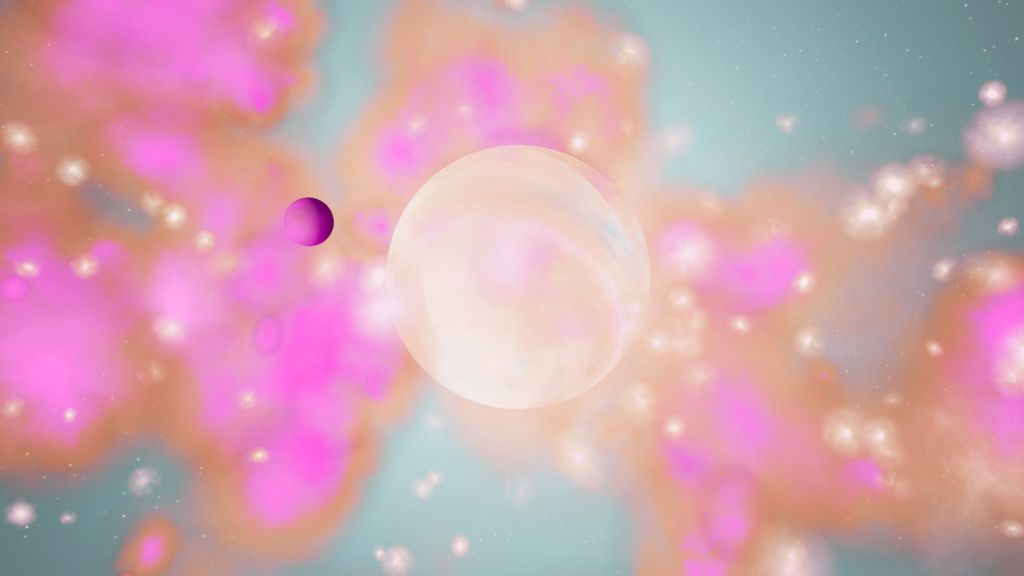
Cover Image: Illustration of an early exoplanet around a newborn star.
Sources:
Why are so many primitive stars observed in the Galaxy halo
Evolution of primordial planets in relation to the cosmological origin of life

Leave a comment