
In 1932, the Soviet physicist Lev Landau proposed a radical concept in nuclear physics—a “gigantic nucleus,” at the time, physics was in the midst of a revolution, with quantum mechanics reshaping our understanding of the atomic world. Landau sought to answer a fundamental question: what happens when matter is compressed to such extreme densities that atomic nuclei themselves are forced into close contact?
The key motivation behind Landau’s idea was the overwhelming energy of electron gas in extreme conditions, which was dictated by Fermi-Dirac statistics. To minimize this energy, he speculated that protons and electrons might merge into a neutral state, and stumbled upon the concept of a neutron star just before the discovery of the neutron itself. This was a bold step toward what would later be recognized as neutronization—the process by which matter is transformed into neutron-rich material. English Physicist James Chadwick would announce the discovery of the neutron later that same year.
Though the concept of a gigantic nucleus was largely speculative, it set the stage for our modern understanding of ultra-dense stellar relics, the remnant cores of dead stars.
The Neutron Star Interpretation
The discovery of neutron stars in the late 1960s, through radio pulsars, breathed new life into Landau’s decades-old hypothesis. Astronomers quickly realized that these ultra-dense remnants of supernova explosions closely resembled his gigantic nucleus, at least in theory. Unlike ordinary stars, neutron stars were composed almost entirely of neutrons, held together by gravity.
For years, scientists believed that neutron stars contained nucleons—protons and neutrons—packed tightly together. But as theoretical physics advanced, new models began incorporating more exotic states of matter. Some proposed the existence of hybrid stars, in which a neutron-rich outer layer encased a core of free quarks, with the density reaching high enough to break down even the building blocks of atoms. Others envisioned the possibility of quark stars, composed entirely of deconfined quark matter.
A major breakthrough came with the realization that strange quark matter—matter composed of up, down, and strange quarks—might represent the most stable form of strongly interacting matter. This led to the proposal of strangeon stars, where “strangeons”—clusters of strange quarks—replace conventional nucleons as the fundamental building blocks.
The term “strangeon” fuses “strange nucleon” and represents a three-flavored bound state of quarks. If strangeon matter is indeed more stable than ordinary nuclear matter, then compact stars could exist in a fundamentally different state than previously assumed. Unlike neutron stars, which are bound by gravity, strangeon stars would be self-bound by the strong nuclear force.
This idea introduces the concept of a strangeness barrier, making it difficult for normal matter to transition into three-flavor strangeon matter through weak interactions. In effect, a strangeon star could be considered a three-flavored version of Landau’s original gigantic nucleus.
Neutron Stars vs. Strangeon Stars
The differences between neutron stars and strangeon stars are striking. Landau’s initial concept of a gigantic nucleus was based on two-flavor matter (up and down quarks), while strangeon stars introduce a third flavor. This subtle distinction has profound consequences.
Neutron stars are supported by neutron degeneracy pressure and gravitational binding, whereas strangeon stars are stabilized by the strong force itself. This means that strangeon stars have a stiffer equation of state, leading to higher maximum masses—potentially reaching around three times the mass of the Sun. Furthermore, strangeon stars may have negligible atmospheres, appearing “bare” in observational data.
If strangeon stars exist, they could explain various enigmatic astrophysical phenomena. Pulsars—rapidly rotating neutron stars—display an array of behaviors that could be interpreted through the strangeon model. The drifting sub-pulses seen in some pulsars, for example, might be linked to the unique surface properties of strangeon matter. Similarly, the clean fireballs associated with supernovae and gamma-ray bursts could hint at the presence of strangeon cores.
Gravitational wave astronomy is opening new windows into these questions. The landmark event GW170817, a neutron star merger detected in 2017, has provided a natural testbed for strangeon star models. If strangeon stars do exist, future observations of kilonovae—explosive afterglows of compact star mergers—may reveal signatures of their unique equation of state.
Unanswered Questions
Despite the theoretical appeal of strangeon stars, key questions remain. One of the biggest uncertainties lies in determining the critical baryon number—how many nucleons must cluster together before a gigantic nucleus forms. The nature of the strong force at extreme densities is still not fully understood, and resolving the competition between neutronization and strangeonization requires further study.
Another frontier lies in studying the microphysics of strangeons in dense environments. How do they interact with one another? Could multi-quark states form new, yet undiscovered phases of matter? Moreover, general relativistic effects on strangeon stars—such as the possibility of starquakes—remain an active area of research.
Upcoming observatories such as the Square Kilometre Array (SKA), the Five-hundred-meter Aperture Spherical Telescope (FAST), and the enhanced X-ray Timing and Polarimetry mission (eXTP) are expected to provide key observational insights. By probing the gravitational and electromagnetic signatures of compact stars, these instruments may ultimately determine whether strangeon stars are a speculative oddity or a fundamental part of the universe.
Lev Landau’s vision of a gigantic nucleus was born in an era before neutrons were even recognized. Nearly a century later, his idea continues to evolve, shaping our understanding of the densest forms of matter in the cosmos. Whether the future confirms neutron stars as the final answer or unveils a deeper layer of strangeness remains to be seen.
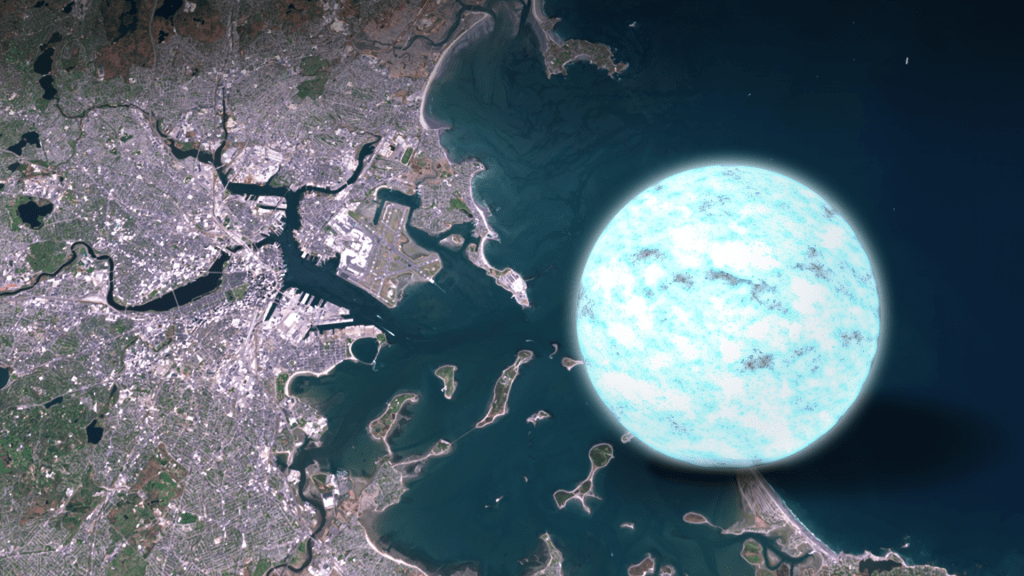
Cover Image: Illustration of a Neutron star by ATG/ESA.
Sources:
Lev Landau and the concept of neutron stars
Neutron star versus neutral star: On the 90th anniversary of Landau’s publication in astrophysics
Pulsar glitches in a strangeon star model. II. The activity
Supernova neutrinos in a strangeon star model
Rotating Massive Strangeon Stars and X-Ray Plateau of Short GRBs

Leave a comment