
In 1933, Swiss Astronomer Fritz Zwicky ‘weighed’ a whole bunch of galaxies called the Coma Cluster, and discovered that they could not be gravitationally bound together based on the mass of the visible light. An invisible mass seemed to be holding the cluster together, which Zwicky dubbed ‘dunkle materie’ or dark matter. Despite decades of search, scientists have not discovered this unknown substance that interacts gravitationally with ‘regular’ or ‘ordentlich’ matter, made up of protons, neutrons or baryons. We have a pretty mundane and familiar explanation for dark matter, it could just be nearly invisible fine particulate matter pervading the universe, that our telescopes struggle to spot. The elusive dark matter might just be dust.

The Coma Cluster of Galaxies. Image Credit: NASA, ESA, J. Mack, and J. Madrid et al.
The prevailing Lambda Cold Dark Matter Hierarchical Clustering (CDMHC) model suggests that dark matter consists of exotic, non-baryonic particles that do not interact with light. However, an alternative idea—rooted in hydrogravitational dynamics (HGD) cosmology—proposes that dark matter is composed of primordial planets within protoglobular star cluster (PGC) clumps. In other words, the missing mass can be explained by concentrations of gas and dust, specifically the exoplanets being assembled around new-born stars in roughly spherical, gravitationally bound associations. This theory challenges the standard model and carries profound implications for our understanding of galaxy formation and mass distribution throughout the universe.
Dark Matter as Primordial Planets
According to HGD cosmology, the dark matter of galaxies is composed of primordial planets trapped in PGCs. These PGCs, formed from Earth-mass planets that arose from plasma in the early universe, act as reservoirs of dark matter. If stars fail to form within these clusters, the frozen planets remain as dark matter, influencing the structure of galaxies without emitting light.
In contrast, the CDMHC model suggests that dark matter consists of non-baryonic particles that clustered together in the plasma epoch. These cold dark matter (CDM) particles provided the gravitational potential wells necessary for baryonic matter to accumulate and form the first stars and galaxies.

Images of protoplanetary discs captured by Webb and ALMA. ALMA, ESO, NAOJ, NRAO, S. Andrews , Nicolas Lira
HGD cosmology envisions galaxy formation occurring through the fragmentation of plasma protogalaxies into PGCs, which subsequently disperse to form baryonic dark matter halos. Stars form within these clusters when planetary mergers trigger nuclear fusion, that marks the birth of a star.
The CDMHC model posits that cold dark matter seeds hierarchically cluster to form CDM halos. Stars and galaxies emerge as primordial gas falls into these potential wells, creating the structures observed in the universe today.
Quasar Microlensing
The light from a distant quasar can be slightly bent and amplified by a passing foreground mass, providing scientists with valuable information on the foreground object, specifically how mass is distributed within it. Observations of quasar microlensing lend support to the idea that dark matter consists of planetary-mass objects rather than unknown, exotic particles. These studies reveal that dark matter exists in the form of planet-mass objects arranged in million-solar-mass clumps. This evidence aligns with HGD cosmology’s prediction of frozen primordial planets acting as dark matter, raising doubts about the CDMHC model’s assumptions.

Microlensed quasars lensed by foreground galaxies, captured by the Hubble Space Telescope.
Despite its widespread acceptance, the CDMHC struggles to explain the number of observed small galaxies and the mechanisms behind star and planet formation, does not incorporate essential fluid mechanical processes crucial to gravitational structure formation, and fails to naturally permit the formation of life. Whether the last of these is a foundational issue for cosmological evolution, or a stretch goal for astrophysics, is up for you to decide.
HGD cosmology offers alternative explanations for cosmological phenomena, particularly the apparent dimming of Type Ia supernovae, which has been attributed to dark energy in the CDMHC model. Instead, HGD suggests that the observed dimming results from light scattering in the hot turbulent atmospheres of evaporated planets surrounding central white dwarfs, eliminating the need for a mysterious dark energy force.
A Paradigm Shift in Cosmology?
If primordial planets within PGCs truly account for dark matter, it would require a fundamental reevaluation of our understanding of cosmic evolution. The implications extend far beyond galaxy formation, influencing the nature of gravity, planetary science, and even the fundamental forces governing the universe. While the CDMHC model remains the dominant framework, the growing body of observational evidence supporting HGD cosmology demands further investigation.
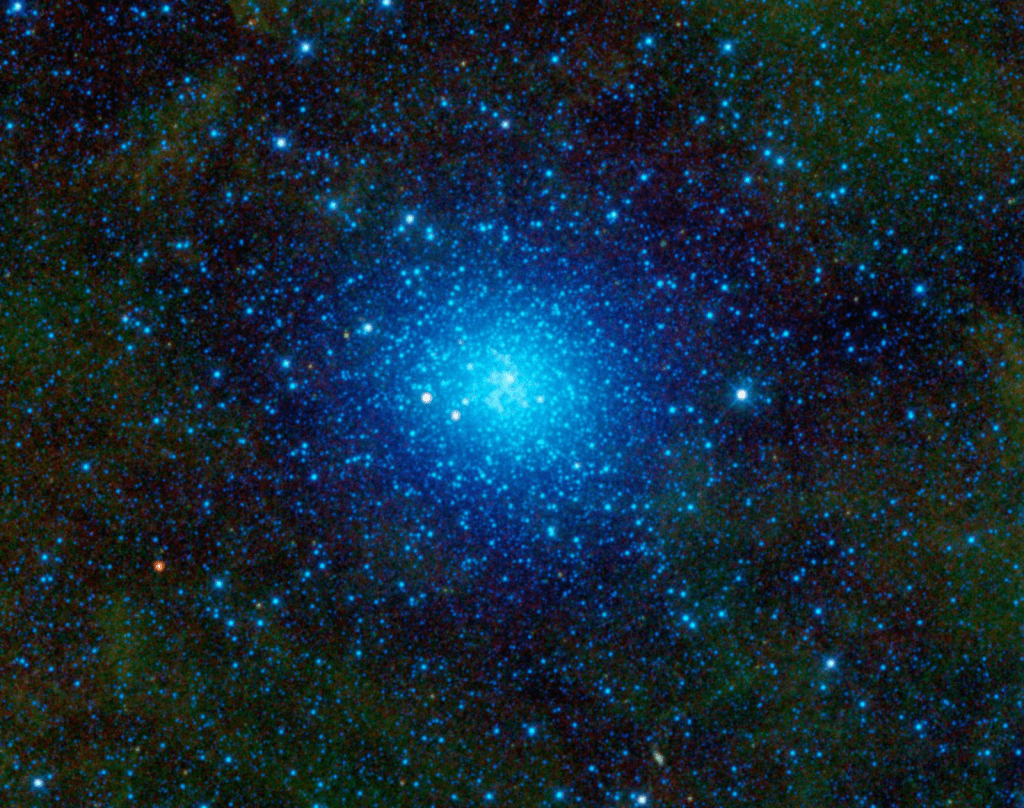
The Omega Centauri Globular Cluster captured by the WISE telescope, NASA/JPL-Caltech/UCLA.
The debate over dark matter’s true nature is far from settled. As future observations refine our understanding, the possibility that entire populations of primordial planets silently shape the universe remains a tantalizing mystery.
Cover Image Credit: Protoglobular Clusters forming less than 500 million years after the Big Bang, as seen within the ‘Cosmic Gems arc’ captured by the James Webb Space telescope. ESA/Webb, NASA & CSA, L. Bradley (STScI), A. Adamo (Stockholm University) and the Cosmic Spring collaboration.
Sources
Why are so many primitive stars observed in the Galaxy halo

Leave a comment