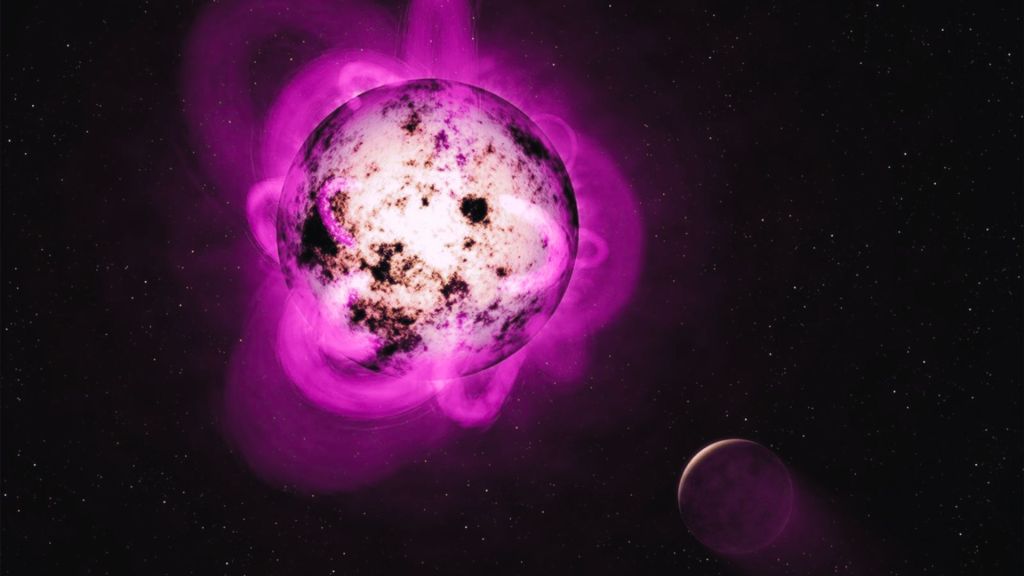
Red dwarfs are the bad-tempered midgets in the stellar neighbourhood. Unlike our more civilized Sun, they pummel their planets with flares so violent they’d make a doomprepper blush. Any poor, unfortunate world orbiting one of these cosmic firecrackers gets a daily dose of X-rays and ultraviolet radiation strong enough to strip its atmosphere entirely. And yet, these are the most common type of stars, and in the terrestrial worlds orbiting the red dwarf, life may somehow eke out an existence between solar tantrums.
To begin with, such a world would have to avoid getting eaten by its host star, which Red Dwarfs tend to do. Any surviving world in orbit would most likely be tidally locked, like the Moon is to the Earth. One hemisphere bakes under relentless daylight, while the other is so cold that gases freeze out. The climate system on such worlds may be even more dysfunctional than ours. The world would be caught in a tug-of-war between infernal heat and cryogenic death, with a narrow strip of habitability, a band of perpetual twilight with the very cool name of ‘the terminator line’. It is not exactly a vacation spot, but hey, extremophiles might call it home.
These stars burn slow and long, can live much longer than the Sun, allowing for more time for life to emerge, evolve and thrive, but they also throw spectacular temper tantrums. Flare storms, coronal mass ejections, filament eruptions and intense stellar winds would delight anyone enthusiastic heliophysicist. Cosmic rays could start messing with the the chemistry of exoplanets in orbit, whipping up misleading biosignatures that could fool even the most careful alien hunter into thinking something is alive down there.
The Ghosting Magnetic Field
Any terrestrial exoplanet would struggle to maintain a magnetosphere. A proper magnetosphere could have at least tried to deflect some of the star’s fury. But thanks to its slow rotation and lackluster internal dynamo, the world is about as defenceless as a high frequency radio during an strong solar flare. Scientists speculate about possible substitutes—induced magnetospheres from conductive oceans, electric currents and a weak magnetic field generated by the strong atmospheric circulation driven by the contrast in temperatures between the day and night sides, or maybe some lingering ghost of a magnetic past stored in crustal rocks if the planet had a strong magnetic field in its infancy. None of these are particularly encouraging.
Unlikely Survivors
Despite all the odds stacked against it, such planets may still be habitable, at least in some corners. Scientists have some theories. Could life be hiding underground, safely tucked away from the star’s wrath? Could it be clinging to the terminator zone, where temperature and light balance out just enough for something weird and tenacious to thrive? Maybe evolution found a way to weaponize the radiation, creating creatures that bask in high-energy storms the way Earth’s plants bask in the Sun. The universe is nothing if not creative.
Red dwarf systems may be playing hard mode when it comes to habitability, but that doesn’t mean life isn’t out there. It just means that if we ever find it, it’s likely to be tougher, stranger, and more adaptable than anything we have ever imagined. And if not? Well, at least we get to watch stars beat the living daylights out of exoplanets. That’s got to count for something.
Illustration of an energetic Red Dwarf star. (Image Credit: NASA/ESA/G. Bacon, STScI)).

Leave a comment