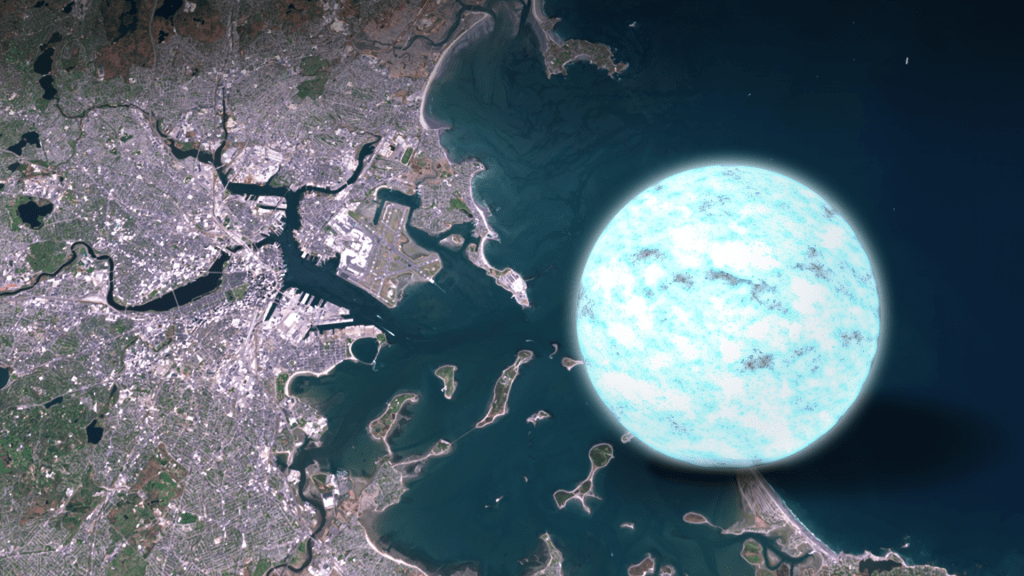
At times, the Universe can combine exquisite precision with profound destruction. Nowhere is this more evident than in the formation of neutron stars, the dense, enigmatic remnants of massive stars that have exhausted their nuclear fuel. When a star many times the mass of our Sun reaches the end of its life, its core collapses in an instant, while the outer layers are violently shed in a cataclysmic supernova. What remains is a neutron star that retains the mass of a star but, crushed into a sphere no larger than a city, its matter packed so tightly that a mere teaspoon would outweigh a mountain.
Neutron stars are the ultimate paradox of nature: tiny yet massive, dead yet astonishingly dynamic. Upon their birth, they spin furiously, some rotating hundreds of times per second, their magnetic fields among the strongest in the known universe. The field’s immense pressure can warp the crust, creating stress fractures that rupture with seismic force. The crust itself is a layered, complex landscape, an outer shell of crystalline nuclei and electrons giving way to an inner domain where neutrons flow like a superfluid, their quantum behaviour sculpting the star’s evolution in ways both predictable and terrifying.
This rapid rotation and magnetic intensity give rise to pulsars, beacons of radio waves sweeping through space with metronomic precision. These pulses are so regular that when they were first discovered in 1967, astronomers briefly considered the possibility of an extraterrestrial signal. Instead, they had found nature’s most extreme lighthouse, a stellar corpse continuing to burn, focusing beams of ionised matter into polar jets as an outlet for its extreme rotational energy.
Cracking Under Pressure
As neutron stars age, they gradually lose energy, spinning down over millions of years. This shift is neither smooth nor predictable. Stored angular momentum, locked away in the superfluid interior, can suddenly transfer to the crust, resulting in a “glitch”, a momentary, unexplained increase in rotational speed. The cause? A starquake. The neutron star’s crust, under relentless stress from competing forces, reaches its breaking point and shatters. The result is a seismic event unlike anything on Earth, releasing bursts of energy powerful enough to be detected across the galaxy.
For some neutron stars, this stress is compounded by a decaying magnetic field, which twists and knots itself until it snaps. When this happens, the star can unleash an eruption of high-energy radiation—one of the most violent magnetar flares ever recorded in our cosmic history came from a neutron star over 50,000 light-years away, briefly outshining all other sources in the Milky Way.
Echoes in the Fabric of Spacetime
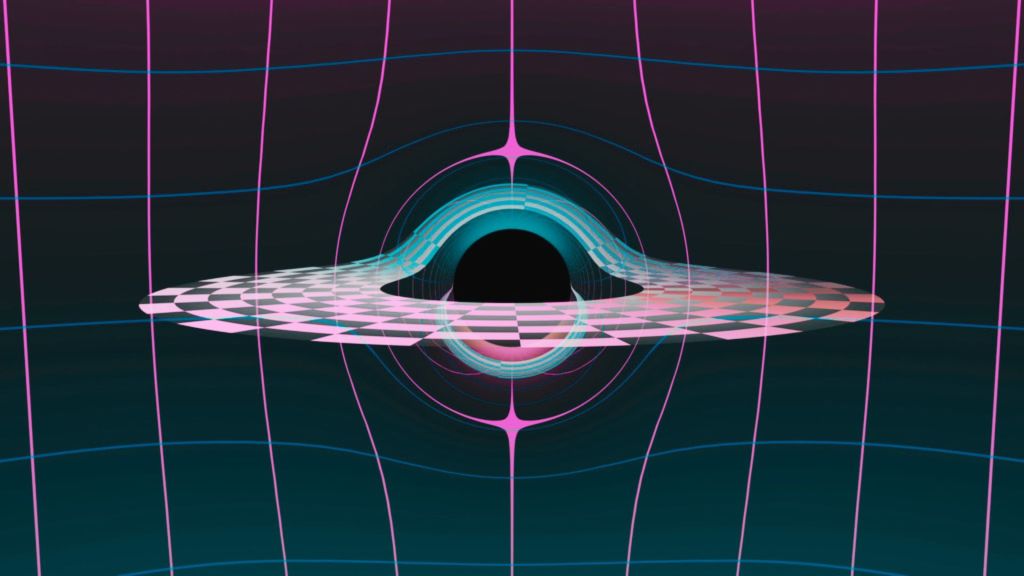
Neutron stars do not always die alone. Some exist in binary pairs, locked in a slow cosmic waltz, spiraling inward until they merge in a final act of celestial violence. When this happens, the collision sends gravitational waves rippling through spacetime itself, subtle tremors that the Laser Interferometer Gravitational-Wave Observatory (LIGO) has only recently begun to detect. If enough mass is accreted, the neutron star’s final fate is sealed: it collapses further into a black hole, vanishing from sight, leaving only the ghost of its former existence imprinted on the universe’s gravitational field.
Yet even in its solitary state, a neutron star is never truly silent. It may spin on for eons, its pulses slowing, its energy fading, until it becomes a cold, dense relic. Whether through violent merger, sudden collapse, or quiet extinction, every neutron star tells a story written in the language of fundamental physics—gravity, magnetism, quantum mechanics, and the inexorable passage of time. In their formation and fate, they reveal the boundless ingenuity of the universe, a place where even the spectacular, violent demise of a massive star can just be the beginning.
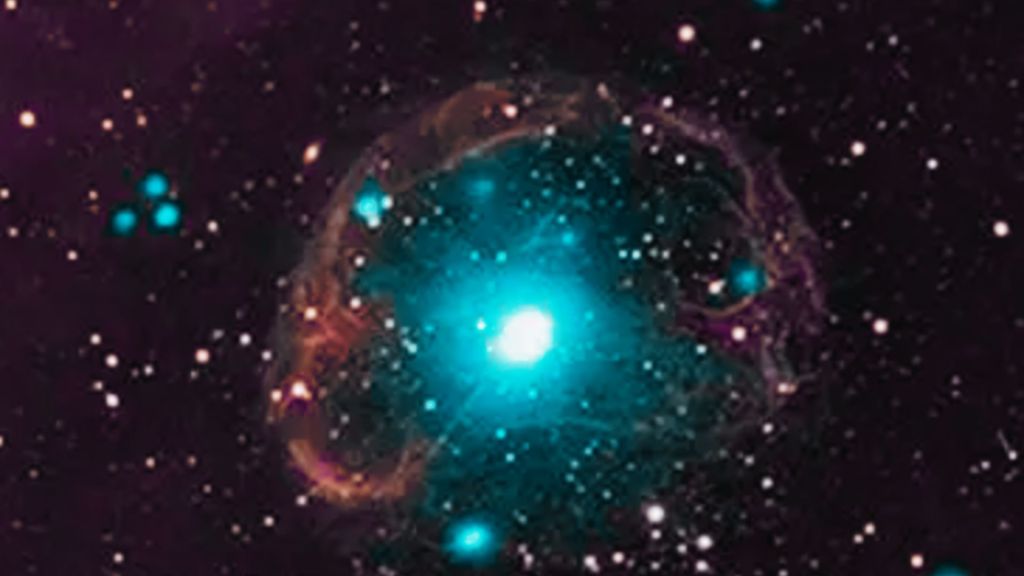
The Pulsar SXP 1062. (Image Credit: NASA/CXC/Univ. of Potsdam/L. Oskinova et al.).

Leave a comment