Neutron star crusts, the outermost layers of these ultra-dense stellar remnants, exhibit unique physical properties that determine their response to stress. Understanding the elasticity and breaking strain of the neutron star crust is critical, as it directly influences the size and frequency of starquakes—sudden shifts in the crust that release immense energy.
The composition of the crust—specifically the types of nuclei present and their arrangement in a lattice—significantly affects its shear modulus, a measure of resistance to deformation under shear stress. One crucial factor is the density dependence of symmetry energy, which represents the energy cost of creating an isospin asymmetry in nucleonic matter. However, uncertainty in the density dependence of symmetry energy complicates precise determinations of the crust’s shear properties.
Dead stars have crystal surfaces
The crystalline structure of the crust plays a significant role in determining its breaking strain. At greater depths, nuclei become highly deformed, forming exotic shapes in a “pasta phase.” This phase, characterized by elongated and sheet-like nuclear structures, is expected to be crucial in defining the strength and elasticity of the crust.
Since replicating the extreme conditions inside neutron star crusts in a laboratory is nearly impossible, scientists use molecular dynamics simulations to estimate the breaking strain—the amount of stress the crust can withstand before fracturing. These simulations provide insights into how neutron star crusts behave under immense pressure and contribute to our understanding of starquakes.
The nature of a neutron star’s crust may vary depending on the type of star. For instance, strange stars—hypothetical stars composed of strange quark matter—may possess significantly different crustal properties compared to ordinary neutron stars. A strange star could have a thin crust made of normal nuclear material or one containing nuggets of strange quark matter embedded within an electron background.
Crustquakes
Crustquakes are believed to occur in rapidly spinning or ultra-high-field neutron stars. Shear stress accumulates in the outer layers until the crust reaches its breaking point and cracks. One proposed model suggests that when a crack forms and then heals, highly compressed gas containing electron-positron pairs could erupt from the neutron star’s interior. This gas may then be accelerated by the star’s oscillation modes, escaping into the magnetosphere at relativistic speeds, potentially explaining various transient and bursting phenomena observed in neutron stars.
Despite the appeal of the fracture model in explaining starquakes, there are significant doubts about its feasibility. Some researchers argue that a neutron star’s solid crust is unlikely to sustain a large strain for an extended period. Additionally, forming and maintaining voids or cracks with sufficiently long lifetimes under the extreme conditions of a neutron star remains an open question.
Studying neutron star crusts offers valuable insights into the behavior of matter under extreme conditions. As observational techniques improve and computational models advance, researchers hope to refine our understanding of neutron star interiors, the mechanisms behind starquakes, and the unique role of superfluidity in these cosmic giants.
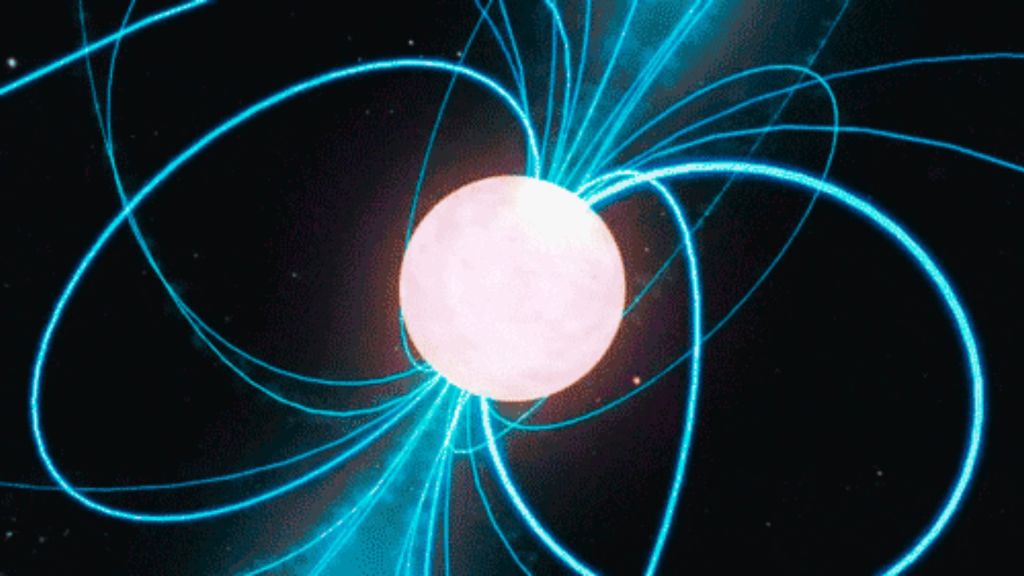
Illustration of a Neutron Star. (Image Credit: NASA GSFC).

Leave a comment