
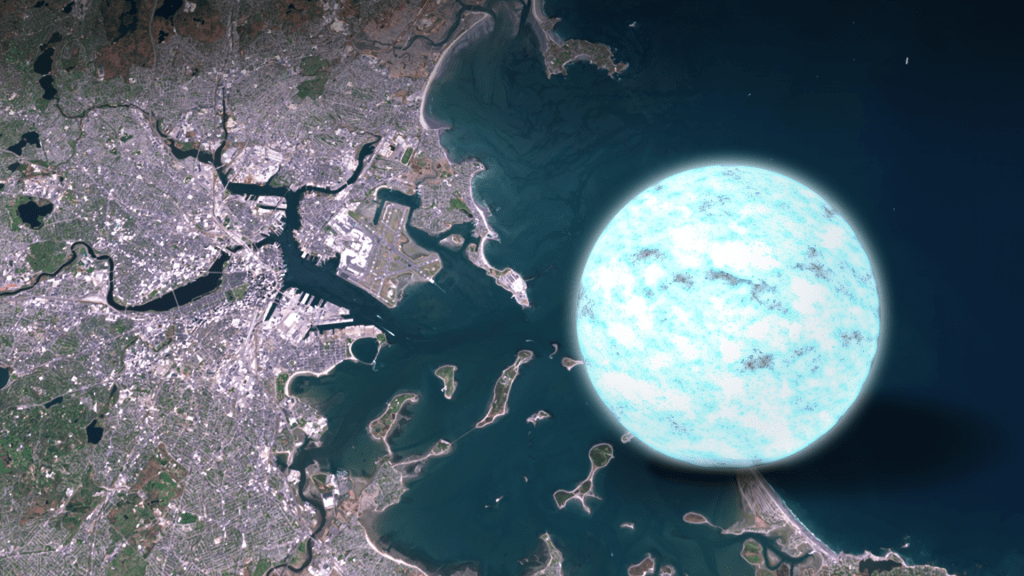
Neutron stars are among the most fascinating objects in the universe, boasting extreme densities, powerful magnetic fields, and rapid rotations. Among the many intriguing phenomena associated with these remnant cores of dead stars are elastic mountains, deformations in a neutron star’s crust sustained by the rapid rotation and the strain. Because of the extreme density of the matter, these ‘mountains’ are only a few centimetres high. Unlike other types of neutron star deformations, these mountains can play a key role in the generation of continuous gravitational waves (CGWs), providing insights into fundamental physics and the behaviour of matter under extreme conditions.
What Are Elastic Mountains?
Elastic mountains are distortions on the surface of a neutron star, maintained by the elastic strain within the crust. As a neutron star rotates, these deformations result in what is known as a ‘time-varying quadrupole ellipticity’, which is crucial for the emission of CGWs. These mountains differ from magnetic mountains, which are sustained by Lorentz forces originating from the star’s magnetic field. The key distinction lies in their supporting mechanisms: elastic mountains rely solely on crustal strain rather than magnetic forces.
Continuous Gravitational Waves
The presence of an elastic mountain on a neutron star leads to the emission of CGWs, which can be picked up by gravitational wave detectors. Unlike centrifugal distortions, which create symmetrical perturbations and do not contribute to CGW generation, non-axisymmetric deformations, such as those from elastic mountains, create a gravitational wave signal detectable over time. This makes neutron stars with elastic mountains promising candidates for CGW detection, offering a potential method for studying their internal structures.
Formation Mechanisms of Elastic Mountains
Several processes contribute to the formation of elastic mountains. Starquakes occur when the crust of a neutron star fractures due to internal stresses, leading to sudden and often dramatic shape changes. These events can produce non-axisymmetric deformations, thereby forming mountains. The linkage between starquakes and mountain formation suggests that whenever a quake reshapes the neutron star’s surface, some axisymmetric energy must be redistributed to accommodate the newly formed mountain.
In accreting neutron stars, matter from a companion star can build up on the surface, increasing the spin rate. As the neutron star spins up due to angular momentum transfer, centrifugal forces can become strong enough to break the crust, creating fractures that lead to non-axisymmetric shape changes. This process can contribute to the gradual formation of elastic mountains over time.
Modeling and Analysis of Neutron Star Deformations
Understanding neutron star deformations requires complex modeling techniques. Energy minimization methods can be used to predict how a neutron star’s crust responds to strain, while calculations that account for non-axisymmetric shape changes provide insights into the mountain-building process.
A key constraint on mountain size is the finite breaking strain of the neutron star crust. Even in the presence of significant stress, the maximum height of these mountains remains much smaller than the relaxed, axisymmetric shape the star would naturally assume. This limitation means that even the most extreme neutron stars can sustain only relatively modest deformations.
Neutron Star Glitches
Starquakes have been proposed as a possible mechanism behind neutron star glitches—sudden changes in rotation speed observed in pulsars. When a starquake occurs, the redistribution of mass may temporarily alter the star’s moment of inertia, leading to an abrupt shift in rotational frequency. If the quake also leads to the formation or modification of an elastic mountain, it could further impact the neutron star’s gravitational wave emissions.
The maximum height of an elastic mountain depends on multiple factors, including the star’s angular momentum and the conservation of energy during a starquake. A mathematical relationship can be derived to estimate the highest peak a mountain can reach under these constraints, which is in the order of centimetres because of the extreme density of the star. Typically, the largest possible mountain corresponds to the highest deformation point on the star’s elliptical shape. However, these mountains remain relatively small due to the high internal pressure resisting large structural changes.
For a neutron star to generate significant CGWs via an elastic mountain, its crust must exhibit an exceptionally large distortion. This requirement imposes another natural limitation on the likelihood of large, detectable gravitational wave-emitting mountains forming in neutron stars.
Detecting continuous gravitational waves from neutron stars with elastic mountains could open a new window into astrophysical research. These signals would provide direct insights into the internal structure of neutron stars, the physics of ultra-dense matter, and the dynamic interactions between crustal strain and rotational forces. Future gravitational wave observatories, such as the next-generation LIGO and the proposed Einstein Telescope, may offer the sensitivity needed to detect these elusive waves, furthering our understanding of neutron star physics.
Cracks in dead stars
Elastic mountains represent a fascinating aspect of neutron star science, linking crustal mechanics, gravitational wave generation, and extreme astrophysical conditions. Whether formed by starquakes, accretion, or other processes, these deformations could provide a direct observational handle on neutron star interiors. As gravitational wave detectors become more advanced, the study of elastic mountains may become a crucial tool for unravelling the mysteries of some of the most extreme objects in the universe.
Illustration of a Pulsar. (Image Credit: NASA).

Leave a comment